Temples are everywhere in Siem Reap. There are temples two streets from your hotel. There are temples right behind the temple you are visiting. The only difference is how old they are, and chances are you only care about the oldest ones.
The part nobody warns you about is this: after the third temple, every sandstone wall starts to blur into the last one, your legs stop cooperating, and you will seriously question why you are spending your holiday walking through ruins in 35-degree heat.
We did 12 temples in 11 hours. It nearly broke us, but every single one was worth the sweat. This is the list, in order, with the details that actually matter when you are standing in the ticket line at 5 am wondering what you have signed up for.
Read also: 6 Best Places to Watch Apsara Dance in Siem Reap, Cambodia

What Are the Best Temples to Visit in Siem Reap?
The 12 best temples in Siem Reap range from Angkor Wat, the largest religious monument on Earth, to overgrown jungle ruins where tree roots split the stonework in half.
Most can be covered in one or two days with a tuk-tuk and a temple pass. A few, like Banteay Srei and Phnom Kulen, need a separate drive.
Book Angkor Wat Sunrise and Temples E-Bike Tour from Siem Reap
Angkor Wat
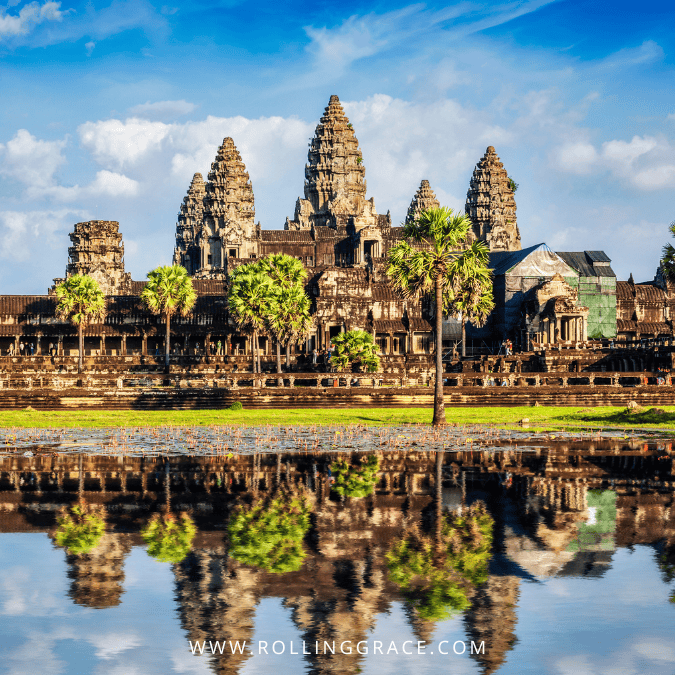
Angkor Wat is the reason you are in Siem Reap. Built between 1113 and 1150 CE by King Suryavarman II as a Hindu temple dedicated to Vishnu, it is the largest religious monument ever constructed, covering 162.6 hectares and surrounded by a moat 190 metres wide. That is larger than Vatican City.
The five lotus-shaped towers, the hundreds of metres of carved bas-reliefs depicting the Ramayana and the Churning of the Ocean of Milk, and the more than 3,000 individually carved apsara figures on the walls make this the single most important piece of Khmer architecture still standing.
The temple later transitioned to a Buddhist site in the late 12th century and remains an active place of worship today.
Read also: 6 Best Historical Places to Visit in Phnom Penh, Cambodia
Angkor Wat appears on every version of the Cambodian national flag since 1863. It is the only building in the world to feature on a country’s flag. The UNESCO World Heritage listing, granted in 1992, covers the entire Angkor Archaeological Park.
Go at sunrise if you can tolerate a 4.30 am start. The reflection of the towers in the moat during the first hour of light is the most photographed moment in Cambodia, and for good reason.
The temples in Siem Reap are not short on options, but this one asks for more of your attention than the others.
Angkor Thom
Angkor Thom is not a single temple. It is a walled city, the last capital of the Khmer Empire, built in the late 12th century by King Jayavarman VII after the previous capital was sacked by the Cham.
The city walls run for 3 km on each side, forming a perfect square enclosing 9 sq km. Five monumental gates, each topped with four carved stone faces, control the entrances. The south gate is the most famous and the most photographed, lined on both sides by 54 stone figures pulling a giant serpent in a representation of the Churning of the Ocean of Milk.
Inside the walls, several of the temples listed below (Bayon, Baphuon, Phimeanakas, and the Terrace of the Elephants) are all within walking distance of each other. The south gate is 7.2 km north of Siem Reap town and 1.7 km north of the entrance to Angkor Wat.
Bayon Temple
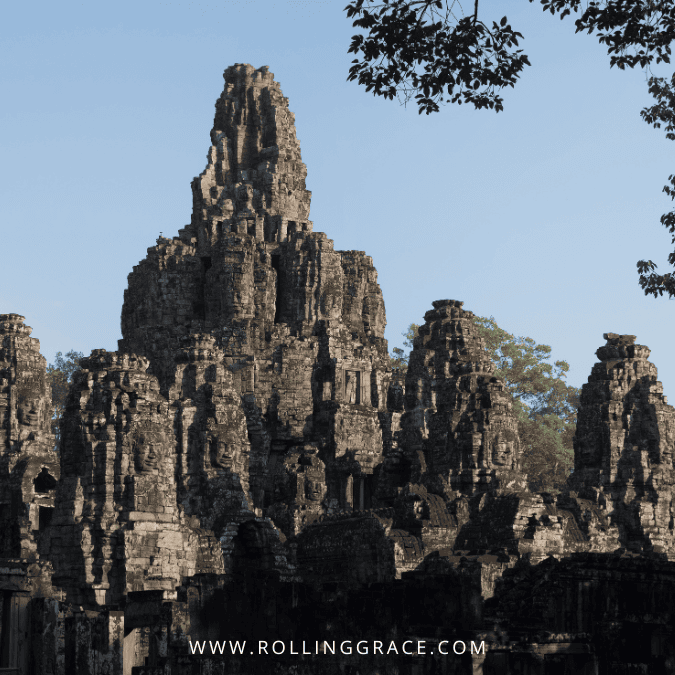
Bayon is the temple that stares back at you. Built in the late 12th century as the state temple of King Jayavarman VII, it was originally a Mahayana Buddhist site and stands at the exact centre of Angkor Thom.
The temple is most famous for its 54 towers, each carved with four enormous serene stone faces that gaze outward in every direction. The faces are believed to represent either the bodhisattva Avalokiteshvara or Jayavarman VII himself, and the effect of being watched from every angle as you walk through the complex is unlike anything else in the Angkor region.
The bas-reliefs at Bayon are different from Angkor Wat’s. Where Angkor Wat depicts mythology, Bayon shows daily Khmer life: market scenes, fishing, cockfighting, childbirth, and soldiers marching to war. It is the most human temple in the park.
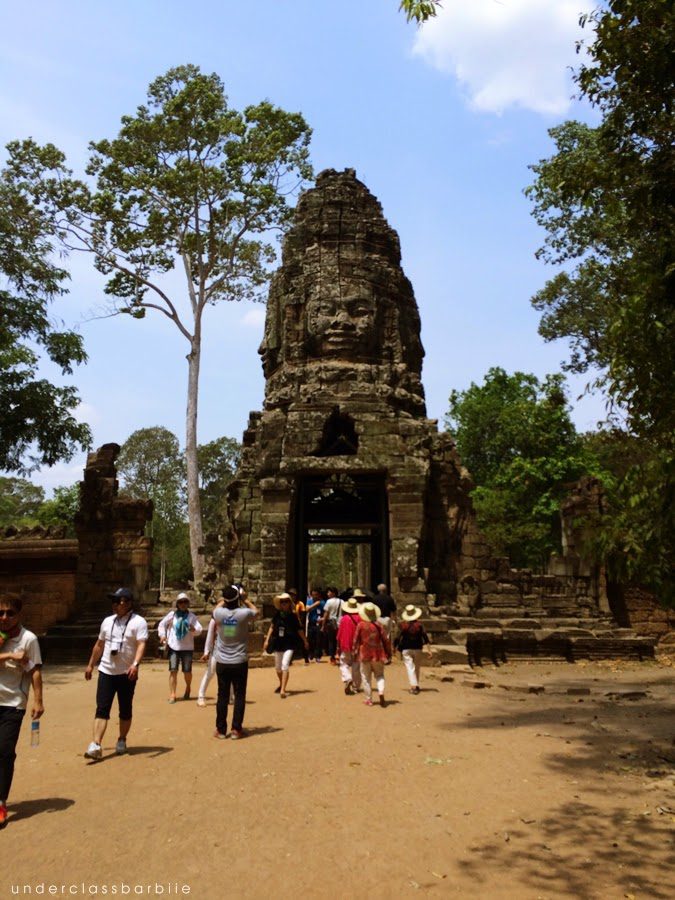
Expect crowds. Bayon fills up quickly after 9 am. Get there early or accept that you will be sharing every photo with 40 other people.

Ta Prohm Temple
Ta Prohm is the one you have already seen in photos, even if you do not know the name.
Read also: Top 10 Cambodian Dishes Every Foodie Must Absolutely Eat
Built in the late 12th century by Jayavarman VII as a Mahayana Buddhist monastery originally called Rajavihara, it was deliberately left in the same condition in which it was found: massive silk-cotton and strangler fig trees growing directly out of the stonework, their roots splitting walls and swallowing doorways whole. This is the “Tomb Raider temple,” and yes, Angelina Jolie filmed scenes here in 2001.
The atmosphere is unlike any other temple in Angkor. Where the other sites have been restored and cleared, Ta Prohm gives you ruins as ruins, and the scale of nature reclaiming the stone is staggering. Some of the root systems are thicker than the pillars they have consumed.

Banteay Srei Temple
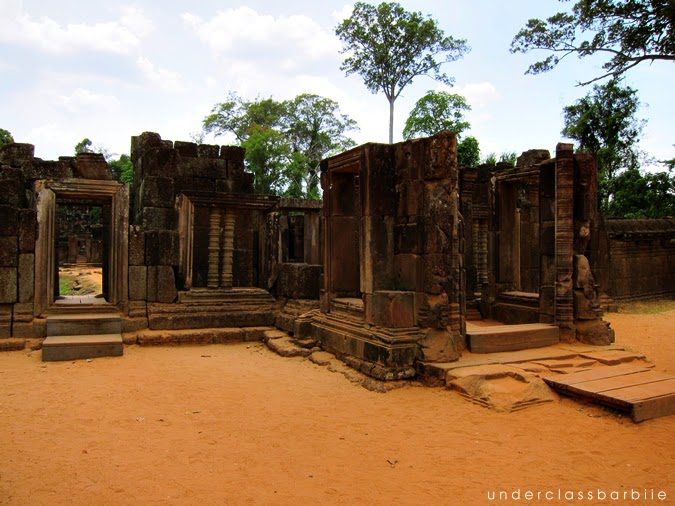
Banteay Srei is the smallest major temple on this list and the furthest from the main circuit, located about 25 km northeast of the central complexes. The drive takes roughly 45 minutes from Siem Reap. It is worth every minute.
Dedicated to the Hindu god Shiva and built in the 10th century, the temple is known for its red sandstone carvings, which are the most detailed and best-preserved in the entire Angkor region. The relief work here is finer than anything at Angkor Wat.
Book 1-day tour to Banteay Srei Temple + Prasat Beng Mealea + Tonlé Sap in Siem Reap, Cambodia
The name Banteay Srei translates from Khmer as “Citadel of the Women” or “Citadel of Beauty,” though its original Sanskrit name was Tribhuvanamahesvara, meaning “Great Lord of the Threefold World.”
The temple is compact and can be seen in under an hour, but the detail in the carvings will slow you down if you are paying attention.
Phnom Bakheng Temple
Phnom Bakheng is the sunset temple. Built in the late 9th century by King Yasovarman I as the state temple of his new capital Yasodharapura, it is the only hilltop temple in the Angkor complex.
The five-tiered pyramid, originally surrounded by 108 towers, gives you an elevated view over the surrounding forest and, on a clear evening, a direct sightline to Angkor Wat as the sun drops behind it.
The hike to the top takes about 15 to 20 minutes and the steps are steep. A strict 300-person cap is enforced on the summit at any one time by APSARA Authority staff, so arrive by 4.00 pm at the latest or you will be turned away. The descent in fading light is the trickiest part, so wear proper shoes.

Baphuon Temple
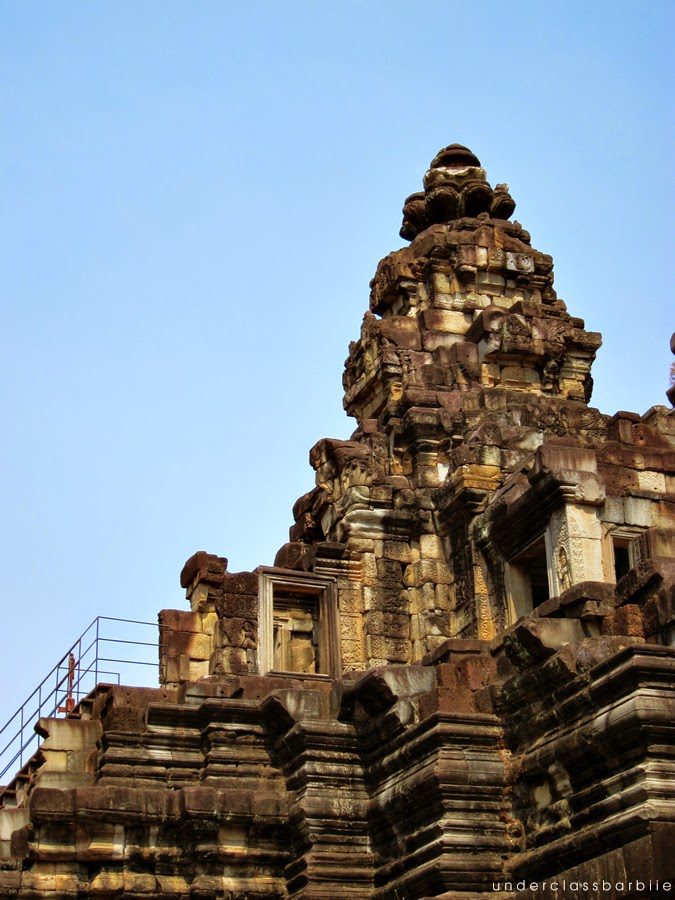
Baphuon is the three-tiered temple mountain built in the mid-11th century by King Udayadityavarman II and dedicated to Shiva. The steep stairs to the top terrace give you one of the best elevated views within Angkor Thom.
On the western side, a massive reclining Buddha was added to the second level in the late 15th century. The figure is 9 metres tall and 70 metres long, built using stones taken from the original temple, and it stretches across nearly the full width of the wall. It is easy to miss if you are not looking for it.
The temple underwent a 51-year restoration led by the French EFEO (École française d’Extrême-Orient), often called the “world’s largest jigsaw puzzle” after 300,000 dismantled stone blocks lost their documentation during the Khmer Rouge period. It reopened to visitors in April 2011 and is now one of the most impressive climbs in the park.
Terrace of the Elephants
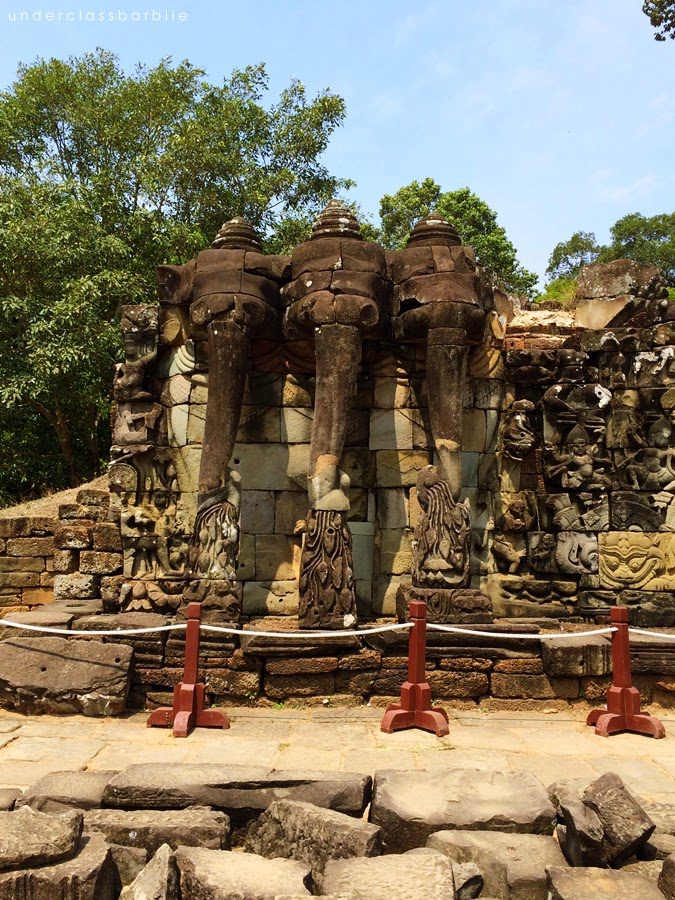
The Terrace of the Elephants runs for 350 metres along the eastern edge of the Royal Palace compound inside Angkor Thom, standing about 2.5 metres high.
Built in the late 12th century by Jayavarman VII, it served as a viewing platform for royal ceremonies and the return of victorious armies. The walls are carved with life-sized elephants in procession, along with garudas, lions, and scenes of hunting and combat.
You will walk past this on your way between Bayon and Baphuon. It does not take long to see, but the scale of the elephant carvings up close is impressive, and it is one of the best spots in Angkor Thom for photos without crowds.
Experienced travellers treat this as the anchor around which everything else in the temples in Siem Reap conversation is arranged.
Phimeanakas Temple
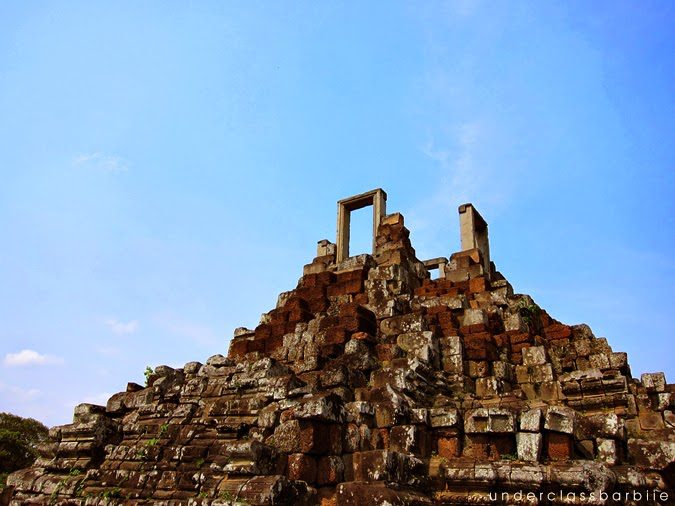
Phimeanakas is a small, three-tiered pyramid temple inside the Royal Palace enclosure of Angkor Thom. Built in the 10th century during the reign of King Rajendravarman and completed by Suryavarman I, it was the royal chapel where the king was said to sleep each night in a gold tower at the summit.
According to the account of Chinese envoy Zhou Daguan, who visited Angkor from 1296 to 1297, a serpent spirit would appear in the form of a woman, and if the king failed to meet her, disaster would follow.
The climb to the top is steep and the temple is modest compared to its neighbours, but its location inside the palace grounds and its mythological backstory make it a worthwhile stop between the bigger sites. It holds up on a second visit, which is more than most of the temples in Siem Reap can claim.
Prasat Bakong Temple
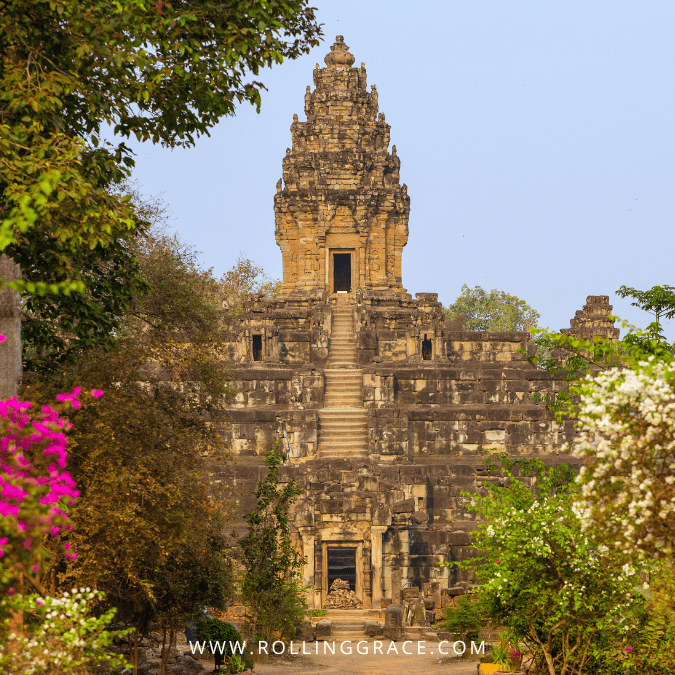
Prasat Bakong is the oldest temple mountain on this list and the first major temple built entirely from sandstone during the Khmer Empire. Constructed in the late 9th century as the state temple of King Indravarman I, it is located in the village of Roluos, about 13 km east of Siem Reap on National Highway 6, outside the main Angkor circuit.
Most tour itineraries skip Roluos, which means Bakong is far less crowded than the central temples in Siem Reap. The five-tiered pyramid, surrounded by a moat and brick towers, is one of the earliest examples of the temple-mountain design that would later define Angkor Wat.
Monolithic elephant statues guard each corner of the lower tiers. If you have a three-day pass and want to see where Khmer temple architecture began, this is where you come. It is the one the temples in Siem Reap regulars tend to mention last, which means it stays with them longest.
Prasat Prei Temple
Prasat Prei, meaning “Sanctuary of the Forest,” is one of the smallest temples in the Angkor complex. The outer enclosure measures roughly 20 by 24 metres, with a single cruciform sanctuary and one small library building inside. It is south of Banteay Prei and well off the main tourist path.
Book 1-day tour to Banteay Srei Temple + Prasat Beng Mealea + Tonlé Sap in Siem Reap, Cambodia
The entrance is through a heavily damaged gopura, and the forest has closed in around the stonework in a way that gives it a lost-world feel without the crowds of Ta Prohm.
If you want to see what an unrestored Angkor ruin actually looks like when nobody else is around, this is it. The temples in Siem Reap set a standard that the rest of the trip tends to struggle to match.

Phnom Kulen
Phnom Kulen is Cambodia’s most sacred mountain and is roughly a two-hour drive from Siem Reap in an entirely different direction from the other temples.
It is home to the 1,000 Lingas at Kbal Spean, ancient carved reliefs cut into the riverbed, the Terrace of Sdach Kum Ling Temple, and Srah Damrei, a large sandstone elephant sculpture. A waterfall cascades down the mountainside, and a reclining Buddha is carved into a boulder near the summit.
Phnom Kulen is not covered by the standard Angkor Pass and needs a separate $5 USD ticket, payable in cash at the entrance. It is a full day trip on its own and cannot easily be combined with the main Angkor circuit.
If you have a spare day and want to see something completely different from the lowland temples in Siem Reap, Phnom Kulen delivers.
Book 1-day tour to Banteay Srei Temple + Prasat Beng Mealea + Tonlé Sap in Siem Reap, Cambodia
How Do You Buy the Angkor Temple Pass?
The Angkor Pass is your entry ticket to the entire Angkor Archaeological Park, covering more than 1,000 temples. You buy it in person at the Angkor Enterprise ticket office on Apsara Road (Road 60), about 4 to 5 km from Siem Reap town centre. The office opens at 5.00 am and closes at 5.30 pm daily, with no days off.
Temple pass prices are $37 USD for a one-day pass, $62 USD for a three-day pass (valid for any three days within one week), and $72 USD for a seven-day pass (valid for any seven days within one month).
Children under 12 enter free. The ticket office accepts cash (USD, riel, Thai baht, euros), all major credit cards, Apple Pay, Google Pay, Alipay, and WeChat Pay. Self-service kiosks are also available. Your photo is taken automatically at the counter and printed on the pass.
If you buy your pass after 5.00pm, it is valid from that moment plus the entire following day, which is the best strategy if you are planning an Angkor Wat sunrise visit the next morning.
The three-day pass is the best value for most travellers. It gives you enough time to cover the main circuit, the outer temples, and a rest day in between without rushing.
What Should You Wear to the Temples?
Dress code is enforced. You need long trousers or a skirt that covers below the knee and a top that covers your shoulders. No singlets, no shorts above the knee, no miniskirts. Guards at the major temples will turn you away if you do not comply, and there is no dress-code leniency at Angkor Wat, Bayon, or Baphuon.
Beyond the rules, wear light, breathable fabrics. The heat inside the temple compounds is relentless, especially between 10 am and 3 pm. A good pair of closed shoes is essential, as the stone steps at Phnom Bakheng, Baphuon, and Angkor Wat are steep, uneven, and slippery after rain. Bring sunscreen, a hat, and at least two litres of water per person.
There are vendors selling water and snacks outside most temples, but prices go up the further you get from the main road.
How Many Temples Can You See in One Day?
We did 12 in 11 hours and it nearly finished us. The honest answer is five to seven major temples in a single day if you want to enjoy them, take photos, and still walk properly the next morning. After the third temple, the carvings start to blend together, and by the sixth, you will be looking for shade more than sandstone.
If you have one day, focus on Angkor Wat, Angkor Thom (including Bayon, the Terrace of the Elephants, and Baphuon), and Ta Prohm. That covers the essentials without destroying your feet.
If you have three days, spread the temples across two mornings and add Banteay Srei, Phnom Bakheng for sunset, and the Roluos group on day three. Save Phnom Kulen for a separate day entirely.
Hire a tuk-tuk driver for the day. Agree on the route and price before you leave. A full-day tuk-tuk covering the main circuit runs roughly $15 to $20 USD. Most drivers know the park better than any map, and a good driver will get you to each temple before the tour buses arrive.
Get the good stuff first. Join Rolling Grace for the restaurants worth crossing a city for, the stays worth the upgrade, and the places to go before everyone else. Free, straight to your inbox.
Leave a Reply