The dancers are sewn into their costumes before every single performance, because the silk has to hold close enough to move like a second skin. Then they bend their fingers backwards to ninety degrees and hold a smile for an hour while barely appearing to touch the floor.
This is Apsara dance, Robam Tep Apsara in Khmer, and it is the closest thing Cambodia has to a national symbol. Watch it in Siem Reap and you are watching an art form that survived an attempt to erase it, performed by dancers who trained for a decade to earn the part.
Most visitors see it over dinner and a buffet, which is fine, but knowing what is happening in front of you changes the evening entirely. Here is what the Apsara dance actually is, the history most guides get wrong, and the six best places to see it.
Read also: Discover the 12 Top Things to do in Phu Quoc, Vietnam
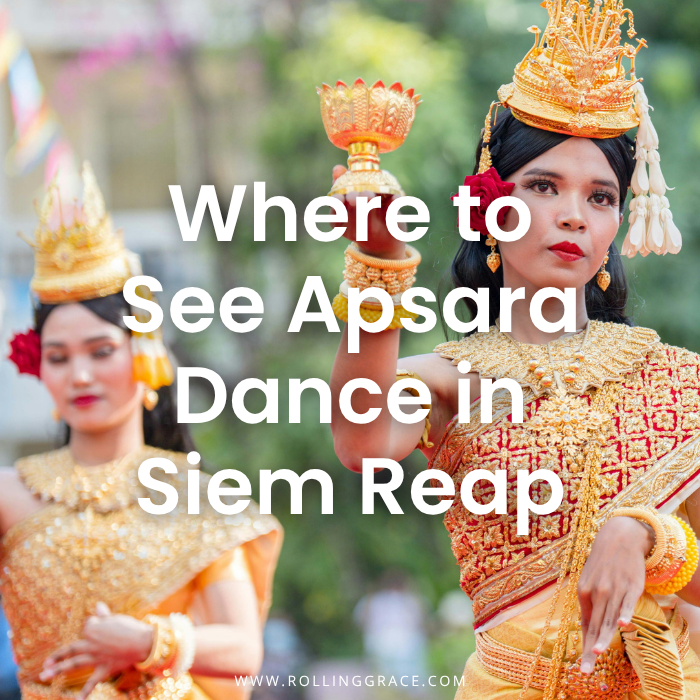
What is the Significance of Apsara Dance?
Apsaras are celestial nymphs from Hindu and Buddhist mythology, divine dancers who entertain the gods in Indra’s heavenly palace.
They are young, beautiful, expert in dance, and able to change shape at will. The dancers performing Robam Tep Apsara are understood to be channelling them.
Difference Between Devata and Apsara Dance
Walk through Angkor and you will hear every carved female figure called an apsara. That is not right. In Khmer convention, the figures that are dancing or poised to dance are apsara.
The ones standing still and facing forward, positioned as temple guardians, are devata. The bas-reliefs of the Angkorian temples, dating from roughly the 8th to the 13th centuries, are full of both.

Apsara Dance Origin in Cambodia
The Angkor Connection Is Real, but Not Direct
Khmer classical dance has been tied to the royal courts for more than a thousand years, and the apsara motif is carved across Angkor. Under Jayavarman VII there were reportedly more than three thousand apsara dancers at court, performing for the king alone.
Their skill was prized enough that when the Thais sacked Angkor in the 15th century, they took a troupe of dancers home with them.
But the Dance You Will Watch Was Created in the 1940s
The specific dance performed for you tonight is not a thousand years old. Robam Tep Apsara as it exists today was created by Queen Sisowath Kossamak in the mid-20th century.
Visiting a primary school in the 1940s, she watched children imitating the apsara figures from the Angkor bas-reliefs in paper costumes, and set out to build a dance from it. She drew on an existing court dance, the Phuong Neary, set it to a pinpeat orchestra piece, and dressed it in costumes modelled on the temple carvings.
She then chose her granddaughter to perform it. Princess Norodom Buppha Devi began training at five and became the first professional Apsara dancer of the modern era, prima ballerina by eighteen, and the international face of Khmer dance through the 1950s and 60s.
Auguste Rodin Was a Fan
When the Royal Ballet toured France in 1906, Auguste Rodin was so taken with the dancers that he followed the troupe and produced more than a hundred drawings and watercolours of them.

How the Khmer Rouge Nearly Ended It
The Khmer Rouge targeted artists alongside the educated and the elite. Estimates suggest around 90 per cent of Cambodia’s classical dancers were killed between 1975 and 1979. The teachers died, and because this art passes from body to body rather than from any written notation, the knowledge died with them.
Read also: 1-Day Kampong Khleang Itinerary: Best Attractions & Tips
Rebuilding From Fragments
Survivors began reconstructing the repertoire after 1979, some of them piecing choreography back together by studying the temple panels.
Princess Buppha Devi taught dance in refugee camps in Thailand in the mid-1980s, returned after the 1991 Paris Peace Agreements, and led the restoration. It took until 1995, sixteen years after the regime fell, for Cambodians to see a public Apsara performance again, at Angkor Wat.
UNESCO, 2003
Buppha Devi served as Minister of Culture and Fine Arts from 1998 to 2004 and lobbied successfully for international recognition.
In November 2003, UNESCO proclaimed the Royal Ballet of Cambodia a Masterpiece of the Oral and Intangible Heritage of Humanity. She kept promoting the ballet until her death in 2019.
Book tickets to the Royal Ballet of Cambodia Apsara Show
Apsara Costume and the Silent Language
Traditional Apsara Costume
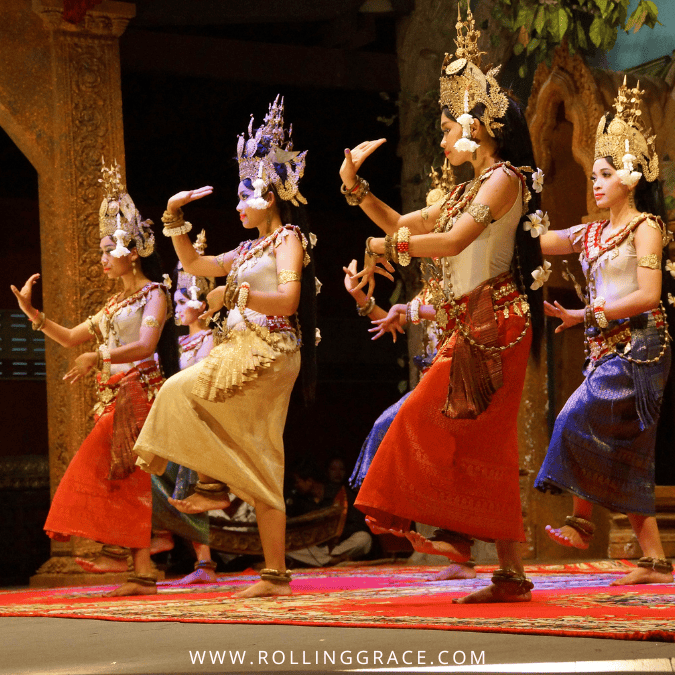
The dancers wear a sampot, the pleated silk garment wrapped close to the body, in gold or jewel tones, often in rich brocade. Above it goes the mokot, the tall golden crown built to echo the spires of a temple.
Add heavy gold jewellery at the neck, wrists, and ankles, and metal extensions on the fingers that draw the hand into an unnatural, elegant line. Then the sewing-in, which is the only way to get the fit the choreography demands.
Apsara Hand Gestures and Meaning
The hands are the vocabulary. A finger pointed to the sky means today. Standing side-on to the audience with the sole of the foot turned upward means flying.
There are around 1,500 codified positions in the classical repertoire, and the movements narrate myth and religious story without a word being spoken.

Techniques and Skills
Dancers are selected young, sometimes from age seven, chosen for aptitude but also for the flexibility and elegance of their hands. Learning the positions takes roughly six years.
Reaching the artistic maturity to perform them properly takes another three to six on top. The person in front of you has likely trained longer than a surgeon.
Read also: Top 10 Cambodian Dishes Every Foodie Must Absolutely Eat

Where to See Apsara Dance Performed
Apsara Theatre
The oldest theatre in Siem Reap, running since 1997, and the most serious of the dinner-show options. It was built in a semi-colonial wooden style and still has the antique décor and marquee lights, and Madam Net has been training dancers and promoting Khmer performing arts here since the 1980s.
A troupe of 30 artists performs three classical dances and two village dances to a live traditional orchestra, with dancers, singers, and musicians all present. That live pinpeat is the differentiator; a good number of venues use recordings.
The repertoire draws on the Reamker legends and rural folk dances. Dinner comes first, with Khmer classic, Khmer tapas, or Cambodian vegetarian menus available.
- Address: Street 26, Krong Siem Reap
- Reservation and booking: Apsara Theatre The Reamker Show Ticket + Dinner + Round-trip Transfer From Hotel
- Showtimes: Dinner from 7.30pm, performance 8.30pm to 9.30pm, daily
- Ticket prices: Around USD 30 per adult, USD 15 for children under 12. Under-3s free but without a seat or meal
Apsara Terrace, Raffles Grand Hotel d’Angkor
The upmarket choice, performed outdoors on the terrace of Siem Reap’s grande dame hotel. If you want the dance with proper polish and are not counting dollars, this is it.
An hour-long performance alongside an Asian barbecue menu, in the open air of a hotel that has been running since 1932. It is the most comfortable and best-serviced version of the evening on this list.
- Address: Raffles Grand Hotel d’Angkor, 1 Vithei Charles De Gaulle
- Showtimes: Monday, Wednesday, and Friday. Seating from 7pm, performance from around 7.45pm
- Ticket prices: Around USD 49 per adult and USD 35 per child. Prices have risen sharply here, so confirm when booking
Temple Balcony
The free one and a reasonable option if you are travelling on a budget. You pay only for what you eat.
An à la carte Khmer menu and a nightly performance on the balcony above Pub Street, running around two hours, which is longer than most paid shows. The trade-off is exactly what you would expect: it is loud, busy, and the audience is not always paying attention. The dancing is decent. The atmosphere is a bar, not a theatre.
- Address: Street 08, Krong Siem Reap
- Showtimes: Seating from 7.30pm, performance from around 8pm to 9.30pm, daily
- Ticket prices: Free entry, pay for food and drink
Koulen Restaurant
With a big buffet operation, this is the right pick if you are in a group or travelling with children who need options.
Koulen Restaurant has a theatre-style setup with proper lighting and a large stage area, paired with an extensive buffet that includes vegetarian dishes. The scale means less intimacy but more choice, and the production values on the performance itself are high.
- Address: Sivatha Street, Siem Reap
- Showtimes: Seating from around 6.30pm, performance from 7.30pm, daily
- Ticket prices: Roughly USD 22 to 40 per person depending on the package

Alliance Café
The one for people who want more than Apsara. Set in the Wat Damnak area, it pairs classical dance with Sbek Thom, Cambodian shadow puppetry, which is itself a separate UNESCO-listed art form.
A smaller, more intimate evening with a set dinner, combining traditional Khmer dance with shadow theatre. Shadow puppetry is rarer and harder to find than Apsara, which makes this the most unusual bill on the list.
- Address: Wat Damnak, 7 Makara Street
- Showtimes: Tuesday, Thursday, and Saturday. Dinner from 7pm, performance from 8pm
- Ticket prices: Set dinner and show package. Confirm the current rate when booking
The Divine Sala, Sacred Dancers of Angkor
The purist’s option worth going out of your way for. The Sacred Dancers of Angkor are the only spiritual Apsara dance troupe in Cambodia, and this is not dinner theatre.
The troupe was trained from 2007 under the patronage of Princess Buppha Devi and with UNESCO support, through the dance and music conservatoire of the NKFC, a non-profit. The dancers were born in the land of Angkor, at Banteay Srei, and train five days a week, six hours a day, learning the 4,500 gestures of the classical repertoire alongside meditation and prayer.
They have performed in the United States, Japan, and Laos. If you want the version closest to the tradition as it was meant to be practised, this is the closest you will get in Siem Reap.
- Address: 234 River Road, Siem Reap
- Showtimes: Check current performance days and times directly, since the schedule is smaller than the commercial venues
- Ticket prices: Ticket revenue supports the non-profit conservatoire
Famous Apsara Dance in Cambodia
For the best combination of live music and real credentials, Apsara Theatre. For luxury and comfort, the Raffles terrace. For free, Temple Balcony, with realistic expectations. For groups and fussy eaters, Koulen. For something rarer, Alliance Café and its shadow puppets. And if you care about the art more than the dinner, the Sacred Dancers at the Divine Sala.
Two things worth doing whichever you pick. Book ahead, especially between November and February, and ask before photographing the dancers, with the flash off.
This art form nearly disappeared inside four years, and it exists now because a handful of survivors rebuilt it from memory and from the stone carvings. The tourist dinner circuit is what pays a lot of these dancers today, so the show you choose matters.
The venues training their own troupes and running live orchestras, and the non-profit conservatoires putting ticket revenue back into teaching, are keeping something alive that the country came within a few years of losing for good. That is worth the extra ten dollars.
Get the good stuff first. Join Rolling Grace for the restaurants worth crossing a city for, the stays worth the upgrade, and the places to go before everyone else. Free, straight to your inbox.
Leave a Reply