From fish amok steamed in banana leaf to peppercorn crab from the southern coast, these are the Cambodian dishes that make the country’s food culture worth taking seriously.
We visited Cambodia personally and ate our way through the country over several trips. This is what stayed with us.
Cambodia earns more than its temples. For all the hours visitors spend in the heat of Angkor, the meals that tend to stay longest in memory are eaten off plastic stools, beside open-air markets, or in small restaurants where the menu changes with the day’s catch.
Read also: 8 Best Dishes to Try in Myanmar: Traditional Burmese Dishes
Table of Contents
What Is the Most Popular Food in Cambodia
Cambodian cuisine is built on contrasts: sour against rich, herbal against earthy, cool crunch against warm broth. A proper Cambodian spread is rarely one dish eaten alone. It is a table of components that work together, anchored by steamed jasmine rice and a row of dipping sauces that do a quiet, essential job.
These are ten popular Cambodian dishes worth making a plan around.

Num Banh Chok
The rice noodles arrive fresh, ground from scratch early each morning by families who have been doing this for generations. They are slightly thicker than vermicelli, with a faint fermented depth that sets them apart from any other noodle in the region. The broth ladled over them is a fish-based green curry built on kroeung paste, prahok and coconut milk: slightly tangy, gently savoury, aromatic without being sharp. Banana blossoms, water lily stems, bean sprouts and fresh herbs go on top, cool and bright against the warm gravy beneath.
It is a morning dish and typically gone by mid-morning. Miss the window and you will have to wait until the next day. Order it without adjusting anything first. Taste the broth before reaching for the chilli sauce.

Khmer Red Curry
Less fiery than its Thai equivalent and built on a base of fresh coconut milk, Khmer red curry gets its character from kroeung, which is a paste of lemongrass, galangal, turmeric, kaffir lime and fingerroot, pounded before each use. The result is fragrant without being aggressive, with a warmth that builds slowly and lingers. Eggplant and beans soften into the sauce; potato adds body.
Eat it the way locals do: with soft, pillowy bread to mop up every last bit rather than rice. The bread soaking up the coconut-rich sauce is the point of the whole thing.

Lok Lak
Lok Lak looks simple on arrival and delivers more than expected. Stir-fried meat, your choice of beef, chicken or fish, cooked down with soy sauce and Kampot pepper until glossy and well-coated. It comes on a bed of crisp lettuce and sliced tomatoes, with a dipping sauce of fresh lime juice, salt and cracked pepper on the side. The lettuce is not decoration. You wrap, dip and eat.
The dish travelled through Vietnamese and French influence before becoming a fixture of Cambodian restaurant menus. That history is legible in the dish: it is both familiar and specific to this place.

Fish Amok
Fish Amok is Cambodia’s most recognised dish internationally. Fresh fish, typically a white freshwater variety, is combined with coconut cream, kroeung paste, kaffir lime and noni leaf, then steamed inside a folded banana leaf until it sets to a soft, mousse-like texture: silky, light and gently sweet from the coconut. The lemongrass and turmeric carry through clearly without overpowering the fish.
The banana leaf keeps everything sealed and fragrant through the cooking process. It is not spicy. The flavour is layered and aromatic rather than sharp. Served with steamed rice, it is one of the more refined things you will eat in the country.

Samlor Korkor
If any single dish reflects how Cambodians actually eat day to day, it is this one. Samlor Korkor is a thick, nourishing stew built on a base of kroeung paste and prahok, the fermented fish paste that underpins much of Cambodian cooking. Into it goes whatever is seasonal: banana blossom, young jackfruit, morning glory, eggplant, kaffir lime leaf. Fish or meat is added depending on the household. The result is earthy and complex, with the prahok lending a deep, savoury backbone that is assertive without being overwhelming once it has cooked down.
Order it in a local restaurant rather than a tourist-facing one and the difference is immediately obvious. It stands among the Cambodian dishes that reflect the country’s culinary heritage.
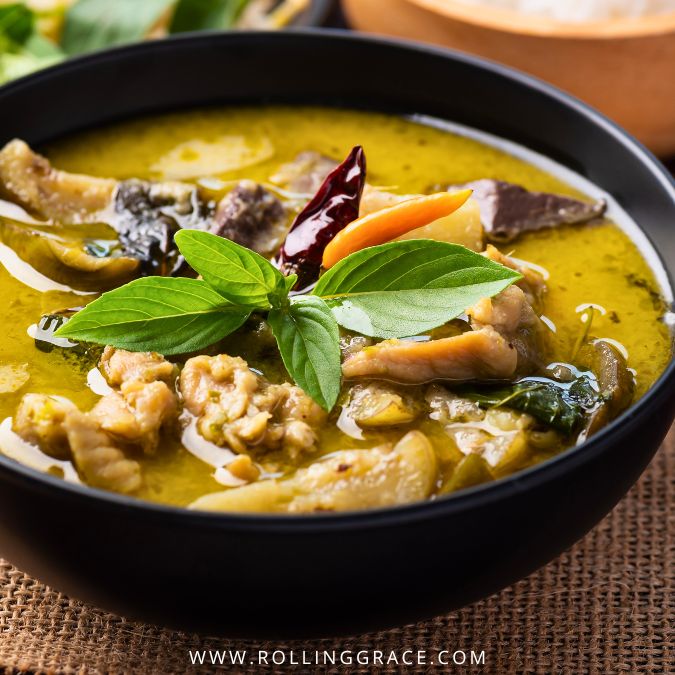
Kampot Pepper Crab
Kampot peppercorns hold protected geographical indication status, which tells you something about how seriously Cambodia takes them. Grown in the hills around Kampot on the southern coast, the peppercorns carry a complex heat, bright and aromatic rather than one-dimensional. Whole crab is cooked through in a sauce heavy with green or black Kampot pepper, depending on the season. The crab meat is sweet and fresh from the coast; the pepper builds at the finish with a tingle that outlasts the meal.
Eat it in Kampot if you can. The proximity of the sea and the peppercorn farms makes the combination there what it should be. It is one of the Cambodian dishes known for its distinct taste.
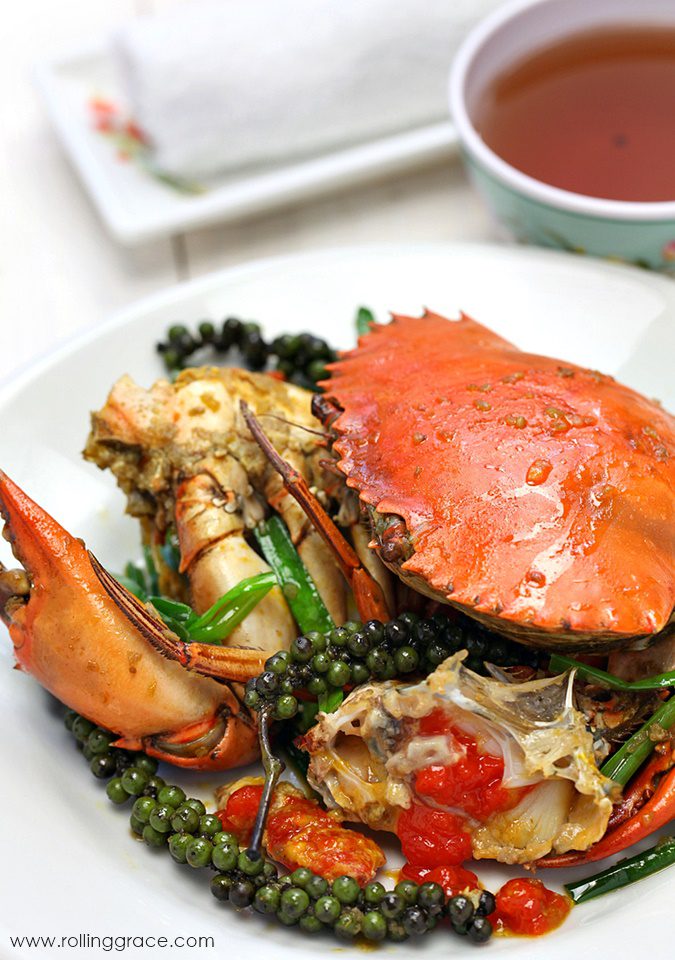
Fish on the Fire Lake (Trei Bung Kanh Chhet)
The name is more dramatic than the dish needs to be, but the dish itself earns attention. The fish is deep-fried until properly crisp throughout, then placed into a coconut curry broth built with hot chilies, cabbage and yellow kroeung. The contrast is deliberate: the exterior softens at the edges where it meets the curry while holding its crunch in the centre. The broth is fragrant and carries a real heat, balanced by the sweetness of the coconut base.
It rewards eating quickly. The longer the fish sits in the curry, the more the crunch gives way. The first few minutes are when this dish is at its best. It remains one of the Cambodian dishes for those discovering traditional flavours.
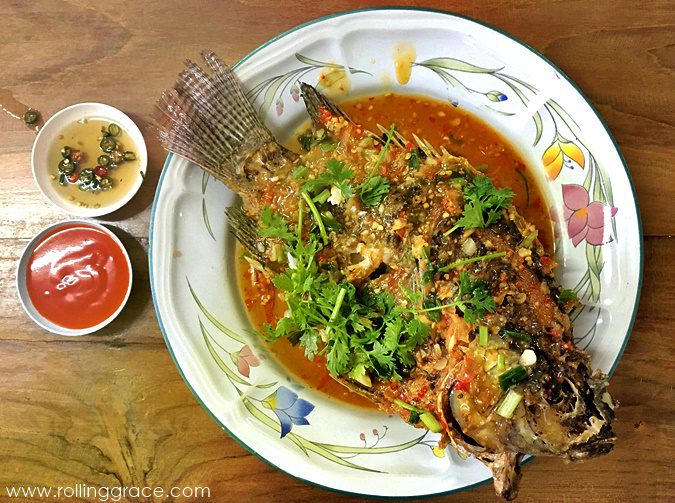
Red Tree Ant Stir-Fry with Beef
This dish is more widely available than visitors assume. Red tree ants contribute a sharp, acidic note when stir-fried at high heat with sliced beef, ginger, lemongrass, holy basil, shallots and chilli. They function closer to a souring agent than a protein, cutting through the richness of the beef the way lime juice does in other dishes. The ants are small; texture is barely a factor. The flavour is the point.
My dining companion ordered it without hesitation and worked through the plate steadily. Bold, herbal and more coherent than the ingredient list suggests. It is often included in lists of Cambodian dishes to try for visitors.

Morning Glory (Tra Kuen)
Water spinach, stir-fried over high heat with garlic until the leaves wilt and the hollow stems keep a light crunch. Mild, slightly grassy, it takes on whatever it is cooked with. In Cambodia it usually comes with a generous hit of garlic and oyster sauce, arriving at the table with a clean finish that cuts through the heavier dishes around it.
Order it alongside the richer Cambodian dishes and it does exactly what it should: keeps everything in balance. It is one of the Cambodian dishes worth trying when exploring local cuisine.
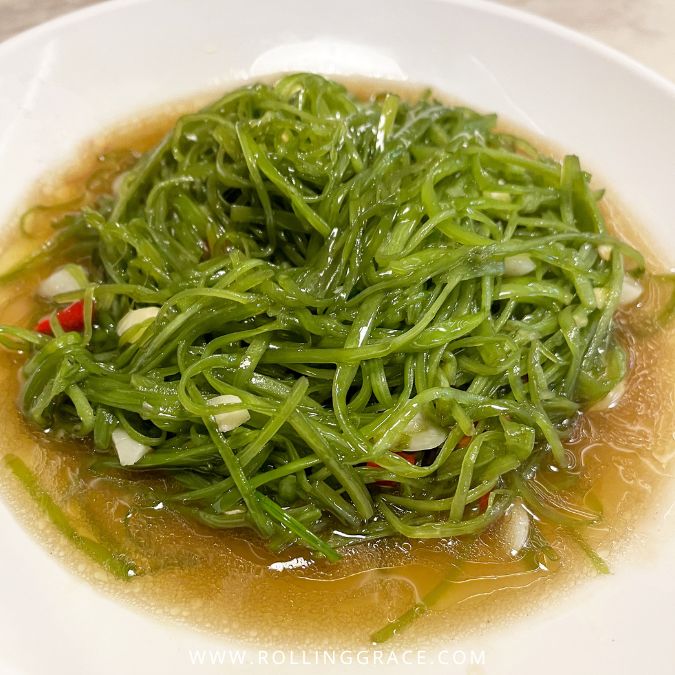
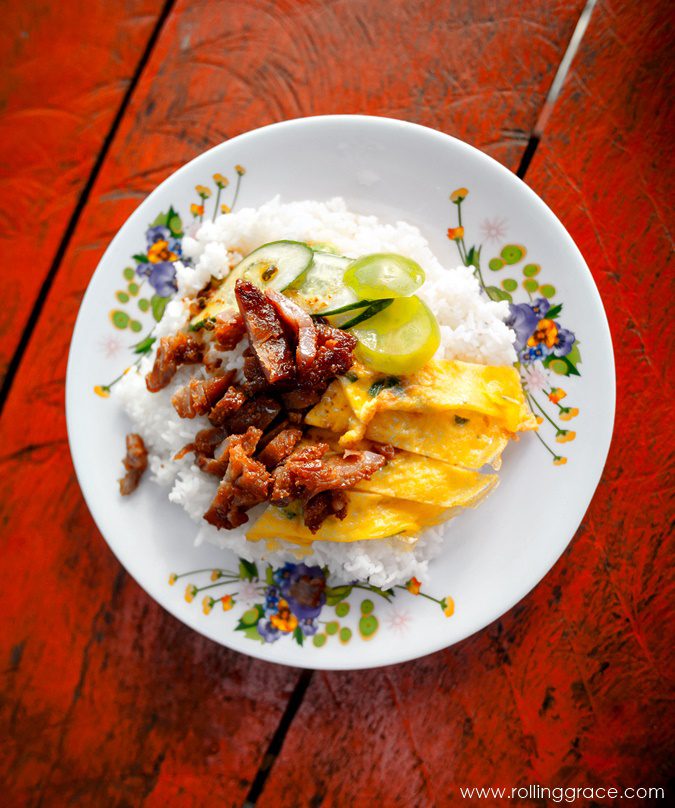
Bai Sach Chrouk
Bai Sach Chrouk is one of the more satisfying things on a Cambodian breakfast table. Thin pork steaks are marinated in garlic and coconut milk overnight, then grilled over charcoal until the exterior chars and caramelises while the inside stays tender. The coconut milk does not read as sweet in the final dish; it pulls the fat into the meat and gives the charred edges a depth that plain marinated pork does not have.
The rice is plain and steamed separately, letting the pork carry the flavour completely. It is a morning dish, sold early, and worth adjusting your schedule for.
Cambodian dishes here are not shouting for attention the way street food cultures in neighbouring countries sometimes do.
They are specific, considered and deeply rooted in ingredients that have been grown, fermented and pounded the same way for centuries. Eat past the tourist menus and what you find is a cuisine that knows exactly what it is.
Get the good stuff first. Join Rolling Grace for the restaurants worth crossing a city for, the stays worth the upgrade, and the places to go before everyone else. Free, straight to your inbox.
Leave a Reply