Phnom Penh arrives with noise, heat, and the particular weight of a city that has survived something catastrophic and kept going.
At the confluence of the Mekong and Tonlé Sap rivers, this is a place of contradictions: golden spires rising alongside French colonial facades, riverside restaurants full of laughter a short tuk-tuk ride from mass graves. No other city in Southeast Asia demands that you hold joy and grief in the same afternoon.
For travellers who want to understand Cambodia beyond the temples of Siem Reap, Phnom Penh is essential. Below are the six places to visit in Phnom Penh that matter most, each with everything you need to plan your visit properly.
Read also: 1-Day Kampong Khleang Itinerary: Best Attractions & Tips

Choeung Ek Genocidal Centre (The Killing Fields)
Before the Khmer Rouge arrived, Choeung Ek was an orchard and a Chinese cemetery, 17 kilometres south of the city.
Between 1975 and 1979, it became an execution ground. More than 8,895 bodies were exhumed here from 86 of the site’s 129 mass graves, most of them prisoners who had already endured months of torture at the S-21 detention centre in the city. The remaining graves have been left deliberately undisturbed. It is one of the most popular places to visit in Phnom Penh, especially for first-time travellers exploring the capital.
What to Expect
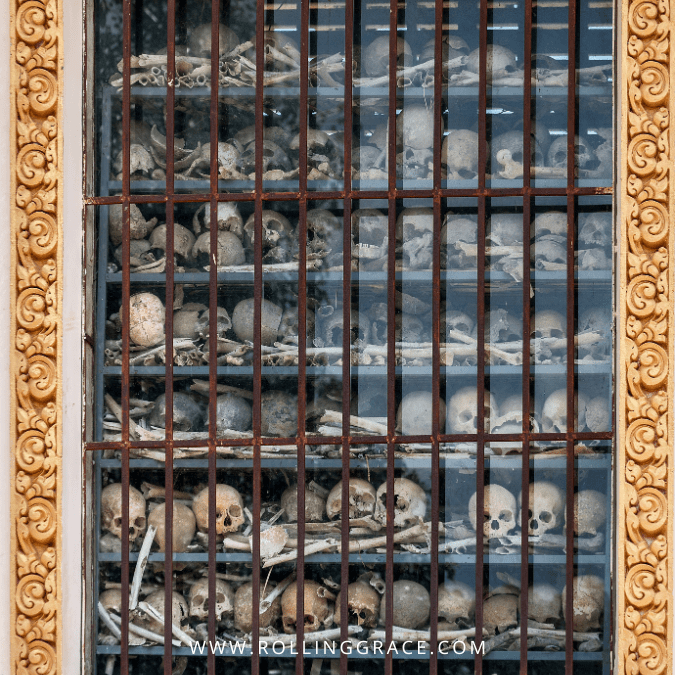
The memorial stupa at the centre of the site holds more than 5,000 human skulls, arranged behind glass. Fragments of bone and cloth still surface from the earth during the rainy season. The audio guide, available in multiple languages and included in your entry fee, is narrated by survivors and takes around 90 minutes to complete. Do not skip it.
Nothing quite prepares you for the ordinariness of the landscape. Green, open, almost pastoral. The horror arrives slowly, detail by detail, as you walk. This is one of the more affecting experiences in all of Southeast Asia, and it is not appropriate for young children.
Visitor Information
- Address: Choeung Ek, Roluos Village, Dangkor District, Phnom Penh
- Opening hours: Daily, 7:30 AM to 5:30 PM
- Entrance fee: USD 6 per person (includes multilingual audio guide)
- Getting there: Tuk-tuk from central Phnom Penh takes 40 to 50 minutes depending on traffic. Budget around USD 15 to 20 return.
- Dress code: Modest dress required. Shoulders and knees must be covered.
Tuol Sleng Genocide Museum (S-21)
This is where the prisoners came before Choeung Ek. A former secondary school in the Chamkar Mon district, Tuol Sleng was converted by the Khmer Rouge into Security Prison 21, one of at least 150 execution centres operating across the country during their four-year reign.
More than 17,000 people were imprisoned here; only a handful survived. The name Tuol Sleng translates loosely from Khmer as “Hill of the Poisonous Trees.” It remains a widely visited stop within places to visit in Phnom Penh, drawing steady interest throughout the year.
Visit Tuol Sleng before Choeung Ek if you can. Understanding S-21 first gives the Killing Fields a grounding, necessary context.
What to Expect
The four main buildings are largely preserved as they were when Vietnamese forces discovered the site in January 1979.
Building A contains the rooms where senior prisoners were interrogated. Building B houses the systematic black-and-white photographs the regime took of every prisoner upon arrival, displayed in rows across the walls: men, women, children, infants. Building C shows the brick cells, some barely large enough to lie flat.
Temporary exhibitions rotate across the upper floors, and documentaries screen in Building E, Monday to Friday at 10 AM and 3 PM.
Visitor Information
- Address: Corner of Street 113 and Street 350, Boeung Keng Kang, Phnom Penh
- Opening hours: Daily, 8:00 AM to 5:00 PM
- Entrance fee: USD 5 for non-Cambodian adults; USD 3 for non-Cambodian visitors aged 10 to 18; free for Cambodian citizens and children under 10
- Audio guide: USD 3 additional, or USD 5 donation for a personal guide
- Dress code: Respectful attire required. Shorts and sleeveless shirts are not permitted.

Royal Palace of Cambodia
Built in 1866 under King Norodom on the site of a former citadel, the Royal Palace remains the official residence of the Cambodian head of state. What is open to visitors is the compound’s public section: the Throne Hall, the Napoleon III Pavilion, the surrounding gardens, and the Silver Pagoda to the south.
The palace receives between 200 and 300 visitors daily and can feel crowded mid-morning on weekends. It is regarded as a familiar highlight among places to visit in Phnom Penh, appreciated by both locals and visitors.
What to Expect
The Throne Hall is the showpiece: a soaring, multi-tiered hall built in Khmer style with French influence, used for coronations and state ceremonies. Its spire reaches 59 metres. The Napoleon III Pavilion, a prefabricated iron building gifted by the French Emperor and originally installed in 1876, is the most unusual element on the grounds and easy to walk past without realising what it is.
Mornings are cooler and notably less crowded. The palace closes without warning during official royal events.
Visitor Information
- Address: Samdech Sothearos Boulevard, Phnom Penh
- Opening hours: 8:00 AM to 11:00 AM and 2:00 PM to 5:00 PM daily (closed during royal ceremonies)
- Entrance fee: USD 10 per person (includes access to the Silver Pagoda)
- Dress code: Shoulders and knees must be covered. Hats and footwear must be removed inside the Silver Pagoda.

Silver Pagoda (Wat Preah Keo Morakot)
Technically within the Royal Palace compound and included in the palace entry fee, the Silver Pagoda earns its own stop. Its formal name, Wat Preah Keo Morakot, means Temple of the Emerald-Crystal Buddha.
The original wooden building dates to 1892; the current one was completed in 1962 using concrete and Italian marble. The pagoda was one of the very few religious buildings left largely intact during the Khmer Rouge period.
It continues to rank among notable places to visit in Phnom Penh, fitting naturally into most travel itineraries.
What to Expect
The floor. More than 5,000 silver tiles, each weighing approximately one kilogram, cover the interior of the main hall. Most are protected by carpet runners, but the exposed section near the entrance is extraordinary. At the centre of the hall is a 17th-century Baccarat crystal Buddha, Cambodia’s equivalent of Bangkok’s Emerald Buddha. Behind it, a life-sized gold Buddha created in 1907 weighs 90 kilograms and is set with 9,584 diamonds.
The outer gallery wall runs 642 metres around the compound and is painted with murals illustrating the Reamker, the Cambodian rendering of the Ramayana, completed in 1904 and partially restored after Khmer Rouge damage.
Visitor Information
- Address: Within the Royal Palace compound, Samdech Sothearos Boulevard, Phnom Penh
- Opening hours: 8:00 AM to 11:00 AM and 2:30 PM to 5:00 PM
- Entrance fee: Included in the Royal Palace ticket (USD 10). Standalone entry is USD 3.
- Photography: Permitted in the courtyard and outer gallery. Restrictions apply inside the main hall.

National Museum of Cambodia
Designed by French historian and architect George Groslier and built between 1917 and 1924, the National Museum occupies a prime position directly adjacent to the Royal Palace on Preah Ang Eng Street.
The building itself is worth pausing at before you go inside: four pavilions arranged around a central garden courtyard, built in Khmer style with terracotta-red towers and ornamental detailing.
It is Cambodia’s largest collection of cultural history and its most important archaeological museum. It is one of the more compelling places to visit in Phnom Penh, where traces of the city’s past sit alongside its changing skyline.
What to Expect
More than 14,000 objects spanning prehistoric Cambodia through to the post-Angkorian period. The collection includes bronze and stone Khmer sculptures, ceramics, royal regalia, and ethnographic objects.
The standout piece is the sandstone statue of the leper king, recovered from Angkor Thom and dating to the late 12th or early 13th century. The central garden courtyard, with its large bronze Naga sculpture and fish ponds, is one of the calmer spaces in the city.
Photography and videography are strictly prohibited inside all gallery spaces.
Visitor Information
- Address: 13 Preah Ang Eng Street (Street 13), Phnom Penh
- Opening hours: 7:30 AM to 11:00 AM and 2:00 PM to 5:00 PM daily
- Entrance fee: USD 10 for foreign adults; free for Cambodian citizens
- Photography: Not permitted inside the galleries
- Time required: Allow 90 minutes to two hours

Wat Ounalom
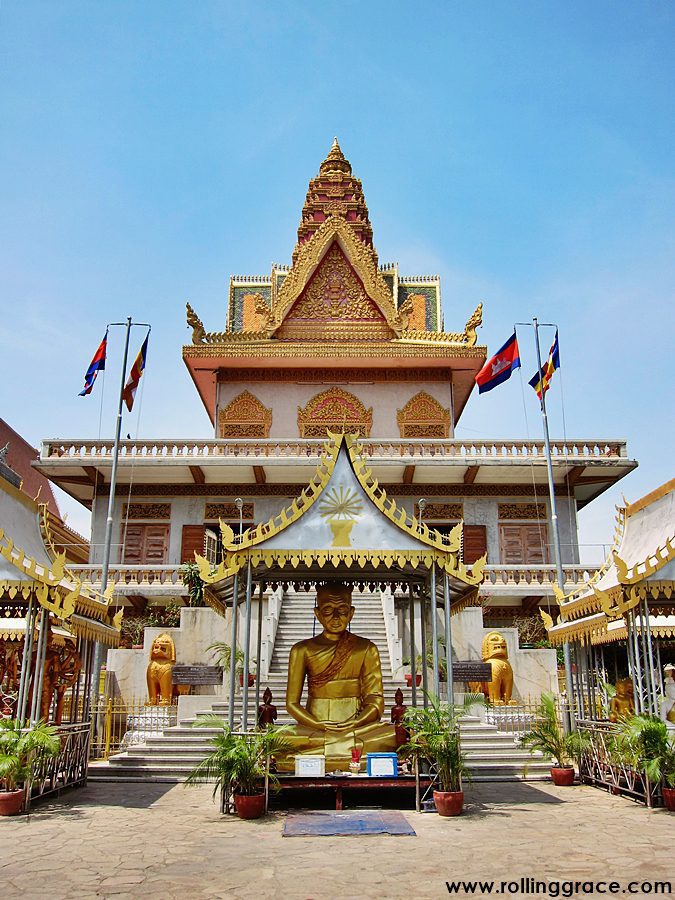
Founded in 1443, Wat Ounalom is the seat of Cambodian Buddhism and the official headquarters of the Khmer Buddhist Order.
Located on Sisowath Quay, directly on the riverfront, it is the most significant pagoda in the country and one of the oldest surviving landmarks in Phnom Penh. The name Ounalom derives from Pali, referencing the strand of the Buddha’s eyebrow hair believed to be housed within the main stupa on the compound.
Being on the riverfront, Wat Ounalom pairs well with an early morning walk along Sisowath Quay before the heat takes hold. The pagoda is at its most atmospheric before 8 AM, when monks are conducting morning prayers. It is often highlighted among places to visit in Phnom Penh for its atmosphere, especially in the softer hours before evening.
What to Expect
Unlike the city’s genocide sites, Wat Ounalom is a functioning religious community with around 500 monks in residence. The main stupa is believed to contain the relic alongside a stone inscription in Pali. The compound also includes a small library, a memorial room dedicated to the monk Samdech Huot Tat, and several smaller shrines.
The Khmer Rouge executed the reigning patriarch and systematically destroyed much of the compound’s archive and artwork. The pagoda has been gradually rebuilt since 1979, making it both a place of active faith and visible recovery.
Visitor Information
- Address: Sisowath Quay, Phnom Penh (near the junction with Street 154)
- Opening hours: Daily from sunrise to sunset (approximately 6:00 AM to 6:00 PM)
- Entrance fee: Free
- Dress code: Shoulders and knees must be covered. Remove shoes before entering the main hall.
Planning Your Visit to Phnom Penh
How to Get Between the Sites
A tuk-tuk hired for a full day from central Phnom Penh runs between USD 20 and USD 30. The Royal Palace, National Museum, and Wat Ounalom are all walkable from each other along the riverfront. Tuol Sleng and Choeung Ek require transport.
The standard circuit runs: Tuol Sleng in the morning, Choeung Ek after lunch, then the Royal Palace compound and National Museum on a separate day. Combining both genocide sites in a single day is emotionally demanding. Most visitors find Tuol Sleng alone takes more out of them than expected.
What to Wear
All sites require covered shoulders and knees. Lightweight linen or cotton is practical in the heat. Comfortable walking shoes matter; several sites require shoes to be removed and worn again multiple times throughout the day.
Best Time to Visit Phnom Penh
November to February is the dry season and comfortably the best window. March to May is very hot. The rainy season runs June to October: the city remains navigable, but humidity is high and afternoon downpours are routine.
Tips for Visiting Responsibly
Both Choeung Ek and Tuol Sleng receive entry fees that fund ongoing conservation, research, and survivor support initiatives. The USD 5 to 6 admission is modest by any measure. Buying from the small vendors near Choeung Ek directly supports families from the surrounding community.
At both genocide sites, photography of human remains requires serious consideration. Many visitors choose not to photograph at all. The audio guides at both sites cover this directly and are worth listening to before you lift your camera.
Frequently Asked Questions on Places to Visit in Phnom Penh
How many days do you need in Phnom Penh to see the main sites?
While one day is possible, two full days is the optimum to cover the six sites in this guide without rushing. Allocate one day for the genocide sites (Tuol Sleng and Choeung Ek) and a second day for the Royal Palace, Silver Pagoda, National Museum, and Wat Ounalom.
A third day gives you room to revisit anything that resonated, explore the riverside markets, or take a day trip.
Is Phnom Penh safe for tourists?
Phnom Penh is generally safe for tourists and receives hundreds of thousands of international visitors each year.
Standard urban precautions apply: keep valuables out of sight on tuk-tuks, be aware of bag-snatching on busy streets, and use reputable ride-hailing apps such as PassApp or Grab for transport. The tourist areas around Sisowath Quay and BKK1 are well-frequented and well-lit.
What is the dress code for visiting sites in Phnom Penh?
Covered shoulders and knees are required at the Royal Palace, Silver Pagoda, Wat Ounalom, and the genocide sites. Tuol Sleng specifically prohibits shorts and sleeveless shirts. Lightweight trousers and a short-sleeved shirt or blouse cover every site without issue.
Can you visit Tuol Sleng and the Killing Fields on the same day?
You can, and many guided tours combine them. That said, doing both in a single day is a heavy experience. If you have the time, separating them by a day makes each visit more absorbing and less overwhelming.
Do the Royal Palace and National Museum close for lunch?
Yes. Both sites observe a midday break and are closed between approximately 11:00 AM and 2:00 PM. Plan your morning visit to finish by 10:45 AM, or arrive after 2:00 PM. The Silver Pagoda follows a slightly different schedule, reopening at 2:30 PM.
Is it worth hiring a guide in Phnom Penh?
For the genocide sites in particular, yes. The context that a knowledgeable local guide brings to Tuol Sleng and Choeung Ek transforms the visit from an encounter with objects into a comprehensible history.
The National Museum also benefits significantly from guided interpretation, as the labelling inside the galleries is limited.
What currency is used at entry points in Phnom Penh?
US dollars are accepted and expected at all the sites listed in this guide. Cambodian riel is the national currency but USD is the standard for tourist transactions. Carry small bills; change in large denominations can be difficult to obtain at ticket booths.
This guide is compiled from personal visits, verified travel sources, current venue information, and direct reference to official museum websites.
Get the good stuff first. Join Rolling Grace for the restaurants worth crossing a city for, the stays worth the upgrade, and the places to go before everyone else. Free, straight to your inbox.
Leave a Reply