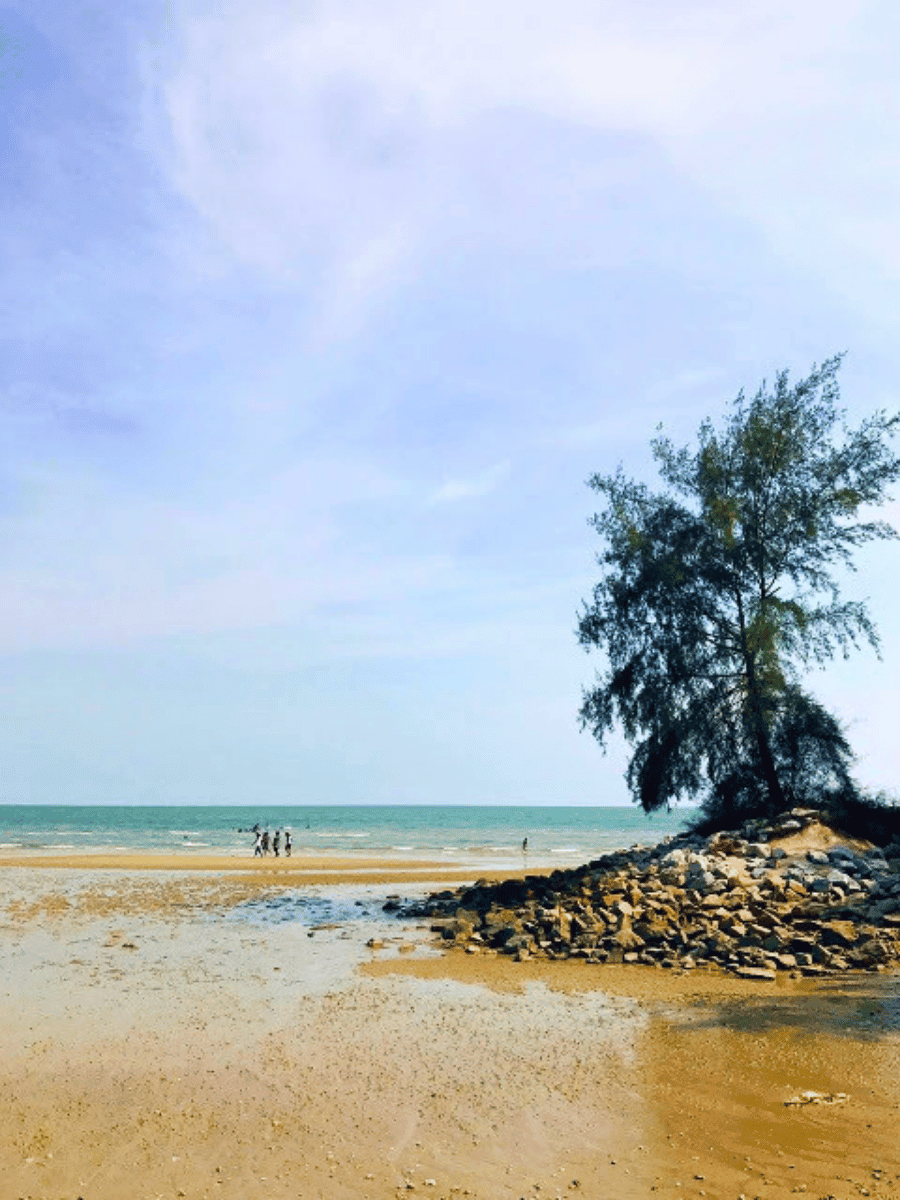
Low tide at Pantai Tanjung Biru pulls the sea back and leaves a working exhibit behind: crab holes punched into wet sand, clams breathing through the seabed, small pools holding whatever the water forgot. Children walk out into it with buckets. Nobody is in a hurry.
Read also: Islands in West Malaysia: Discover 7 Most Beautiful Paradise

Blue Lagoon Beach, Port Dickson
Pantai Tanjung Biru, still known to most people by its old name of Blue Lagoon Beach, drew national attention in mid-2026 after photos of its clear water spread across social media, and the crowds followed within weeks. Families now drive two hours from Selangor to see it for themselves.
The draw is 300 metres of sand tucked into a bay south of Port Dickson town, hemmed in by hills and the forest of Tanjung Tuan, facing northwest into the sunset. What most day-trippers miss is that they have parked at the edge of one of Southeast Asia’s most significant wildlife sites. Here is what to do when you get there.
Why Pantai Tanjung Biru Went Viral
This beach has not always looked like this. Visitors who came a few years ago describe a shoreline littered with wood debris and a black, charcoal-like residue along the sand.
Read also: 12 Best Things to Do in Langkawi, Malaysia
In June 2026, the beach was pulling large domestic and international crowds, with visitors describing clean surroundings, clear water, and a white sandy shoreline they rated alongside Malaysia’s better-known beach destinations. One regular who had known it in its rougher days put it plainly: it used to be covered in debris, and now the water is clear.
So this is a beach in recovery, and a recent one. That matters for how you treat it, which is the last section of this guide.

Swim in the Calm, Shallow Water
The bay is sheltered, so the water stays calm and shallow a long way out, which makes this one of the safest beaches on the coast for young children. Adults can wade a considerable distance before the water reaches waist height.
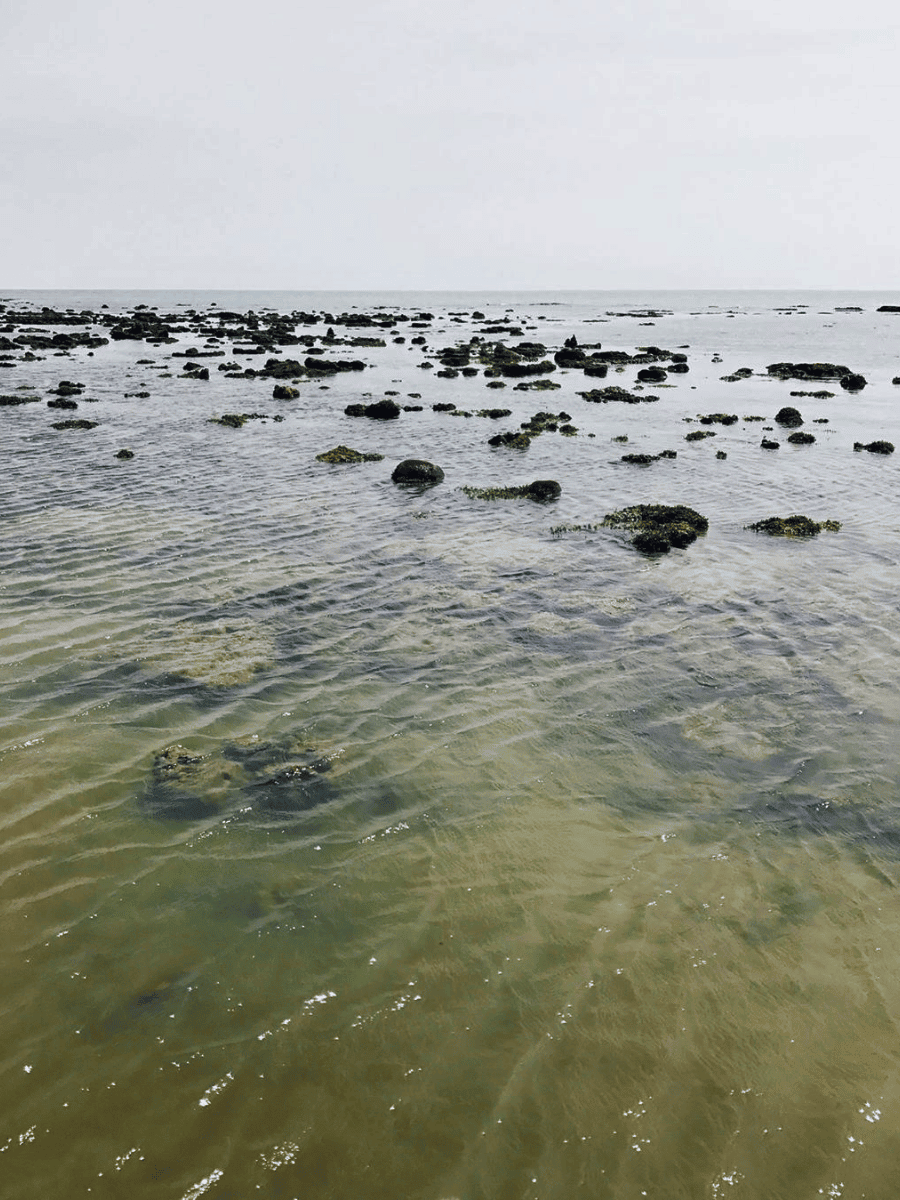
The tide governs everything here. At low tide the sea pulls back and you walk out over exposed seabed. As it comes in, the swimming improves and the shallows warm through the afternoon. Check a tide chart before you set off, because arriving at the wrong end of the cycle means a long walk to reach water deep enough to swim in.
Explore the Seabed at Low Tide
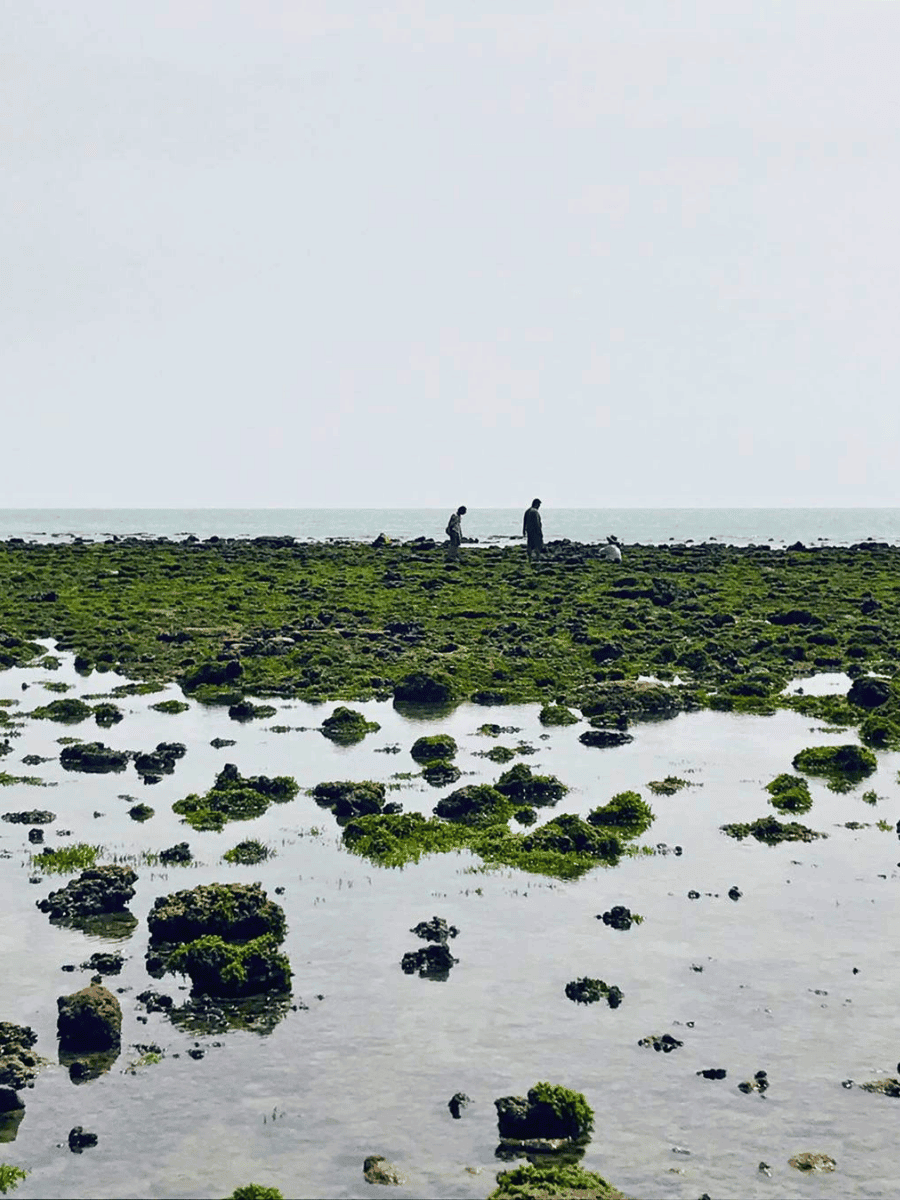
When the sea retreats, a shallow ecosystem is left open to inspection. Tiny crabs work across the sand in numbers. The exposed seabed holds clams and shellfish. Sandbanks and tidal pools form and refill.
Further out, small coral formations become visible at low tide, enough that the bay occasionally draws divers. For anyone with a camera and a slow morning, it is the best hour of the day.


Meet the Forest Wildlife
Pantai Tanjung Biru borders the Tanjung Tuan Forest Reserve, and the forest pays no attention to the boundary.
Sightings are routine here: monkeys along the treeline, squirrels in the branches, and resident birdlife throughout. The usual rules apply. Do not feed the monkeys, and do not leave food unattended on your mat while you are in the water.

Time Your Visit for the Raptor Migration
The forest above this beach is one of the most important raptor migration watchpoints in Southeast Asia, and it is listed by BirdLife International as one of Malaysia’s 55 Important Bird and Biodiversity Areas.
Tens of Thousands of Birds of Prey
Every year between January and April, tens of thousands of migratory raptors cross the Strait of Malacca from Sumatra and make landfall here, riding thermal currents on their way north to breeding grounds in China, Japan, Korea, and Siberia.
At peak, up to 4,000 birds arrive in a single day. The reason they choose this exact headland is geography: Tanjung Tuan is the narrowest point of the Strait, with only 38 kilometres of open water between it and Pulau Rupat in Sumatra.
The Oriental honey-buzzard makes up more than 90 per cent of the traffic, followed by black bazas, Chinese goshawks, grey-faced buzzards, and Japanese sparrowhawks. March is the peak month, and the best watching window is roughly 11am to 3pm, once the sun has built the thermals the birds ride in on.
Raptor Watch
The Malaysian Nature Society has run its annual Raptor Watch here since 1999, drawing birders from Japan, Korea, China, and Singapore. The 2026 edition was held on 14 and 15 March at Tanjung Tuan, centred on the lighthouse and the surrounding trails, with guided watching sessions and identification talks.
Catch the Sunset at Blue Lagoon Beach
The beach faces northwest. That single geographic fact is why it has a following among sunset chasers, and why the evening crowd differs from the afternoon one.
The sun drops straight down the axis of the bay and into the Strait of Malacca, with the forested headland framing one side. Late afternoon light on the water is also when the beach photographs best, which is a fair part of why it went viral to begin with.
Picnic Under the Trees
Unlike most beaches on this coast, Tanjung Biru comes with its own shade. Mature trees grow down to the sand, so you are not choosing between a view and heatstroke.
The facilities are unusually good for a public beach: toilets, bathrooms, a food court, market stalls, and a playground, all within a minute’s walk of the sand. The food court serves local dishes, and shops near the entrance sell beach gear, toys, and souvenirs.
Plenty of visitors bring a mat and homemade food instead. Plastic chairs and awnings can be rented on the sand, so ask at the beach for current rates.
Take Part in Water Activities
The sheltered bay lends itself to water sports, and operators run directly from the beach.
Kayaking and banana boat rides are the mainstays, with the occasional jet ski. Calm conditions suit beginners and families. Prices move with the season and the operator, so ask on the day.
Walk to Pantai Cermin and the Cape Rachado Lighthouse
The best thing about Tanjung Biru is that it is not a dead end. Two more places sit within easy reach.
Pantai Cermin Port Dickson
Pantai Cermin lies on the far side of the headland, close enough to pair with a Tanjung Biru visit in one trip. It is longer, emptier, and its sand runs orange with black mineral deposits.
The water looks murkier there because of a muddy seabed, though it is clean. It faces the sunrise, which makes the two beaches natural bookends to a day.
Oldest Lighthouse in Malaysia
Above both stands the Cape Rachado lighthouse, built by the Portuguese in 1528 and 1529 to guide ships into Melaka, and the oldest in the country.
The Hutan Rekreasi Tanjung Tuan car park is the trailhead, and the climb to the lighthouse takes around 15 minutes through primary coastal rainforest with hardwoods topping 40 metres. Other trails lead to the Dutch Well and Monkey Bay. The forest is open daily from 7am to 6pm. Take water, because it is humid work.

Geographic Oddity Worth Knowing
You would assume the whole cape is in Negeri Sembilan. It is not. Tanjung Tuan is an exclave of Melaka, entirely surrounded by Negeri Sembilan, a leftover from how the state boundaries were drawn.
It is also the only coastal forest on the west coast of Peninsular Malaysia gazetted as a forest reserve, a wildlife reserve, a fisheries prohibited area, and a historic site all at once. The waters off the cape were the site of the 1606 naval Battle of Cape Rachado between the Dutch and the Portuguese.
How to Get to Pantai Tanjung Biru
Address
Blue Lagoon Beach, Batu 10, Jalan Pantai, 71050 Port Dickson, Negeri Sembilan. The beach lies around 17 kilometres south of Port Dickson town, roughly a 20-minute drive, and about 3.7 kilometres from the Lexis Hibiscus resort.
From Kuala Lumpur
The drive from KL takes around one and a half to two hours depending on traffic, putting it inside day-trip range. Driving is by far the easiest way in, and signage along Jalan Pantai to Blue Lagoon is clear. The old name is still what most signs and locals use.
Best Time to Go
The Blue Lagoon Beach is open around the clock, though the useful window runs roughly 7am to 7pm. Weekdays are markedly calmer than weekends since the viral surge, and school holidays are now busy.
For the low-tide seabed to yourself, check a tide chart and go early on a weekday. For raptors, come in March.
Cleanest Beach in Port Dickson
Here is the part that matters. This beach was not clean a few years ago, and it is clean now because effort went into making it so. It went viral in June 2026, and the crowds arrived within weeks. Those two facts are on a collision course.
Take your rubbish out with you, including whatever the food court hands you, because a beach with stalls generates plastic fast. Do not stand on the coral at low tide. Leave the shells and the clams where they are, since the exposed seabed is the attraction precisely because it is alive. And back the stall holders and chair renters who work here, because the people who earn a living from a clean beach are the ones with the strongest reason to keep it clean.
The forest above this beach is a protected reserve that tens of thousands of birds depend on to survive a 10,000-kilometre journey, and a number of them arrive already exhausted. The beach and the forest are one place. Treating the sand well is part of treating the rest of it well.
Port Dickson has spent years living down a reputation for dirty water. Tanjung Biru is proof it does not have to be that way. Keeping it that way is now a question about the people who read articles like this one.
Get the good stuff first. Join Rolling Grace for the restaurants worth crossing a city for, the stays worth the upgrade, and the places to go before everyone else. Free, straight to your inbox.
Leave a Reply