An estimated 200,000 crosses, a crucifix sent by a pope, a Franciscan monastery and nearly two centuries of defiance all crowd onto one small mound in northern Lithuania. The Hill of Crosses rises out of flat farmland 12 km north of Šiauliai.
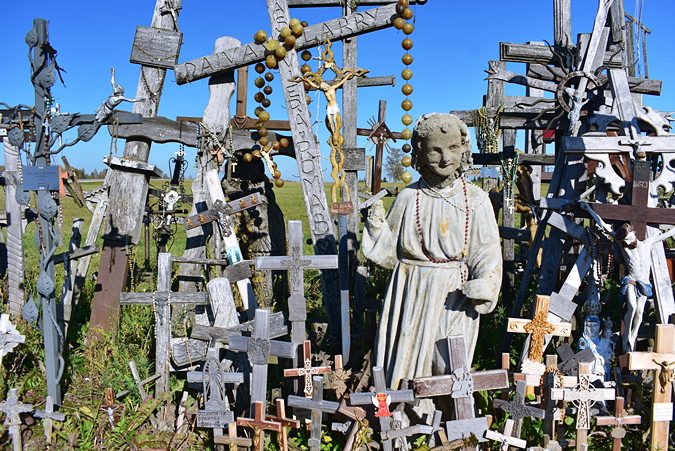
We arrived on a day when the wind came hard across the open fields, and the whole hill seemed to chime. Thousands of rosaries and small metal crosses knock against each other in the breeze.
This guide covers the history of the Hill of Crosses, the seven things you should not miss, how to get there from Vilnius, Šiauliai and Riga, and every practical detail you need to plan the trip.
Read also: Exploring Curonian Spit Lithuania: 10 Amazing Things to Do

Hill of Crosses Lithuania at a Glance
The Hill of Crosses, known in Lithuanian as Kryžių kalnas, rises near the village of Domantai, about 12 km north of Šiauliai. By road it is roughly 214 km from Vilnius and around 125 km from Riga.
- What It Costs: Entry is free and the hill never closes. You pay only for parking, usually a euro or two, and a small fee for the toilets at the visitor centre.
- How Long You Need: Give yourself one to two hours. That is enough to walk the paths, find the papal crucifix and visit the monastery without rushing.

What Is the Hill of Crosses?
The Hill of Crosses is a Catholic place of pilgrimage near Šiauliai in northern Lithuania, covered in an estimated 200,000 crosses, crucifixes and rosaries. It began in the 19th century as a memorial to rebels killed in uprisings against Tsarist Russia. It became a national symbol of resistance during the Soviet occupation.
Book Private Trip from Vilnius to Riga: Hill of Crosses, Rundale Palace, Bauska Castle
Nobody is buried here. Every cross is a prayer, a memorial or a thank-you left by a visitor.
You are free to walk among them and take photographs. In our view, that openness is what makes the Hill of Crosses so moving: anyone can add to it.
History of the Hill of Crosses
In the Middle Ages, a wooden castle stood on this mound, named Kula in the old chronicles. The Livonian army destroyed it in 1348, and the hill stood bare for centuries.
Read also: 20 Best Dumplings in the World You Need to Try at Least Once
The first crosses most likely appeared after the failed 1831 uprising against Russian rule. Families who could not recover the bodies of fallen rebels raised symbolic crosses on the old hill fort instead.
More followed after the 1863 uprising. The Tsarist authorities banned new crosses and tore down existing ones, but people kept coming.

Under Soviet rule, the hill became forbidden ground. In 1961, 1973 and 1975, the authorities levelled it, burned the wooden crosses and turned the metal ones into scrap.
Anyone caught bringing a cross risked fines or prison. Each time, new crosses appeared, many of them planted at night.
After Lithuania regained its independence in 1990, pilgrims arrived in a steady stream. The hill soon ran out of room, so people began placing crosses at its foot.
Pope John Paul II visited on 7 September 1993 and celebrated Mass for around 100,000 pilgrims. He called the Hill of Crosses a place of hope, peace, love and sacrifice, and his visit made it famous around the world.
7 Must-See Sights at the Hill of Crosses
Main Hill and Its Narrow Paths
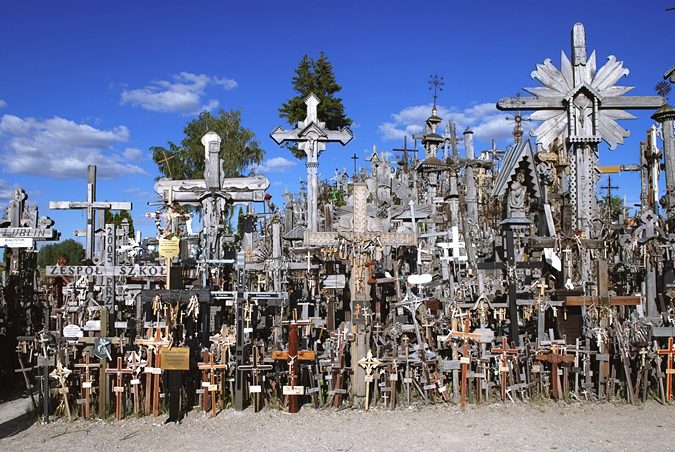
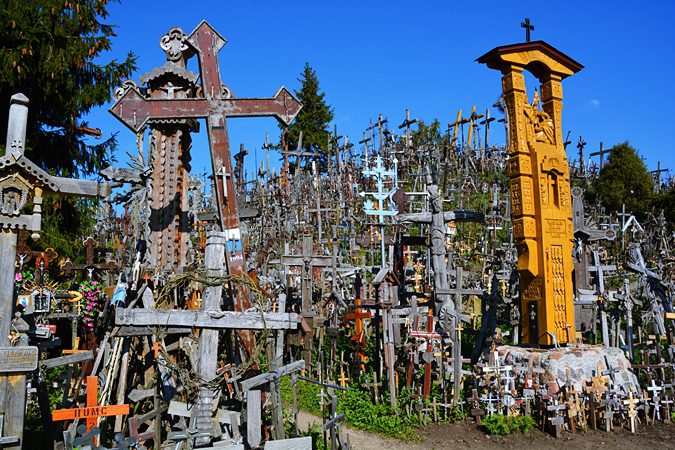
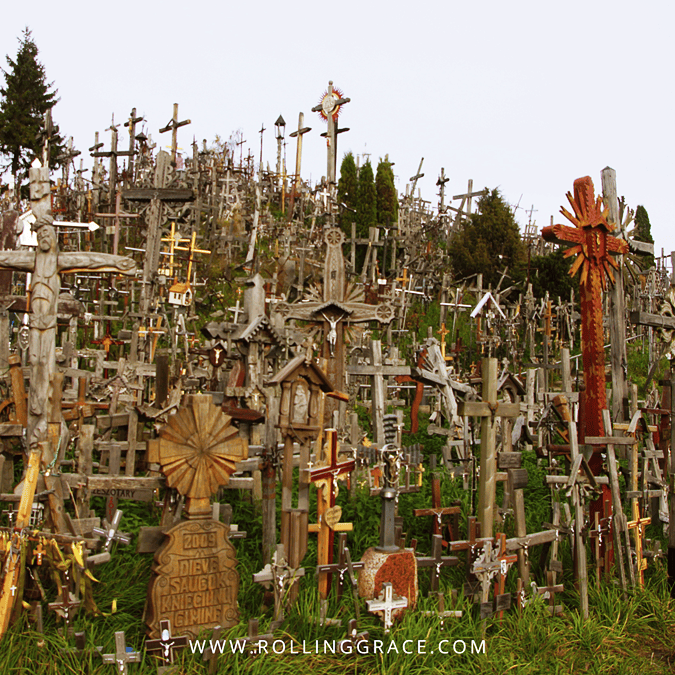
Narrow trails run straight through the middle of the Hill of Crosses. Crosses press in on both sides: towering carved wooden ones, iron crucifixes, tiny crosses hung in clusters, and rosaries draped over almost everything.
Walk it slowly. The best details are small, and the inscriptions are worth stopping for.

Papal Crucifix
A year after his visit, John Paul II sent Lithuania a gift: a crucifix by the sculptor E. Manfrini. It stands near the hill.
Pilgrimage processions usually begin and end beside it. For many Lithuanians, this crucifix marks the moment the world finally noticed the Hill of Crosses.
Book Private Full-Day Trip to Hill of Crosses, Rundale Palace & Bauska
Chapel Where the Pope Celebrated Mass
Opposite the hill stands the chapel where John Paul II celebrated Mass in 1993, designed by architects A. Jukna and R. Budrytė.
Stand here and look back. In our opinion, it gives you the best wide view of the whole Hill of Crosses.
Franciscan Monastery
Weeks after his Lithuania trip, the Pope visited the Franciscan sanctuary of La Verna in Italy and urged the friars to build a monastery beside the Hill of Crosses. Franciscans from Tuscany took up the call.
The monastery stands about 300 metres from the hill and was consecrated on 8 July 2000. Its architect was the Franciscan friar Angelo Polesello, and its cornerstone was cut from Mount La Verna itself.
Inside, the chapel has stained glass by Algirdas Dovydėnas telling the story of the Franciscan order. The friars here also look after the Hill of Crosses.
Crosses at the Foot of the Hill
The newest additions gather around the base, where the hill itself has no space left. Pilgrims from Lithuania, Poland, Italy and much further afield leave crosses here every day.
Some are simple wooden pieces. Others are large carved memorials.
Cross Stalls by the Visitor Centre
If you want to leave a cross of your own, small ones are sold near the entrance. You do not need to be religious to take part.
Lithuanian cross-making has been recognised by UNESCO as intangible cultural heritage since 2001. Buying from the local stalls, instead of bringing a mass-produced cross from home, keeps that tradition going.
Hill of Crosses at Dawn or After Dark
There are no gates and no closing time. Come early in the morning or in the evening, when fewer people are around.
At these hours, the Hill of Crosses feels closest to what it was during the Soviet years: a handful of visitors, the wind and the crosses.

How Many Crosses Are on the Hill of Crosses?
Nobody has an exact count, but current estimates put the Hill of Crosses at around 200,000 crosses, with some guesses far higher. The number grows every day as visitors add new crosses, crucifixes and rosaries, so any figure is out of date almost as soon as it is published.
Book Private Full-Day Trip to Hill of Crosses, Rundale Palace & Bauska
Records show at least 150 large crosses by 1895, 200 by 1914 and 400 by 1940, each surrounded by thousands of smaller ones. Since independence, the growth has been impossible to track.
How to Get to the Hill of Crosses
The Hill of Crosses is 12 km north of Šiauliai. From Vilnius, take the train to Šiauliai in around two to two and a half hours. Then catch a local bus towards Joniškis to the Domantai stop and walk 2 km to the hill. If you are driving, the trip from Vilnius covers roughly 214 km.
Book Private Trip from Vilnius to Riga: Hill of Crosses, Rundale Palace, Bauska Castle
From Vilnius by Train
LTG Link runs direct trains from Vilnius to Šiauliai daily, with tickets around €8 to €14 one way. Check ltglink.lt for current times.
A round trip in one day is possible but long. We suggest staying a night in Šiauliai and visiting the Hill of Crosses first thing in the morning.
From Šiauliai by Bus
From Šiauliai bus station, go to platform 12 and take a bus heading to Joniškis. Ask the driver for the Domantai stop.
The ride takes about ten minutes and costs under €1. From the stop, follow the signposted lane for 2 km to the visitor centre.
From Riga
The Hill of Crosses is around 125 km from Riga. Take a bus to Šiauliai and switch to the local Joniškis bus.
It also works well as a stop on the overland journey between Riga and Vilnius.
By Car
Driving is the simplest option. There is a large car park beside the visitor centre, with space for coaches and motorhomes.
Is the Hill of Crosses Worth Visiting?
Yes. The Hill of Crosses is worth visiting for anyone travelling through Lithuania, religious or not. No photograph captures the scale, and its history of defiance against two empires gives the place real weight. Pair it with a night in Šiauliai or a Riga to Vilnius road trip to make the journey worthwhile.
Is It Spooky?
Some visitors find it eerie, especially on grey days. We found it more moving than unsettling. It is a memorial to faith and survival, not a graveyard.
Can You Bring Children?
Yes. The paths are easy to walk, and children tend to be fascinated by the sheer number of crosses. Keep voices low near anyone praying.

Best Time to Visit the Hill of Crosses
The Hill of Crosses is open all year, but late spring to early autumn brings the mildest weather. For a deeper experience, go on the last Sunday of July, when the Indulgenced Feast is held and pilgrims walk from Šiauliai Cathedral to the hill.
Book Private Trip from Vilnius to Riga: Hill of Crosses, Rundale Palace, Bauska Castle
Pilgrimage Dates
On the first weekend of September, a pilgrimage walk sets out from the Hill of Crosses to Šiluva.
Visiting in Winter
Winter visits are stark and beautiful, but the wind across the open fields is bitter. Wear proper layers and waterproof shoes.
Visitor Information
Opening Hours
The Hill of Crosses is open 24 hours a day, every day of the year. The visitor centre has its own hours, and they do not affect access to the hill.
The visitor centre opens Monday to Friday:
- January to March: 9am to 5pm
- April to September: 9am to 6pm
- October to December: 9am to 5pm
Hours are shortened by one hour on the eve of public holidays.
Entrance Fee and Parking
Entry to the Hill of Crosses is free. Parking costs a euro or two, and the toilets cost around €1.
Contact Details
- Address: Piliakalnio g. 7, Domantai village, Meškuičiai eldership, Šiauliai district, Lithuania
- Phone: +370 41 37 08 60
- For more official information, see Lithuania Travel.
Get the good stuff first. Join Rolling Grace for the restaurants worth crossing a city for, the stays worth the upgrade, and the places to go before everyone else. Free, straight to your inbox.
Leave a Reply