The prayer wheel was still warm from the last person’s hand when I picked it up – and that was my first five minutes in Tibetan Quarter, Chengdu, back in 2016, and I have been thinking about the place ever since.
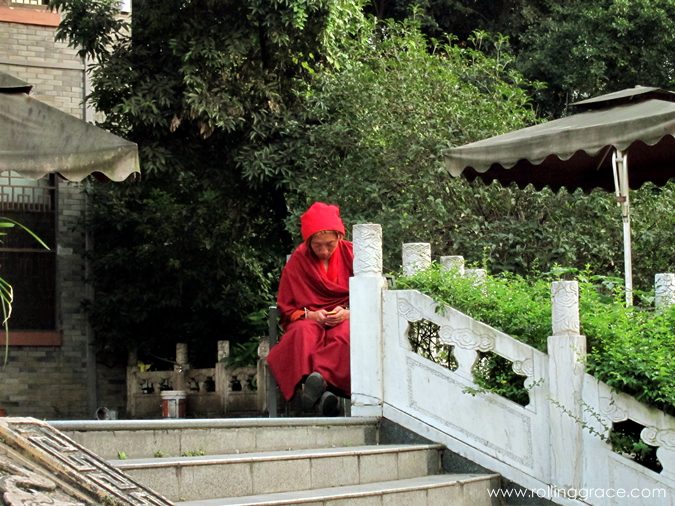
A monk in maroon robes sits at a plastic stool outside a noodle shop, prayer beads looped over one wrist, phone in the other hand. Two women walk past carrying groceries, their hair braided into two plaits each. A man in a traditional chuba stops to spin a prayer wheel outside a temple doorway, barely breaking his stride.
This is Wuhouci Cross Street on a Tuesday morning. Not a cultural attraction. Not a heritage precinct. Just a neighbourhood in southwest Chengdu where roughly 60,000 Tibetans live, work and go about their week, a few minutes from the nearest metro station and a world away from the city outside it.
Read also: What to Eat in Chengdu: 8 Great Dishes To Try in Sichuan
Largest Tibetan Community Outside Tibet
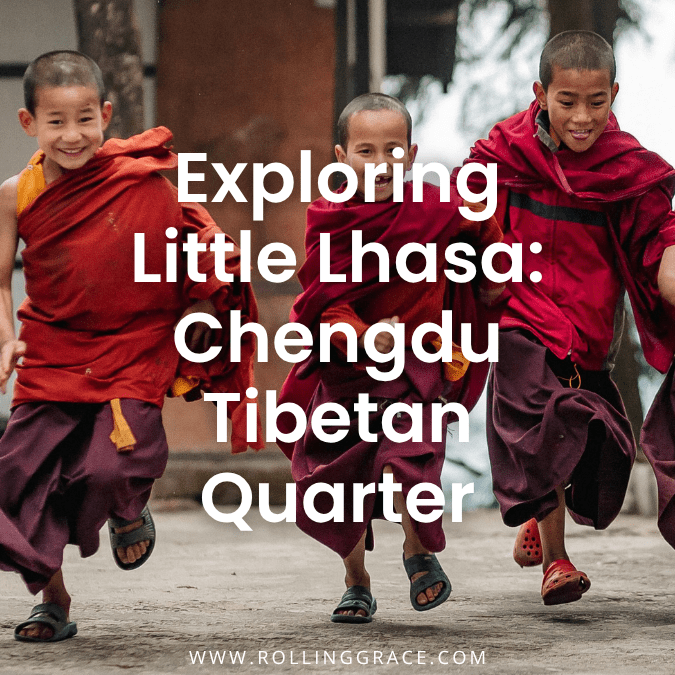
Chengdu is home to approximately 60,000 Tibetans, many of them concentrated in and around Wuhouci Cross Street. This is not a replica or a curated cultural display. It is a genuine diaspora community. Many residents have come from the Kham areas of western Sichuan, the Amdo regions of northern Sichuan and Qinghai, and as far as Lhasa itself.
The community grew partly because of Chengdu’s position as the nearest major Chinese city to Tibet (around 1,250 kilometres from Lhasa) and partly because of government incentives that brought Tibetan migrants into the city, including free education, medical access and employment support. The Southwest University for Nationalities, which has been running courses for ethnic minorities for over six decades, has played a significant role in anchoring the Tibetan presence in Wuhou District.
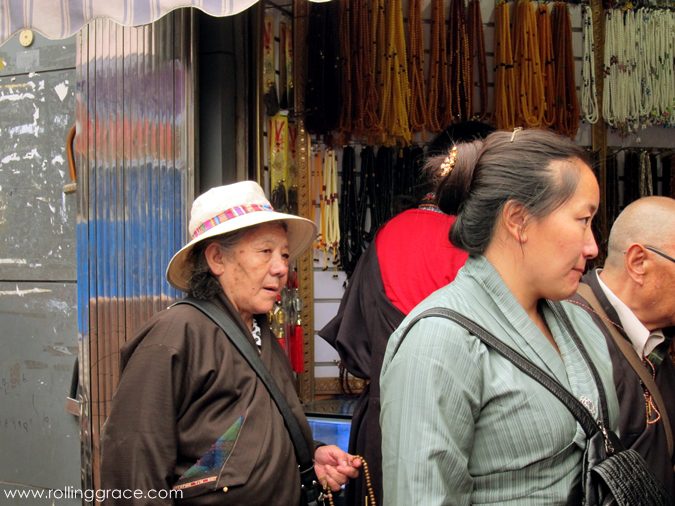
What you see on the street reflects that depth. Men wear traditional chubas and carry prayer malas with 108 beads. Women’s hairstyles carry meaning: unmarried women braid their hair into a single plait; married women into two. Prayer wheels, called Mani-Chos-‘Khor, are turned clockwise as a form of meditation in motion.


Best Tibetan Food in Chengdu: What to Eat in Little Lhasa
Tibetan cuisine does not get much attention outside of specialist travel writing, and that is a mistake. The Tibetan Quarter in Chengdu is one of the few places outside the plateau where you can eat this food prepared by people who grew up with it.
Momos are the starting point: steamed dumplings filled with seasoned yak meat or vegetables, heartier than their Nepali counterparts and usually served with a thin broth or chilli dip. Thukpa is a dense noodle soup with bone broth and dried meat, exactly what you want on a cold Chengdu morning, and Chengdu has plenty of those.
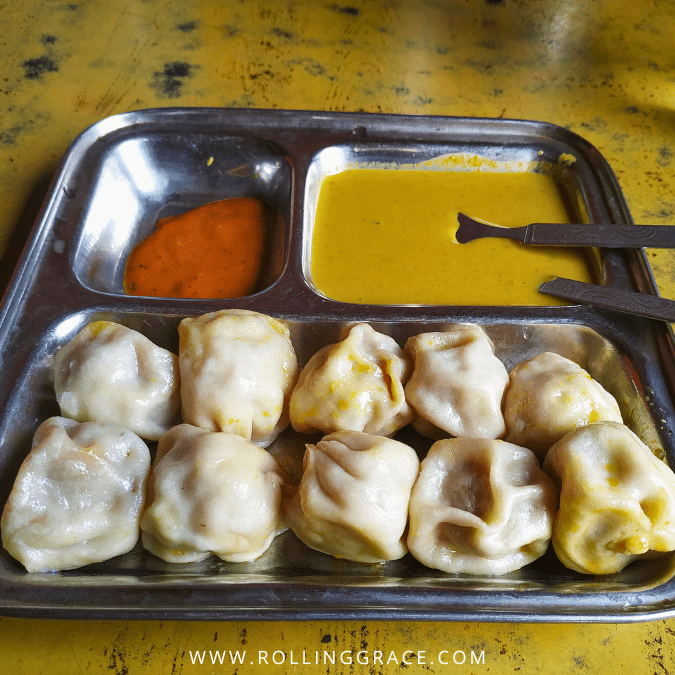
Yak butter tea (po cha) is the drink that separates the curious from the committed. It is salty, fatty and faintly gamey, made by churning brewed tea with yak butter and salt. Most first-timers do not finish the cup. Order it anyway. Sha balep is seasoned yak meat pressed into a flatbread and pan-fried. Most people take to it immediately.
Restaurants along Wuhouci Cross Street and the surrounding lanes range from open-front stalls to curtained private dining rooms separated by thick Tibetan cloth. The closed-room style is traditional and worth trying for the experience alone.
Shopping in Chengdu’s Tibetan Quarter: How to Bargain
The market stalls and shops along the main stretch of the Tibetan Quarter sell everything from hand-painted thangkas and yak-bone jewellery to Buddhist statues, prayer flags, and traditional textiles. The craftsmanship on the better pieces is genuinely impressive, and some items, particularly hand-carved prayer wheels and woven tapestries depicting deities and ancient warriors, are not findable at any airport gift shop.
Prices are consistently inflated for outsiders. This is not unique to the Tibetan Quarter, but it is particularly pronounced here. A bracelet that sells for ¥50 at one stall may go for ¥5 two shops down. The standard approach: open at half the asking price, stay pleasant, and be prepared to walk away. If you do not speak Mandarin, use the calculator on your phone to show numbers. It is a perfectly normal way to negotiate.
The outdoor equipment shops are also worth noting. The Tibetan Quarter has long been a staging point for travellers heading toward Tibet and the high-altitude plateau routes, and the area has accumulated a cluster of gear shops selling cold-weather clothing, sleeping bags and camping equipment. Quality varies, but prices are generally lower than mainstream outdoor retailers.


Wuhou Shrine, Jinli and the Tibetan Quarter: One Half-Day Itinerary
The Tibetan Quarter sits directly adjacent to Wuhou Shrine, one of Chengdu’s most significant historical sites. The shrine is dedicated to Zhuge Liang, Chancellor of Shu Han during the Three Kingdoms period, and contains the mausoleum of Liu Bei. The complex is large, garden-heavy, and considerably quieter than its neighbour Jinli Street.
Admission to Wuhou Shrine is RMB 50 per adult. Bring your passport, as it is required at the gate. Opening hours are 9am to 6pm, but ticket sales close at 5pm. Go early in the morning to avoid school groups. The bamboo groves in the eastern section of the complex are worth taking time with.

Jinli Ancient Street, a rebuilt pedestrian precinct of teahouses, street food vendors and souvenir shops, runs alongside the shrine and connects easily with the Tibetan Quarter on foot. It is more commercially polished than the Tibetan Quarter and significantly more crowded, but the Sichuan opera snacks and sugar-spun street art are worth the walk-through.
A half-day covers all three comfortably: Wuhou Shrine first, then cut through Jinli, then spend the main part of your afternoon in the Tibetan Quarter.
Best Time to Visit Little Lhasa Chengdu
The Tibetan Quarter is at its most interesting before noon on a weekday, when the neighbourhood functions as exactly what it is: a residential and commercial community. Residents do their shopping, monks walk between temples, children head to school. By mid-afternoon on weekends, tourist foot traffic picks up and the dynamic shifts.
Shops typically open around 9am and close by 8 or 9pm. Restaurants stay open later, sometimes until 10pm. There is no entrance fee.
If you are visiting Chengdu during Tibetan New Year (Losar falls on 18 February 2026, the start of the Year of the Fire Horse), the quarter takes on a different atmosphere entirely, with more public ritual activity and community gatherings. It is worth timing your visit around this if the dates align with your trip.
How to Get to Tibetan Quarter, Chengdu
The original route most guides recommend, Bus No. 1 from Tianfu Square, six stops to Wuhouci, still works. But Chengdu’s metro system has expanded significantly, and there are now better options.
- Metro Line 10 opened its Wuhou Shrine Station in September 2025, putting you within a short walk of both the shrine and the Tibetan Quarter. Exit at Wuhou Shrine Station and the quarter is directly north. This is the most direct metro option available as of 2026.
- Metro Line 3 at Gaoshengqiao Station is the longer-established alternative. Exit via Exit A and walk along Wuhouci Avenue for around 10 minutes.
- Bus routes 1, 57, 77, 82, 334 and 335 all stop at Wuhouci Station if you prefer surface transport.
Address: Tibetan Quarter, Xīzàng Jiēqū, Wuhouci Cross Street, Wuhou District, Chengdu
Using Chengdu as Your Gateway to Tibet
For anyone planning to continue west into Tibet, Chengdu is the standard entry point. Lhasa is approximately 1,250 kilometres away, reachable by flight (direct from Chengdu in two to three hours, with around 20 daily departures) or by the Qinghai-Tibet Railway, a 35-plus-hour journey that allows gradual altitude acclimatisation as the train climbs toward the plateau.
The Tibetan Quarter is where many Tibet-bound travellers make their first contact with Tibetan culture, pick up gear, and get practical information about conditions and routes. The gear shops stock equipment appropriate for high-altitude conditions, and many guesthouse owners in the area have connections with local guides.
Important Information for Visitors
- Entry: Free
- Opening hours: Shops approximately 9am to 9pm; restaurants until 10pm
- Getting there: Metro Line 10 to Wuhou Shrine Station (opened September 2025); Metro Line 3 to Gaoshengqiao Station (Exit A, 10-minute walk); Bus 1, 57, 77, 82, 334 or 335 to Wuhouci Stop
- Address: Xīzàng Jiēqū, Wuhouci Cross Street, Wuhou District, Chengdu
- Language: Bargaining is done in Mandarin or via calculator. Basic Mandarin phrases or a translation app will help.
- Payment: WeChat Pay and Alipay are standard; some stalls accept cash only
Frequently Asked Questions
- Is the Tibetan Quarter in Chengdu still active? Yes. As of 2026, Little Lhasa remains a functioning residential and commercial neighbourhood with approximately 60,000 Tibetan residents in the broader Wuhou District. It has not been redeveloped or significantly commercialised in the way that some of Chengdu’s other heritage areas have been.
- Is it disrespectful to visit Little Lhasa Chengdu? The quarter is open to the public and welcomes visitors. The key is to behave as you would in any working neighbourhood: do not photograph people without acknowledgement, do not enter temples without checking whether it is appropriate, and engage with vendors respectfully.
- Can I get to Tibet from Chengdu? Yes. Chengdu is the main gateway to Tibet, with around 20 direct daily flights to Lhasa. You will need a Tibet Travel Permit in addition to your Chinese visa, which must be arranged through a licensed travel agency.
- What is the best food to try in the Tibetan Quarter? Momos, thukpa, sha balep, and yak butter tea are all available across the quarter’s restaurants. Most restaurants display photos on their menus. For yak butter tea, try at least a sip. It is an acquired taste, but the experience is part of visiting.
Visiting Little Lhasa Responsibly
The Tibetan Quarter exists primarily for its residents, not for tourism. Businesses that source products locally and restaurants that are genuinely Tibetan-run tend to reinvest within the community.
Buying direct from artisans rather than through intermediary tourist shops supports the craftspeople who produce the work.
Follow Rolling Grace on Instagram @rollinggrace or tag #RollingGrace to share your photos from Chengdu.
Get the good stuff first. Join Rolling Grace for the restaurants worth crossing a city for, the stays worth the upgrade, and the places to go before everyone else. Free, straight to your inbox.
Leave a Reply