Knowing how to care for a pet rabbit goes well beyond a food bowl and a cage, and this rabbit care guide covers everything a new owner needs to get it right from day one. Consult a rabbit-savvy vet for advice specific to your pet.
A domestic rabbit can live for up to ten years, which makes the decision to get one considerably more significant than it first appears.
Knowing how to care for a pet rabbit at home covers several areas that need to work together: space, diet, grooming, mental engagement, and the right veterinary support. Here is what that looks like in practice.
Read also: How Animals Are Killed for Meat Consumption: 3 Cruel Methods
Table of Contents
Rabbit Care Guide: What to Know Before You Start
Rabbits are not low-maintenance pets. They are social, physically active, and emotionally sensitive in ways that catch new owners off guard. This rabbit care guide applies to all domestic breeds, though some specifics vary by size and coat type.
For beginners, the most important thing to understand upfront is that rabbits hide illness instinctively. By the time a rabbit looks unwell, it has often been unwell for some time. The entire approach to rabbit care, from diet monitoring to daily checks, is built around catching problems before they become visible.
Rabbits are also not suitable to be handled casually by young children. They are not toys, and a rabbit that panics while being held can injure itself or the person holding it. Any household with children needs to establish handling rules from the start.
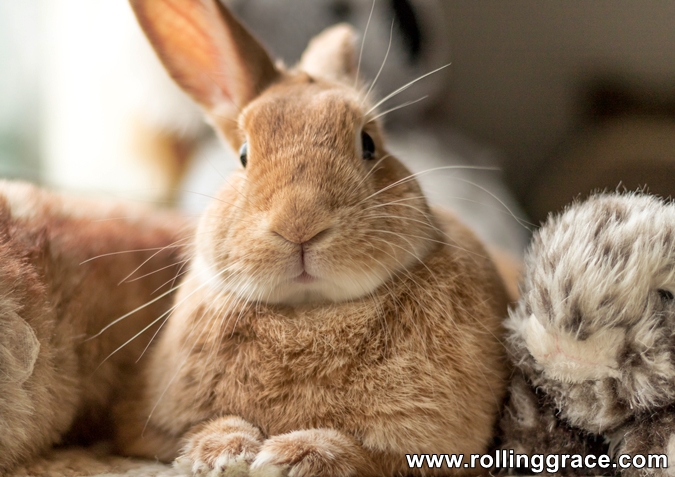
How to Care for a Pet Rabbit Indoors
Indoor living is the recommended default for pet rabbits in Malaysia. The heat, humidity, and presence of stray animals outside make indoor keeping safer and less stressful for the animal. A rabbit kept indoors with access to a safe, open area will be calmer and healthier than one confined to a cage for most of the day.
If a cage is necessary, your rabbit needs a minimum of two to three hours outside it daily. The cage itself should be large enough for the rabbit to stretch fully in all directions and stand upright on its hind legs without its ears touching the top.
Before giving your rabbit access to any room, rabbit-proof it. Cables and wires are the primary hazard. Tuck them away or run them through protective casing, including the ones behind furniture and in corners that look out of reach. Rabbits will find them. A puppy pen is a practical solution if you need to limit your rabbit to a specific zone while still giving it room to move.
Keep the living area away from direct sunlight, loud noise, and high foot traffic. Rabbits feel most secure in a predictable, low-stimulus environment.
How to Care for a Rabbit Outdoors
Outdoor keeping is possible but requires considerably more planning. If your rabbit spends time outside, the enclosure must be fully predator-proof, shaded throughout the day, and positioned away from areas where stray cats or dogs can approach the perimeter. Even the presence of a predator outside the enclosure, without any physical contact, can be enough to cause fatal stress in a rabbit.
Never leave a rabbit outdoors unattended. Bring it inside during the hottest part of the day and during any period of heavy rain. In Malaysia’s climate, outdoor rabbits are at consistent risk of heatstroke; a rabbit showing signs of rapid breathing, lethargy, or wet fur around the nose needs immediate cooling and veterinary attention.
Outdoor enclosures should have a covered section where the rabbit can retreat, a constant supply of fresh water, and flooring that prevents digging out or predators digging in.

Rabbit Diet and Nutrition
For anyone learning how to take care of a rabbit for beginners, diet is where most early mistakes happen. The image of rabbits eating carrots and leafy greens is misleading. Fresh produce should be a minor supplement, not a staple.
Hay is the foundation of a healthy rabbit diet and must be available at all times. Alfalfa hay suits young rabbits; adult rabbits need timothy hay. Hay keeps the digestive system moving and wears down teeth that grow continuously throughout a rabbit’s life. A rabbit that stops eating hay is a rabbit in trouble.
Supplement hay with fibre-loaded pellets and fresh water changed daily. Fruit and vegetables are limited to once a week at most. Overfeeding fresh produce leads to digestive problems that can escalate quickly.
How to Take Care of a Bunny for Kids: Handling and Safety
Teaching children how to take care of a bunny starts with two rules: always sit down before picking a rabbit up, and never chase a rabbit to catch it.
Rabbits feel safest close to the ground. A child holding a rabbit while standing creates a fall risk that can result in serious spinal injury to the animal. Sitting on the floor before picking the rabbit up removes that risk. Children should also be taught to let the rabbit approach them first rather than reaching in to grab it from a hiding spot or a corner.
Supervised interaction only, especially with children under ten. A rabbit that is startled can scratch or bite without warning, and a child who drops a rabbit from surprise can cause lasting damage. Establish clear rules early and hold to them consistently.
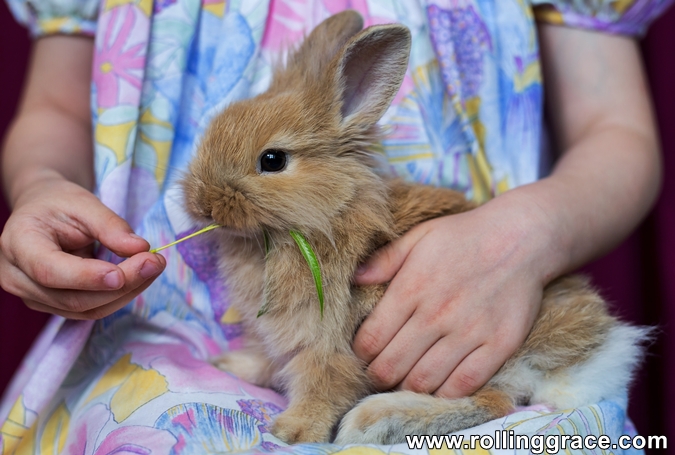
Rabbit Grooming
Rabbits self-groom but still require regular attention. Shedding happens year-round and intensifies during moulting seasons. Brushing your rabbit regularly during these periods reduces the amount of fur being ingested, which left unmanaged can cause potentially fatal digestive blockages.
Nail trimming is required approximately once a month. Overgrown nails catch on surfaces and can break completely, which is painful and occasionally serious. If trimming at home makes you anxious, a rabbit-savvy vet or groomer can handle it during routine visits.
Mental Stimulation and Play
A bored rabbit becomes a destructive rabbit. Cardboard boxes are one of the most effective and low-cost enrichment options; rabbits chew them, push them around, and use them as shelter. Rotate toys regularly to maintain interest. Occasional treats work well for engagement, provided they are organic and free from artificial additives.
A rabbit that has enough mental stimulation throughout the day will be noticeably calmer and more sociable than one left in a bare enclosure with nothing to interact with.
Finding a Rabbit-Savvy Vet
Not all small animal vets are equally experienced with rabbits, and the difference matters in an emergency. Find a vet with specific rabbit experience before you need one, not after. Ask directly about their rabbit caseload when enquiring.
Spaying or neutering is strongly recommended. It reduces aggression in maturing rabbits and significantly lowers the risk of uterine and testicular cancers. Most vets perform the procedure at six months of age, though sexual maturity can begin around four months.
Track your rabbit’s eating, drinking, and excretion patterns daily. Any deviation from normal warrants attention. A rabbit that stops eating for more than a few hours needs same-day veterinary contact.

How to Care for a Rabbit in an Apartment
Apartment living is entirely workable for a pet rabbit, provided the space is set up correctly. The key constraints are noise, temperature, and floor space.
Rabbits are sensitive to sound that travels through walls and floors, which is more of a factor in an apartment building than in a landed property. Position your rabbit’s living area away from shared walls and away from the front door where delivery knocks and foot traffic are unpredictable.
Hard flooring, which is common in Malaysian apartments, can be slippery and uncomfortable for rabbits over long periods. Lay down rubber mats, cork tiles, or grass mats in the areas your rabbit uses most. This protects their joints and gives them better grip when moving at speed.
Temperature control matters more in a high-rise unit where heat builds through the day. Keep the rabbit’s area air-conditioned or well-ventilated, and check the temperature in their space specifically, not just the room thermostat.
A single bedroom apartment can comfortably house one or two rabbits with a puppy pen setup and daily free-roaming time. The limitation is not square footage so much as the consistency of the routine you are able to maintain.
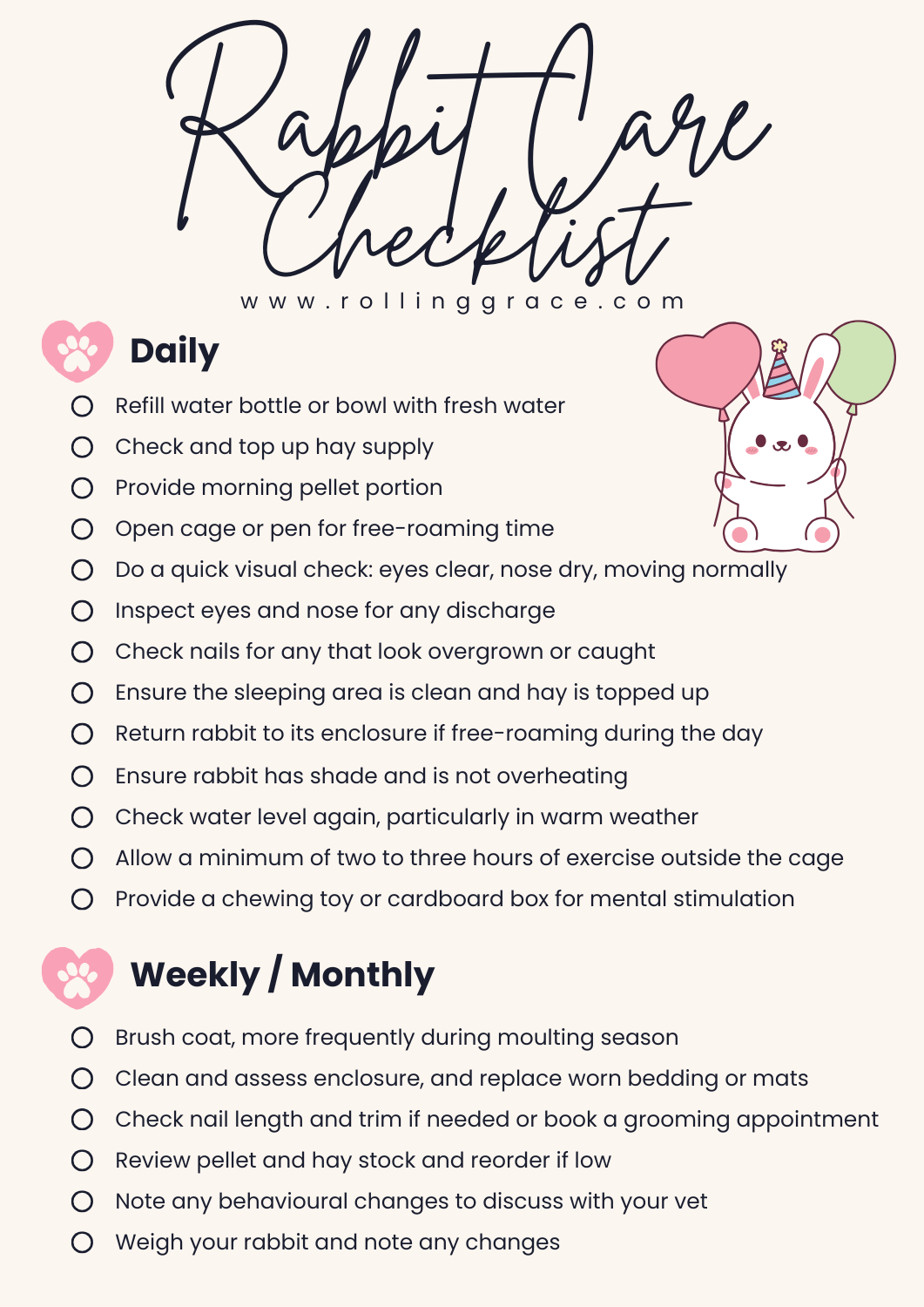
Daily Rabbit Care Checklist
When caring for a pet rabbit, use this checklist every day to keep your rabbit’s health and environment on track. You can download the Rabbit Care Checklist below.
Morning
- Refill water bottle or bowl with fresh water
- Check and top up hay supply
- Provide morning pellet portion
- Open cage or pen for free-roaming time
- Do a quick visual check: eyes clear, nose dry, moving normally
Throughout the Day
- Ensure rabbit has shade and is not overheating
- Check water level again, particularly in warm weather
- Allow a minimum of two to three hours of exercise outside the cage
- Provide a chewing toy or cardboard box for mental stimulation
Evening
- Check droppings: should be round, dry, and consistent in size
- Inspect eyes and nose for any discharge
- Check nails for any that look overgrown or caught
- Ensure the sleeping area is clean and hay is topped up
- Return rabbit to its enclosure if free-roaming during the day
Weekly
- Brush coat, more frequently during moulting season
- Clean the enclosure thoroughly
- Check nail length and trim if needed or book a grooming appointment
- Weigh your rabbit and note any changes
Monthly
- Trim nails if not already done
- Review pellet and hay stock and reorder if low
- Assess enclosure condition and replace worn bedding or mats
- Note any behavioural changes to discuss with your vet
Frequently Asked Questions
- How long do domestic rabbits live? With proper rabbit care, domestic rabbits live between eight and twelve years. Diet, veterinary care, and living conditions all affect lifespan significantly.
- Can rabbits be kept outdoors in Malaysia? When it comes to caring for a pet rabbit, it is not recommended as a permanent arrangement. The heat, humidity, and presence of stray animals make full-time outdoor living stressful. Indoor keeping with supervised outdoor time is the safer option.
- Do rabbits need vaccinations in Malaysia? Rabbit haemorrhagic disease is present in Malaysia. Consult a rabbit-savvy vet about the appropriate vaccination and prevention schedule for your pet.
- Is it better to have one rabbit or two? Two bonded rabbits generally display lower stress levels and more natural behaviour than a single rabbit kept alone. If you are getting your first rabbit, consider adopting a bonded pair from a shelter.
- How do I know if my rabbit is sick? Changes in eating, drinking, or excretion patterns are the most reliable early indicators. A rabbit that stops eating hay or pellets for more than a few hours needs same-day veterinary attention.
For more content related to animals, explore the Rolling Grace animal category at https://rollinggrace.com/category/animals
Get the good stuff first. Join Rolling Grace for the restaurants worth crossing a city for, the stays worth the upgrade, and the places to go before everyone else. Free, straight to your inbox.
Leave a Reply