Most people who eat meat have never seen the inside of a slaughterhouse, and the industry has spent considerable effort ensuring that remains the case. What happens between a living animal and a packaged cut of meat is a process that is deliberately kept out of sight, and for the most part, out of conversation.
This is not an article designed to make you feel guilty about what you eat. It is an attempt to close the gap between consumption and reality, because understanding where food comes from is part of eating responsibly, whether or not it changes what ends up on your plate.
Industrial slaughter operates at a scale that is difficult to comprehend. Billions of animals pass through these systems each year under conditions shaped by speed and volume rather than welfare. What follows is an honest account of the methods most commonly used, and what they mean for the animals involved.
This article explores how animals are killed for meat consumption.
Read also: Paradise Lost: The Alarming Impact of Sea Pollution in Thailand
Table of Contents
How Slaughterhouses Work
The meat industry operates on a massive scale, with billions of animals slaughtered annually to satisfy global demand. Behind the sanitised packaging in grocery stores lies a grim reality of systematic violence against defenceless creatures. From factory farms to slaughterhouses, animals endure horrific conditions and agonising deaths, all for the sake of human appetite.
Lifting the veil on these practices is crucial for making informed choices about our food sources. By understanding the true cost of meat production, we can confront the ethical dilemmas it presents and potentially inspire more compassionate and sustainable alternatives. This content delves into the harsh methods employed to kill various animals for meat consumption, exposing the disturbing truth that has been largely concealed from public view.
How Cows are Killed in Slaughterhouses
Cows are stunned at the start of the slaughter process, typically with a captive bolt gun fired into the skull. When it works, the animal loses consciousness immediately. When it does not, which happens more often than the industry acknowledges, the cow is shackled by a hind leg, hoisted upside down, and has its throat cut while aware of what is happening.
The bleed-out that follows is not instantaneous. The animal hangs inverted as blood drains from the severed carotid arteries and jugular veins, a process that takes several minutes. During this window, cows that were inadequately stunned may regain consciousness, experiencing the full weight of the process before death finally occurs.
Cattle are large, long-lived animals with strong social bonds and a well-documented capacity for fear and distress. The conditions of industrial slaughter, the noise, the smell of blood, the handling, register acutely. The system is not designed around minimising that. It is designed around minimising time.

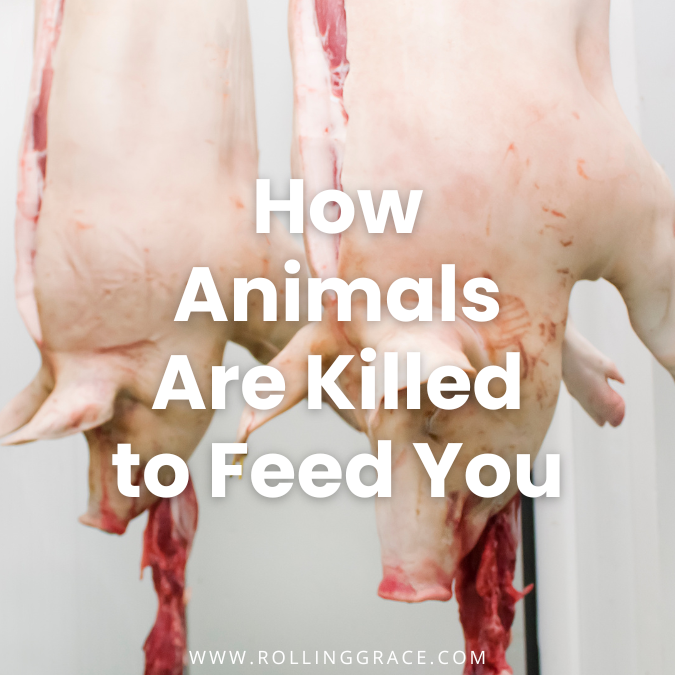
How Are Pigs Slaughtered
Pigs are among the most intelligent animals raised for food, with cognitive abilities comparable to dogs. That makes what happens to them in industrial slaughter facilities harder to set aside.
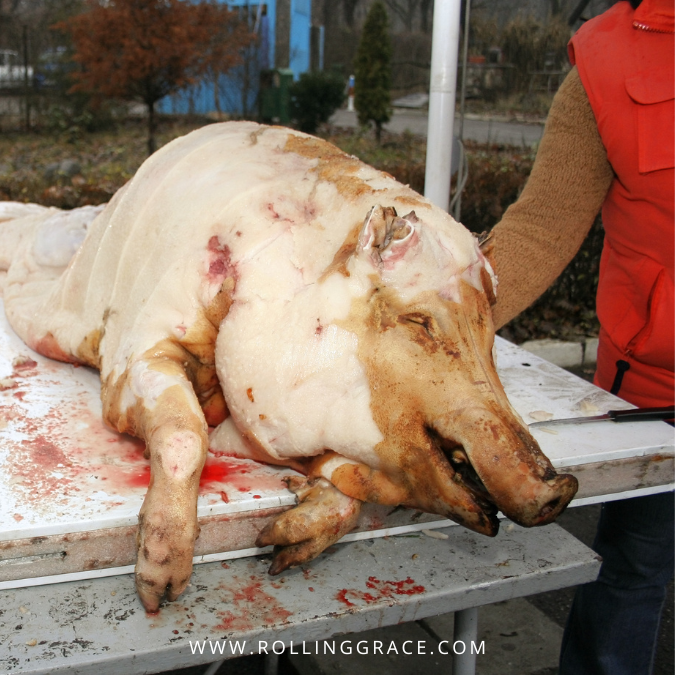
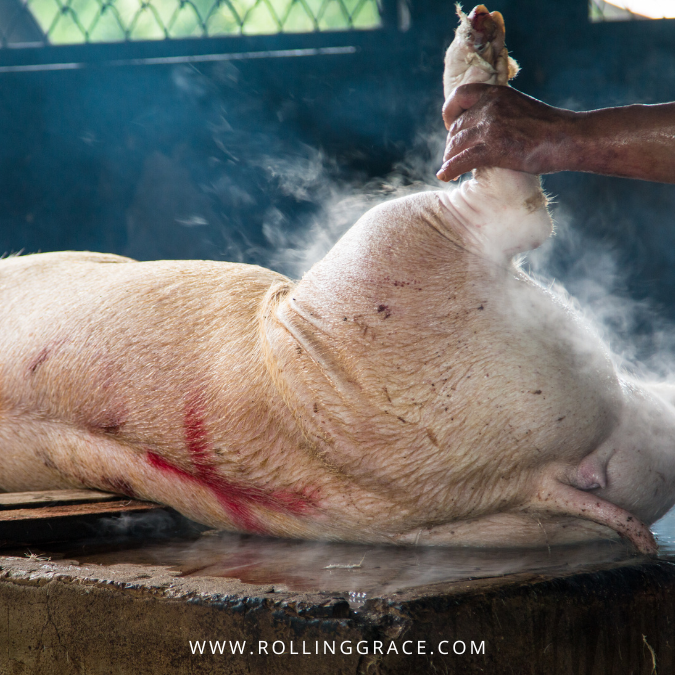
At large-scale slaughterhouses, pigs are moved from holding pens through narrow chutes and stunned, most commonly with a captive bolt gun. Stunning is inconsistent. Pigs that are inadequately stunned are shackled by their hind legs, hoisted, and have their throats cut while conscious, bleeding out over several minutes. Some regain consciousness during this process and are scalded alive in the next stage of processing, a step designed to remove bristles from the carcass.
The suffering is not incidental. It is a predictable outcome of a system built around throughput, where the speed of the line takes precedence over whether the animal in front of you is actually dead.
How Sheep & Goats are Killed
Sheep and goats are typically stunned before slaughter using a captive bolt gun or electrical stunning, though neither method is consistently effective. Animals that are inadequately stunned remain conscious through the process that follows, including having their throats cut and bleeding out. In halal slaughter, stunning is not always applied, and the animal’s throat is cut while fully conscious, a process that can take several minutes before death occurs.
Even where stunning is effective, the handling that surrounds it causes significant distress. Animals are shackled by their hind legs and hoisted upside down before slaughter, a position that is deeply distressing for prey animals with a strong instinct for flight. The bleed-out that follows is not instantaneous.
Abattoir conditions compound the suffering. Overcrowding, noise, and the presence of blood from animals slaughtered before them mean that sheep and goats are in a state of acute stress well before they reach the kill floor.

Slaughter of Poultry: Chickens, Turkeys, and Ducks
Poultry accounts for the largest share of animals slaughtered for meat globally. Chickens alone number in the tens of billions killed each year, a scale that makes individual suffering easy to abstract and easier still to ignore.
Most birds spend their lives in overcrowded sheds with inadequate ventilation, limited light, and floor space that does not allow normal movement. By the time they reach slaughter weight, many are already suffering from leg deformities, respiratory disease, and infections caused by living in close contact with their own waste. Transport to the abattoir, often over long distances without food or water, adds further distress to animals already in poor condition.
At the slaughter facility, birds are shackled upside down by their legs and moved along a line toward either an electrified water bath or a mechanical blade. Stunning failure rates in poultry are high. Birds that are not effectively stunned have their throats cut or enter scalding tanks for feather removal while conscious.
Under halal and kosher requirements, slaughter without prior stunning is permitted, meaning the throat is cut on a fully conscious bird. At the volumes involved, even a small percentage of failed stuns translates to millions of animals experiencing the full process awake.

Does Stunning Animals Reduce Suffering?
Stunning is the meat industry’s primary answer to the question of animal suffering at slaughter. The principle is straightforward: render the animal unconscious before killing it. The reality is less clean.
Captive bolt guns, used on cattle and pigs, fire a metal rod into the skull to induce immediate unconsciousness. Electrical stunning passes current through the brain. Both methods fail regularly. Poorly maintained equipment, inadequate training, high line speeds, and animals that move at the wrong moment all contribute to incomplete stunning. An animal that has been inadequately stunned is shackled, hoisted, and has its throat cut in a state somewhere between unconscious and fully aware. There is no pause in the process to check.
The deeper problem is that stunning was designed to make slaughter more palatable, not necessarily more humane. Its effectiveness depends entirely on conditions that industrial facilities are not structurally incentivised to maintain. Welfare, in a system built around volume and speed, will always come second. Stunning does not resolve that. It papers over it.
Controversies of Halal Slaughter Methods
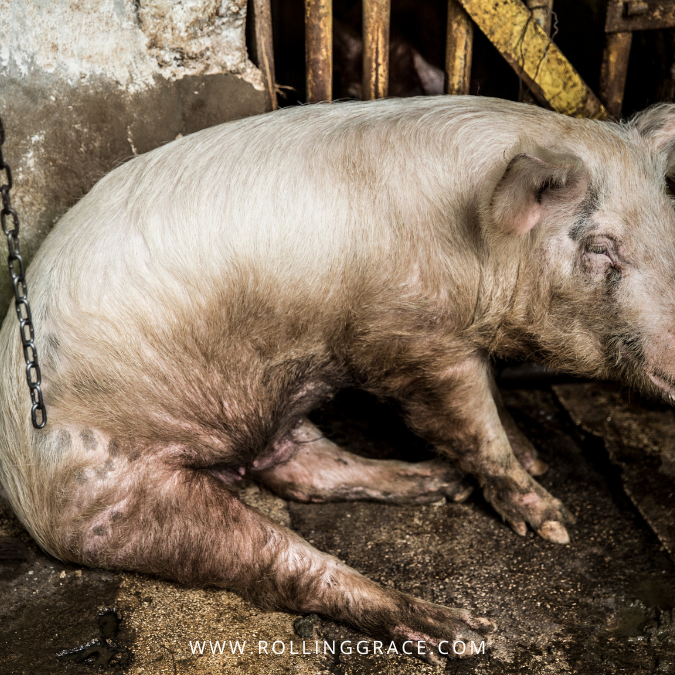
Halal slaughter requires the throat of a conscious, unrestrained animal to be cut with a single stroke of a sharp blade, severing the carotid arteries, jugular veins, and windpipe. Proponents argue that a swift, clean cut causes rapid loss of consciousness through blood pressure drop. The evidence does not consistently support this. Studies measuring brain activity in animals slaughtered without prior stunning show that some remain conscious and responsive to pain for up to two minutes after the cut.
The absence of stunning is the central welfare concern. In conventional slaughter, animals are rendered unconscious before their throats are cut. In halal slaughter as practised in many facilities worldwide, they are not. The animal is aware of the restraint, the cut, and the bleeding out that follows.
The argument that halal slaughter is humane when performed correctly is technically true in the narrowest sense. At scale, in industrial facilities processing thousands of animals a day, it is rarely performed under the conditions that argument assumes. Suffering is not the exception. It is a structural outcome of the method.
How Animals Are Killed for Meat
The global meat industry processes billions of animals each year behind closed doors. Before they reach the slaughter floor, animals endure overcrowded transport, extreme temperatures, and deprivation of food and water. Once inside the facility, rough handling, failed stunning, and high-speed lines mean that many are conscious when their throats are cut or when they enter scalding tanks. The suffering does not begin at the kill. It begins much earlier.
Common slaughter methods include captive bolt stunning, electrical stunning, and throat-slitting. All are intended to minimise pain. In practice, poor training, faulty equipment, and pressure to keep the line moving mean they frequently do not. An animal inadequately stunned is an animal that feels what comes next. At the volumes the industry operates, that is not an edge case. It is a daily reality.

Ethical Alternatives to Industrial Animal Agriculture
Plant-based Meat
The cruel practices of industrial animal agriculture have rightly raised ethical concerns among conscientious consumers. However, there are viable alternatives that align with compassionate values while meeting our nutritional needs.
Plant-based diets, which eliminate animal products entirely, have gained significant traction in recent years. By embracing a diverse array of plant-based whole foods, including legumes, grains, fruits, and vegetables, individuals can obtain all the essential nutrients required for optimal health.
Sustainable Farming
Furthermore, sustainable farming practices that prioritise animal welfare and environmental stewardship offer a more humane approach to food production. Regenerative agriculture, for instance, focuses on enhancing soil health, biodiversity, and animal well-being through holistic management practices. Small-scale, pasture-raised animal farming, where animals are allowed to roam freely and exhibit their natural behaviours, represents a stark contrast to the confined and inhumane conditions prevalent in industrial animal agriculture.
By consciously choosing ethical alternatives, we can collectively contribute to a more compassionate and sustainable food system, one that respects the inherent dignity of all living beings while safeguarding the planet for future generations.

Reality Behind How Animals Are Killed for Meat
Despite claims of humane practices, the reality is far from it. Improper stunning techniques, such as captive bolt guns or electrical stunning, frequently fail to render the animals unconscious before slaughter. This means that many animals experience excruciating pain and terror as their throats are slit or their bodies are dismembered while still conscious.
Moreover, the methods used in halal and kosher slaughter, which involve cutting the animal’s throat without prior stunning, have been widely criticised by animal welfare organisations for causing unnecessary suffering. As the animals bleed out, they experience prolonged agonising deaths, often thrashing and gasping for air.
It’s time to confront the harsh truth and demand accountability from the meat industry. By raising our voices and supporting ethical, cruelty-free alternatives, we can create a more compassionate and sustainable future for all beings.
Get the good stuff first. Join Rolling Grace for the restaurants worth crossing a city for, the stays worth the upgrade, and the places to go before everyone else. Free, straight to your inbox.
Leave a Reply