The Puputan War in Bali is the story of a kingdom that looked at certain defeat and chose, deliberately and with full conviction, to die on its own terms rather than live on someone else’s.
The Puputan War is not a single battle. It is a sequence of five mass ritual last stands, spanning more than a century of Balinese resistance to colonial rule, from the first Dutch military intervention in northern Bali in the 1840s through to the final colonial-era confrontation at Klungkung in 1908.
The two most significant puputans, at Badung in 1906 and Klungkung in 1908, ended the last independent kingdoms in southern Bali and sealed Dutch control of the entire island.
Read also: Nyepi Day in Bali: 9 Reasons to Experience the Day of Silence
Table of Contents
Background of Puputan War
The word puputan comes from the Balinese puput, meaning to end or to finish. As a concept, it describes a last stand: a deliberate, ceremonial choice to fight to the death rather than surrender. For the Balinese, surrender to a foreign power was not merely defeat. It was a form of spiritual disgrace.
Dressed in white cremation clothes, armed with traditional kris daggers, the royal families and their followers walked into Dutch artillery fire. The Dutch soldiers, by most accounts, did not know what to do with what they were seeing.
Dutch Colonial Expansion in Bali
The Dutch had been attempting to consolidate control over Bali for decades before 1906. The Netherlands had conquered northern Bali by the mid-19th century, absorbing the kingdoms of Jembrana, Buleleng and Karangasem into the Dutch East Indies after three military campaigns between 1846 and 1849. The southern kingdoms of Badung, Tabanan and Klungkung had remained independent. Various disputes continued, and the Dutch were widely expected to intervene militarily once a suitable pretext presented itself.
That pretext, as it had been multiple times before, involved shipwrecks. The Balinese kingdoms practised tawan karang, the customary right to salvage goods from ships wrecked on the reefs surrounding the island. The Dutch, operating under international maritime law, considered this practice looting. The dispute came to a head on 27 May 1904, when a Chinese-flagged ship named Sri Kumala, owned by a Dutch subject, ran aground on the reef off Sanur beach. The Dutch accused the Raja of Badung of looting the cargo and demanded compensation of 3,000 ringgit. The Raja refused.
Negotiations dragged on for two years. In October 1905, the Governor-General of the Dutch East Indies, Joannes Benedictus van Heutsz, wrote to the Minister of Colonies recommending direct action to remind the Raja of Badung that the Netherlands was the rightful authority. On 20 September 1906, a force of the Royal Dutch East Indies Army, designated the Sixth Military Expedition and under the command of Major General M.B. Rost van Tonningen, landed at the northern part of Sanur beach.

The Badung Puputan War, 20 September 1906
The Dutch force advanced inland from Sanur with minimal resistance. At Kesiman, the local king, a vassal of the Raja of Badung, had already been killed by his own priest after refusing to lead armed resistance against the Dutch. The palace was in flames and the village abandoned when the Dutch arrived. The force then marched on Denpasar.
What happened next shocked Western observers in a way that would reverberate through European political discourse for years. Rather than fight a conventional defence or negotiate terms, the Raja of Badung, I Gusti Gde Ngurah Den Pasar, led the entire royal court in a puputan war. Dressed in white cremation clothes, carrying kris daggers and traditional spears, the procession emerged from the palace in Denpasar. When the column halted approximately one hundred paces from the Dutch force, the Raja descended from his palanquin and signalled to a priest, who drove a dagger into the Raja’s chest. The rest of the procession began killing themselves and each other.
Women threw gold jewellery and coins at the Dutch soldiers. What the Dutch later described as a stray gunshot and a spear attack prompted them to open fire with rifles and artillery. As more people emerged from the palace, the dead accumulated. Estimates of the Balinese killed at Badung range from several hundred to over a thousand. That afternoon, a second puputan war occurred at the nearby palace of Pemecutan. The Dutch looted and razed both palaces.
The king of Tabanan surrendered two days later, then took his own life in prison when the Dutch refused to offer him anything other than exile to Madura or Lombok.
The Klungkung Puputan, 18 April 1908
Two years later, the Dutch moved against Klungkung, the nominal capital of all Bali and the seat of Dewa Agung Jambe II, who held the title of Susuhunan of Bali and Lombok. The immediate pretext this time was a Balinese revolt against a Dutch attempt to impose an opium monopoly. Riots erupted in Gelgel, where Balinese killed a Javanese opium dealer. The Dutch sent troops, killing approximately 100 Balinese in the process and forcing the Raja of Karangasem to flee to Klungkung. The Dutch then bombarded the city.
On 18 April 1908, Dewa Agung Jambe II led approximately 200 followers out of Klungkung Palace, dressed in white and carrying a legendary kris believed, according to a prophecy, to bring destruction upon any enemy. The Raja was shot by a Dutch bullet. His six wives immediately took their own lives, followed by the rest of the procession. The puputan war was over in minutes. With Klungkung’s fall, all of Bali was under Dutch control for the first time in the island’s history.
What Puputan Means
The Balinese term puputan has been translated in various ways: fight to the death, ritual mass suicide, final stand. All of these are accurate in part. The key element is the choice involved. The Balinese who committed puputan were not fighting because they believed they could win. They were making a deliberate statement about the terms on which they were prepared to die.
According to Balinese Hindu belief, the manner of death has consequences for the soul. A death in battle, clothed in ceremonial white, was spiritually preferable to the humiliation of surrender, exile and subjugation under a foreign power. The ritual elements were precise: the white clothes, the kris, the priest’s role in the Raja’s death at Badung. These were not spontaneous acts of despair. They were ceremonial performances of a specific cultural and religious value.
The Dutch, by their own accounts, found them deeply disturbing. Reports of the 1906 and 1908 events spread rapidly to European media and prompted serious political criticism of the Netherlands colonial administration. The image of the Dutch as a benevolent and responsible colonial power, which the 1901 Ethical Policy had been designed to project, was significantly damaged.
The Puputan Margarana, 20 November 1946
The colonial era ended for Bali in 1945 when Japan, which had occupied the island from 1942, surrendered to the Allies. Indonesia declared independence on 17 August 1945. The Dutch, however, attempted to reassert control under the Netherlands Indies Civil Administration, landing 2,000 troops in Bali in March 1946.
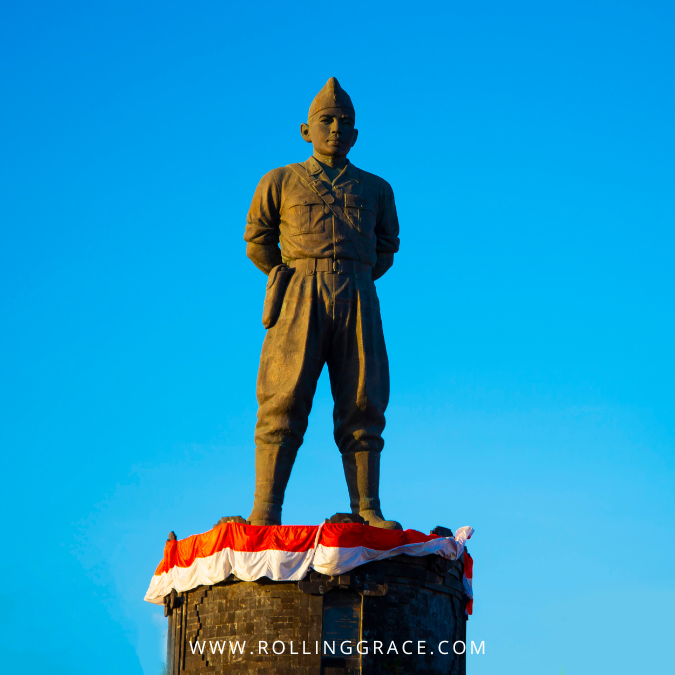
Colonel I Gusti Ngurah Rai, born on 30 January 1917 in Carangsari, Badung, had received Dutch military training at the military cadet school in Gianyar and at Magelang in Central Java. After independence, he formed the People’s Security Army for the Lesser Sunda Islands, which became the Ciung Wanara Battalion. He rejected a Dutch invitation to cooperate and instead led guerrilla operations across the island. On 20 November 1946, surrounded by Dutch KNIL forces at Marga in Tabanan, Ngurah Rai commanded his remaining 95 men in a final puputan war. The battle ran from 8.00am to 5.00pm. Ngurah Rai and all 95 of his men were killed. Dutch casualties were approximately 400.
Ngurah Rai was 29 years old. He was declared a National Hero of Indonesia in 1975. Bali’s international airport bears his name.
The Puputan Margarana is commemorated annually on 20 November. The memorial park at Marga, Taman Makam Pahlawan Margarana, contains individual monuments to each of the 1,372 fighters involved in the broader independence struggle in Bali, along with a cemetery and museum.
The Legacy of Puputan in Balinese Culture
The puputans are remembered in Bali not primarily as tragedies, though they were that, but as acts of honour. The Badung Puputan monument, a large bronze sculpture in the central square of Denpasar known as Lapangan Puputan Badung, depicts Balinese warriors advancing in procession. It stands on the site where the royal palace once stood. The anniversary of the Badung Puputan is commemorated annually on 20 September.
A separate monument at Klungkung, featuring a towering lingam-yoni form, marks the 1908 event. Both sites function as civic memorials and active gathering places, not museum pieces. The language of puputan, the idea of choosing honourable death over shameful surrender, appears throughout Balinese cultural identity to the present day.
The colonial consequences of 1906 and 1908 were paradoxical. The harshness of the Dutch campaigns generated such international criticism that the Netherlands felt compelled to make amends by actively preserving Balinese culture rather than suppressing it. Bali was opened to tourism in 1914. Western artists, scholars and writers began arriving in the 1920s. The romanticised image of Bali as an untouched paradise that drives the island’s tourism economy today was in significant part constructed by Dutch colonial image management following the very events that destroyed the island’s royal houses.

Visiting Puputan Sites in Bali
Lapangan Puputan Badung, Denpasar
The central square of Denpasar occupies the site of the former royal palace of Badung. The bronze monument at its centre depicts the 1906 puputan procession. It is surrounded by Bali’s provincial museum, the state secretariat and several significant temples, making it one of the most historically layered public spaces in Indonesia. Open at all times as a public square.
Puputan Klungkung Monument, Semarapura
Located in the town of Semarapura (formerly Klungkung) in eastern Bali, approximately 40 kilometres from Denpasar. The monument marks the site of the 1908 puputan war and sits adjacent to the Kertha Gosa, the historic Hall of Justice of the Klungkung kingdom, which survived the Dutch bombardment.
Taman Makam Pahlawan Margarana, Marga, Tabanan
The memorial park and cemetery for the Puputan Margarana of 1946, located in the village of Marga in Tabanan Regency, approximately 20 kilometres north of Denpasar. The site includes a museum, individual monuments to 1,372 independence-era fighters, and the graves of those killed on 20 November 1946. Open daily from 8.00am to 5.00pm.
Museum Negeri Propinsi Bali, Denpasar
The Provincial Museum of Bali contains a permanent collection that includes weapons, photographs and documentation from the puputan period. Located adjacent to Lapangan Puputan Badung.
Planning a Visit
Best Time to Visit Bali
The dry season from April to October offers more reliable weather for outdoor sites and travelling between locations. The period from November to March brings heavier rain, which can complicate transport in Tabanan and Klungkung. The commemorations at Lapangan Puputan Badung on 20 September and at Marga on 20 November draw significant local gatherings and are worth attending if your schedule permits.
How to Get Around Bali
The Denpasar sites are within walking distance of each other. Klungkung and Marga require transport; a hired car and driver for a full day is the most practical option for visiting all three in one itinerary. Expect to pay between RM150 and RM250 equivalent (approximately IDR 500,000 to 800,000) for a full day’s hire with a knowledgeable driver.
What to Wear in Bali
Modest clothing is appropriate at all memorial and temple-adjacent sites. Bring a sarong and sash for entry to any temple precincts adjacent to the monuments.
Rolling Grace covers culture, travel and history across Asia. For more on Indonesia travel, visit rollinggrace.com/indonesia-travel-guide.
Get the good stuff first. Join Rolling Grace for the restaurants worth crossing a city for, the stays worth the upgrade, and the places to go before everyone else. Free, straight to your inbox.
Leave a Reply