If you are searching for Rafflesia in Malaysia, the short answer is: several states, no guarantees, and always call ahead.
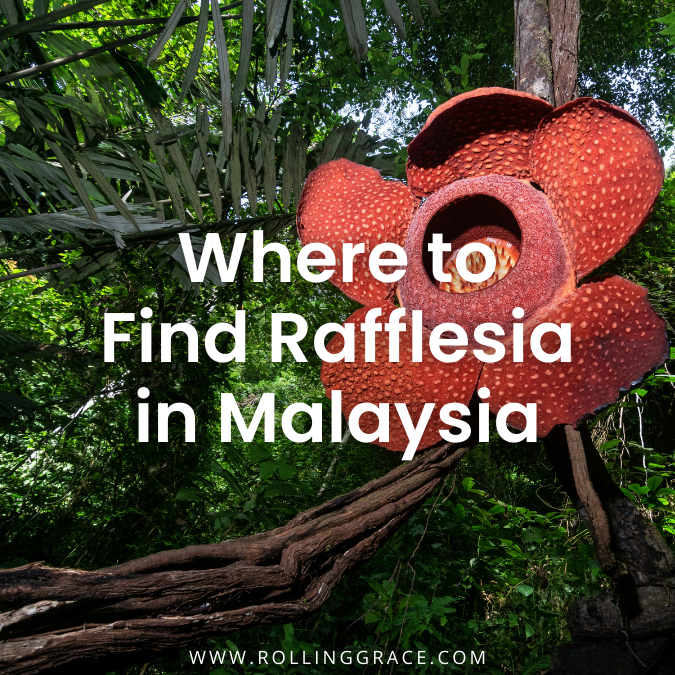
The bud looks like a cabbage. It sits on the forest floor for up to nine months, swelling almost imperceptibly, with no stem, no leaves, no roots. Then, for four to five days, it opens into something extraordinary: a fleshy, five-lobed flower that can measure close to one metre across and weigh up to ten kilograms. It smells, quite deliberately, of rotting flesh. And then it collapses into black pulp.
Here is where to find Rafflesia in Malaysia, and what to expect when you get there.
Read also: Mabul Island Sabah: Meet 2,000 Bajau Laut in Kampung Mabul
Table of Contents
Discovering Rafflesia in Malaysia
The Rafflesia is the largest single flower on earth. It is also one of the most difficult to find.
Malaysia holds the densest concentration of Rafflesia species anywhere in Southeast Asia, with at least thirteen confirmed species scattered across Peninsular Malaysia, Sabah and Sarawak. Six can be found on the peninsula alone. Sabah has three. Sarawak has four, including Rafflesia tuan-mudae, which is endemic to Gunung Gading National Park.
Seeing one in bloom is a matter of timing, preparation and a reasonable amount of luck, as the flowers give no warning, blooms last only days, and 60 per cent of buds never open at all.
Gunung Gading National Park, Sarawak
The park most visitors associate with Rafflesia watching is Gunung Gading, located near the town of Lundu in Southwest Sarawak, roughly an hour and a half’s drive from Kuching.
It is home to Rafflesia tuan-mudae, a species endemic to this park, with blooms typically measuring between 50 and 70 centimetres in diameter. A dedicated Rafflesia Trail runs from the park headquarters along a plankwalk through forest where flowers frequently emerge. Young buds can be spotted scattered across the forest floor even when nothing is in bloom.
The park opened to visitors in 1983 and became particularly well-known for Rafflesia watching as conservation efforts took hold over the following decades. Today it is often described as one of the best places in Asia to witness the flower, and it remains the most logistically accessible of Malaysia’s Rafflesia sites for international visitors travelling from Kuching.

The catch is that no bloom is ever guaranteed so calling ahead to the park headquarters is strongly advised before making the trip. Entry fees are RM20 per person for non-Sarawakians (RM10 for Sarawakians), with a guide fee of approximately RM30 if you want to be led directly to a blooming flower. The park opens daily from 8.00am to 5.00pm.
Beyond the Rafflesia, the park offers a full trail network from the waterfall circuit to the Gunung Gading summit at 965 metres, which takes three to four hours return. Basic overnight accommodation is available, including chalets from RM150 per night, hostel beds from RM15, and camping at RM5 per person. There are no food stalls inside the park; stock up in Lundu before heading in.
- Address: Gunung Gading National Park, 94500 Lundu, Sarawak
- Contact: +6082-735 144
- Opening hours: 8.00am to 5.00pm daily
Kampung Ulu Geroh, Perak
Of all the Rafflesia sites in Peninsular Malaysia, Ulu Geroh has the highest recorded concentration of flowers. Researchers from the Malaysian Nature Society, who helped establish community-based ecotourism here in the early 2000s, describe the site as the peninsula’s most reliable location for Rafflesia cantleyi sightings. The species produces flowers up to 55 centimetres across, with thick, rubbery petals that emerge startlingly close to the forest floor.
Ulu Geroh is not a park. It is a working Semai Orang Asli settlement, about 12 kilometres from the town of Gopeng in Perak’s Kinta Valley, and the entire operation runs on community-managed ecotourism coordinated by SEMAI, Sahabat Eko-Pelancongan Memuliharaan Alam Indah, or Friends of Ecotourism and Conservation.
Guides are Semai community members with detailed knowledge of where buds are developing at any given time. Visits to see the Rafflesia are typically organised when blooms are imminent, sometimes with only two or three days’ notice.

The trail is described as moderately difficult: a sustained elevation gain of around 45 degrees, with river crossings and stretches of slippery mud. Wear long trousers and shoes you are prepared to lose. Leech socks are worth bringing. The forest also holds Rajah Brooke’s Birdwing butterfly, Malaysia’s national butterfly, which feeds on minerals near the limestone outcrops by the river. It stands among the places known for rafflesia in Malaysia.
- Nearest town: Gopeng, Perak (approximately 175km from Kuala Lumpur)
- Contact number: +6016 454 7245
- Tour operators: Riverbug Perak, Nature Inspired, Ventrex Outdoor and Recreation
Tambunan Rafflesia Information Centre, Sabah
About one to two hours south of Kota Kinabalu, the Tambunan Rafflesia Information Centre manages documented bud plots in the surrounding forest, giving visitors a more structured way to track active flowers. Because the team monitors buds throughout the year, there is a better chance here than at most sites of finding something close to bloom, though the flower’s four-to-five-day lifespan still makes timing unpredictable.
The terrain requires trekking shoes and appropriate clothing. A licensed guide costs approximately RM100, and there is a photography fee of RM5 on top of the RM5 entrance charge. The centre opens from 8.00am to 3.00pm.
Sabah is home to three Rafflesia species: Rafflesia keithii (found mainly in the lowlands), Rafflesia pricei (in the highlands) and Rafflesia tengku-adlinii, the rarest of the three. In August 2024, a new population of R. tengku-adlinii was discovered in the Bukit Monkobo and Bukit Mentapok Forest Reserves, a significant find, as the species had previously only been recorded in the Trus Madi Range and Maliau Basin. It is one of the spots to visit for rafflesia in Malaysia.
- Address: 500, 89650 Tambunan, Sabah
- Contact: +6088-899 589
- Opening hours: 8.00am to 3.00pm
Poring Hot Springs, Sabah
Most visitors come to Poring for its outdoor hot spring baths and the suspension canopy walkway above the jungle. Rafflesia watching is a secondary draw, but the Rafflesia Blooming Observation centre within the complex has made sightings accessible, and visitors no longer need to trek deep into the forest to reach a documented bloom site.
Poring falls within the Kinabalu Park buffer zone and is operated by Sabah Parks. Entrance fees for Malaysians begin at RM10 per adult for the conservation area, and RM15 for access to the Rafflesia Blooming Observation specifically. The species most likely to be in bloom here is Rafflesia keithii.
The complex offers a range of accommodation, from hotels to lodges and villas, making it a reasonable overnight base if you are also planning to visit Kinabalu Park. It is one of the best places where visitors can see rafflesia in Malaysia.
Note: Fees and access arrangements at Poring are managed through Sabah Parks and are subject to change. Confirm current pricing at the time of booking.
- Address: Poring Hot Spring, 89300 Ranau, Sabah
- Contact: +6088-523 500
- Opening hours: 8.00am to 3.00pm

Crocker Range Biosphere Reserve, Sabah
The Crocker Range stretches along Sabah’s west coast and encompasses some of the most biodiverse forest on the island of Borneo. Rafflesia keithii has been recorded here, and the range’s status as a UNESCO Biosphere Reserve (declared in 2014) provides an added layer of conservation protection for the species.
Access to the reserve for Rafflesia spotting is best arranged through the Tambunan area, where facilities and guides are more established. Entry fees are modest at RM3 per person, with camping charges of RM5 for adults and RM1 for those under 18. This is one of the more affordable entry points to Sabah’s Rafflesia sites, and remains one of the locations known for rafflesia in Malaysia.
- Address: West coast of Sabah, accessible via Tambunan
- Contact: +6088-523 500
Lojing Highlands, Kelantan
Less visited than the Perak or Sarawak sites, Lojing Highlands in southern Kelantan holds one of the largest known concentrations of Rafflesia kerri in the world. The Kelantan state government gazetted 500 hectares of land here for Rafflesia conservation in 2011; a survey conducted earlier that year identified 26 distinct populations within the statelands alone.
Rafflesia kerri is substantial: thick, rubbery petals in deep red, with blooms that have been recorded at 50 centimetres and above. It takes approximately nine months from bud to flower, and there is no specific blooming season. Local operators in Lojing offer guided walks, which can be arranged through operators who also serve Cameron Highlands visitors. The two areas are geographically close, and combined itineraries are possible.
The forest here is hill dipterocarp and sub-montane, with the Lojing Forest Reserve and Sungai Brooke Forest Reserve forming the conservation backbone of the area. Guides are local, knowledgeable and worth engaging. This is not a site to navigate independently.
Book Lojing Nature Excursion to see Rafflesia here.

Royal Belum, Perak
Rafflesia has been recorded in the Royal Belum State Park and the wider Belum-Temeggor Forest Complex, though sightings here are less predictable than at dedicated Rafflesia sites.
Royal Belum is better known for its hornbill populations, with all ten Malaysian hornbill species recorded in the park, and for river-based wildlife excursions. Rafflesia spotting is possible through a guided river and trekking excursion, typically arranged through Belum Rainforest Resort.
Best Time to Visit
There is no fixed season to see Rafflesia in Malaysia. The plant operates on its own schedule: nine months of near-invisible growth inside its host vine, followed by a bloom window of four to five days, with 60 per cent of buds failing before they open. Some sources suggest slightly higher activity during the wetter months, but no month offers a reliable guarantee.
The practical approach is to check in with your chosen site two to four weeks before you plan to visit. Most Rafflesia sites now maintain Facebook pages where staff post bloom updates as soon as flowers begin to open. Call ahead. Be flexible. If nothing is in bloom, the forests at every one of these sites are worth the trek on their own terms.
How to Plan Your Visit
- Can I take photographs? At most sites, yes. Some charge a small camera fee (Tambunan is RM5). Use natural light; flash can disturb the flower’s delicate surface.
- What should I wear? Long trousers, covered shoes with grip, insect repellent. Leech socks are recommended at Ulu Geroh and Lojing. Leave the hiking boots at home for Ulu Geroh. Rubber kampung shoes, available locally for under RM10, handle the mud better.
- Is there a guarantee I will see a bloom? No. This is the honest answer, and it is worth setting expectations before you book transport or accommodation. The best way to improve your odds is to confirm with the site before departure and to choose sites with active monitoring programmes. Tambunan and Ulu Geroh are the two most consistent.
- Is the flower dangerous? No. It is a parasite on a vine, not on people. The smell can be strong at close range but dissipates quickly in open forest.
Conservation of Rafflesia Flowers
Rafflesia in Malaysia is under real pressure. Habitat loss from logging and land conversion reduces the availability of its host vine, Tetrastigma, without which no Rafflesia can survive. The plant cannot be cultivated, cannot be transplanted, and does not grow in captivity. Every bloom you see in the forest is the product of nine months of slow, precarious development, and 60 per cent of buds do not make it.
The most meaningful way to engage with these sites is to book through established community or conservation operators, particularly at Ulu Geroh and Lojing, where ecotourism revenue directly funds the Semai community’s ability to monitor and protect the flower’s habitat. Do not collect any part of the plant, including the bud.
Rolling Grace is an editorial travel and lifestyle publication based in Kuala Lumpur. For the latest on Malaysia travel, visit rollinggrace.com/malaysia-travel-guide.
Get the good stuff first. Join Rolling Grace for the restaurants worth crossing a city for, the stays worth the upgrade, and the places to go before everyone else. Free, straight to your inbox.
Leave a Reply