Most people know Nagano as the city that hosted the 1998 Winter Olympics. What they do not know is that the northern half of the prefecture, an area called Kitashinano, holds more variety per square kilometre than almost anywhere else in Japan.
You can stand inside a 7th-century temple that houses a Buddhist statue nobody has ever seen, lie on your back staring up at a Hokusai phoenix painted when the artist was 89, watch wild macaques soak in a volcanic hot spring, then finish the day drinking sake brewed with snowmelt water from a family operation that has been running for seven generations.
Here are the 8 best things to do in Nagano that made the trip worth every train ticket. Buy JR Pass East Japan Rail Pass.
Read also: 5 Best Hot Springs in Beitou, Taipei for Ultimate Relaxation
What is Nagano Famous For?
The best things to do in Nagano stretch across eight towns and villages in the Kitashinano region, from the 1,400-year-old Zenkoji Temple in the city centre to sake breweries in heavy-snowfall Iiyama and wild monkey hot springs in Yamanouchi.
Most can be reached by train or bus from Nagano Station, and a three to four day trip covers everything comfortably.
Buy JR Pass East Japan Rail Pass

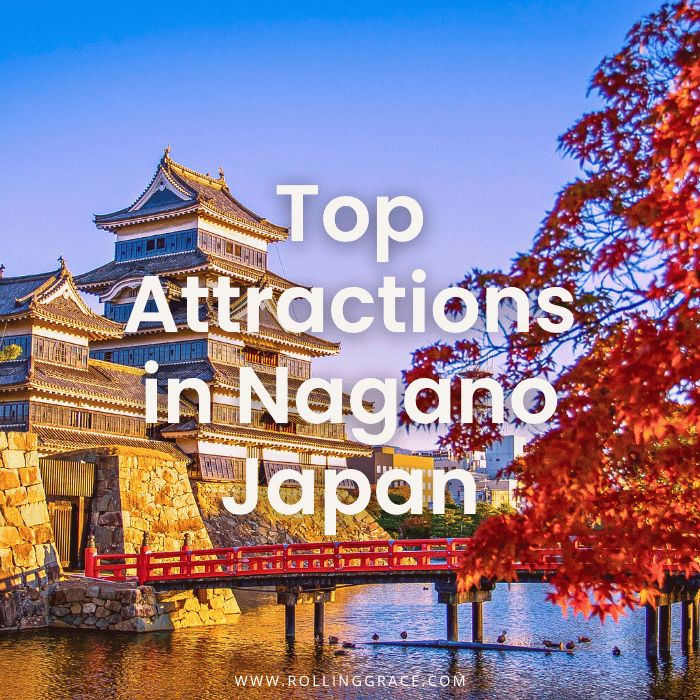
Wild Japanese macaques at Jigokudani Snow Monkey Park make this one of the best things to do in Nagano. Matsumoto Castle is one of Japan’s original castles and one of the best things to do in Nagano. Kamikochi in the Japanese Alps is one of the best things to do in Nagano for mountain scenery. Tasting locally brewed sake at Tanakaya or Kadoguchi Brewery in Iiyama is one of the best things to do in Nagano.


Zenkoji Temple, Nagano City
Zenkoji is one of the most important temples in Japan and the reason Nagano City exists at all. The city grew as a temple town around Zenkoji, and everything from the train station to the main hall is connected by Chuo-dori, a straight 2 km approach lined with soba shops, oyaki vendors, and traditional guesthouses.
Book a trip to Nagano for Snow Monkeys, Zenkoji Temple & Sake Day Trip
The temple was founded in the 7th century (approximately 642 AD) and is nonsectarian, meaning it welcomes all Buddhist denominations and has done so since before Japanese Buddhism split into separate sects.
The main hall (Hondo), rebuilt in 1707, is a National Treasure spanning 24 metres wide and 54 metres long. Entry to the outer chamber is free. The inner chamber, which includes the Okaidan Meguri underground passage (a pitch-black corridor beneath the altar where you feel for a metal key said to grant salvation), costs ¥600.
The temple grounds are open 24 hours, but the Hondo is accessible from sunrise until 4.00 pm to 4.30 pm depending on the season. Around 7 million visitors come through every year.
From Nagano Station, the temple is a 30-minute walk straight up Chuo-dori or a 10-minute bus ride to the Zenkoji-daimon stop. It sits comfortably at the top of any honest list of things to do in Nagano.
Read also: Top 10 Best Shisha in Shibuya, Tokyo

Jigokudani Snow Monkey Park, Yamanouchi Town
Jigokudani Monkey Park is the only place on Earth where you can reliably watch wild monkeys bathe in a hot spring. Around 200 Japanese macaques live in the park, which opened in 1964 in the Jigokudani Valley at 850 metres altitude, approximately 35 km northeast of Nagano City.
The monkeys began bathing in the hot springs on their own in the late 1950s and became internationally famous after a 1970 LIFE magazine cover.
Book a trip to Nagano for Snow Monkeys, Zenkoji Temple & Sake Day Trip
The park is open year-round with no regular closures. Green season hours (April to October) are 8.30 am to 5.00 pm. Winter season hours (November to March) are 9.00 am to 4.00 pm.
Admission is ¥800 for adults and ¥400 for children. Children 5 and under enter free. From late August 2026, online ticketing is available, and advance booking is recommended during the busy winter months when a daily visitor cap may be reached.
The monkeys bathe most reliably from December through March, when the cold drives them into the water. On mild or sunny days, they may skip the spring entirely. There are no cages or fences. These are wild animals, and there is no guarantee they will be at the pool on any given day.
Getting there involves a 1.6 km forest trail from the bus stop, which takes 30 to 40 minutes on foot. In winter, the path turns to ice, so bring winter boots and rent crampons at the trailhead.
From Nagano Station, a direct express bus runs to the Snow Monkey Park bus stop in roughly 40 minutes. The Snow Monkey Pass bundles round-trip transport and admission for approximately ¥5,100. The things to do in Nagano span seasons and temperaments, and this fits naturally into the best of them.

Gansho-in Temple, Obuse Town
Ganshoin Temple is a Soto Zen Buddhist temple founded in 1472, tucked at the foot of the mountains about 2 km east of Obuse Station. The temple is modest from the outside. What brings people here is on the ceiling.
In 1848, the ukiyo-e master Katsushika Hokusai, then 89 years old, completed a monumental ceiling painting of a phoenix titled Happo Nirami Ho-ou Zu, meaning “Phoenix Glancing in All Directions.” The painting covers 584 by 636 cm of cypress wood panels and was lifted and attached to the ceiling of the main hall after completion.
The colours, deep reds, blues, golds, and browns, have never been retouched and remain as vivid as the day they were laid down more than 175 years ago. The phoenix’s gaze follows you from every angle in the room.
Read also: Top 12 Best Shisha in Kyoto, Japan
Behind the temple, a small pond is where haiku poet Kobayashi Issa composed one of his most famous poems about a fighting frog. The gardens are worth walking through slowly after seeing the ceiling. Obuse town itself is known for its chestnut sweets and has a separate Hokusai Museum in the centre worth pairing with the temple visit.
Nozawa Onsen and Furusato no Yu Bath House
Nozawa Onsen Village is one of Japan’s oldest and most traditional hot spring towns, located in the northeastern corner of Nagano Prefecture. The village has 13 free public bath houses (soto-yu). Every bath is fed by 100% natural spring water.
Buy JR Pass East Japan Rail Pass
At the heart of the village is Ogama, a set of five scalding hot water pools reaching temperatures above 90°C, designated as a national natural monument. Locals use the pools daily to cook vegetables and eggs. Visitors cannot enter the pools but can watch from outside the rail.
For a more comfortable bathing experience, Furusato no Yu is a paid day-use onsen near Ogama, sometimes called the “14th public bath” of Nozawa Onsen. The wooden bathhouse blends into the village atmosphere and offers hot, warm, and outdoor baths with soap, shampoo, and showers provided.
Admission is approximately ¥700 for adults and ¥500 for children. Summer hours (April to mid-December) are 10.00 am to 7.00 pm. Winter hours (mid-December to March) are 11.00 am to 8.00 pm. Closed on Thursdays.
Nozawa Onsen is also a ski town and hosted events during the 1998 Winter Olympics. The annual Dosojin Fire Festival, held every January, is designated as an Important Intangible Cultural Property of Japan.
It draws the kind of visitor who has already done Japan once and wants something that goes deeper, which is exactly who the things to do in Nagano tend to reward.

Shirafuji, Suzaka City
Shirafuji is a 140-year-old estate in the centre of Suzaka City, now operating as an exclusive overnight accommodation limited to one group per night.
The property includes a traditional Japanese house and a Meiji-era Western-style building, both nationally registered tangible cultural properties. It was built by the Urano family, who held an important position in the Suzaka feudal domain, during the late Edo to early Meiji period.
Suzaka prospered from the silk industry during the Meiji era, and the town still has numerous kura (storehouses) from that period scattered through its streets. Shirafuji taps into that heritage, offering guests seasonal fruit grown locally, local sake, regional wines, and a full-course French and Italian dinner made with Shinshu ingredients. Breakfast features rare sun-dried rice from the area.
The property is roughly 5 minutes by car from Suzaka Station and about 14 km from Zenkoji Temple. Book your stay now.

Spa Lodge Redwood Inn, Takayama Village
Spa Lodge Redwood Inn is a 10-room mountain lodge in Takayama Village, perched at over 1,500 metres elevation next to the Yamaboku Wild Snow Park ski area. The lodge offers ski-in/ski-out access in winter, a hot spring bath, an outdoor pool in summer, and a restaurant serving Italian, Japanese, and pizza.
The standout is the open-air bath, carved from the hollowed trunk of a 1,650-year-old giant tree. The hot spring water is mineral-rich and the mountain setting means you are bathing with forest and snow (or stars, depending on the season) in every direction.
The lodge is roughly 15 minutes by car from Shiga Kogen and about 28 minutes from Jigokudani Monkey Park. In winter, studless tyres or chains are essential, and 4WD vehicles are recommended.
Free parking is available on site. Continental breakfast costs approximately ¥1,620. A hot spring tax of ¥150 per adult applies on top of the room rate. Book a room now.
Buy JR Pass East Japan Rail Pass
Rose Festa at Ippongi Park, Nakano City
Ippongi Park in Nakano City is home to the largest rose garden in Nagano Prefecture, with approximately 850 varieties and up to 3,000 rose bushes sourced from around the world, including varieties developed locally in Nakano.
The park opened in 1984 as a rest area for locals, thanks to an initial donation of 172 rose varieties by Kikuo Kuroiwa, and has expanded steadily since.
The annual Shinshu Nakano Rose Festa runs from late May to mid-June, when the roses hit peak bloom. Entry is free. Park hours are 9.00 am to 4.00 pm (9.30 am to 4.00 pm from December to February).
The tall rose arches and three-dimensional tower display are the most photographed features during the festival. Events during the festival include photography competitions, concerts, and plant sales.
The park is a 5-minute walk from Nakano-matsukawa Station on the Nagano Dentetsu Line and about 15 minutes from the Shinshu-Nakano Interchange on the Joshin-Etsu Expressway.

Tanakaya and Kadoguchi Sake Breweries, Iiyama City
Iiyama City, at the northern tip of Nagano Prefecture, receives some of the heaviest snowfall in the region. That snow filters through the mountains and produces the spring water that makes Iiyama sake distinct. Two breweries in the city have been producing sake for locals for over a century, and both are worth visiting.
Book a trip to Nagano for Snow Monkeys, Zenkoji Temple & Sake Day Trip
Tanakaya Sake Brewery was founded in 1873 and is now in its seventh generation. The brewery’s flagship sake, Mizuo, is brewed with spring water from the foot of Mt. Mizuo in Nozawa Onsen Village and locally grown Kinmon Nishiki rice.
The Mizuo Junmai Ginjo won first prize at the Kanto-Shinetsu Sake Awards in 2013. The brewery is a 15-minute walk from Iiyama Station and opens to visitors every year in April. Booking is required.
Read also: 11 Best Shisha in Osaka: Top Bars and Lounges Worth Visiting
Kadoguchi Sake Brewery, founded in 1896, is the northernmost sake brewery in Nagano Prefecture. Its flagship Hokko Masamune was originally produced for local consumption only, and its dry, sharp flavour reflects generations of pairing with Iiyama’s winter preserved foods.
Both breweries use Kinmon Nishiki rice, but the results taste noticeably different, which says everything about how much the brewer’s approach matters. Travellers who prioritise this above the more obvious things to do in Nagano rarely regret the decision.

Is Nagano in Japan Worth Visiting?
Nagano is one of the most underrated prefectures in Japan.
Most visitors pass through for skiing or a quick snow monkey photo, but the Kitashinano region alone holds a 1,400-year-old National Treasure temple, a Hokusai ceiling painting that has never been retouched, 13 free public hot spring baths, two family-run sake breweries, and the only place on Earth where wild monkeys bathe in a volcanic hot spring.
All of it is reachable from Tokyo in under two hours by Shinkansen. If you are choosing between Nagano and another day in Tokyo or Osaka, Nagano wins.
How Do You Get to the Kitashinano Area?
The gateway to the Kitashinano region is Nagano Station, reachable from Tokyo Station in approximately 80 minutes via the Hokuriku Shinkansen.
From Nagano Station, the Nagano Electric Railway (Nagaden) connects to Obuse (30 minutes), Yamanouchi/Yudanaka (45 minutes), and other key towns. Nozawa Onsen and Iiyama are served by the Hokuriku Shinkansen stop at Iiyama Station, roughly 12 minutes from Nagano.
Book a trip to Nagano for Snow Monkeys, Zenkoji Temple & Sake Day Trip
A Kitashinano Area Passport is available for visitors covering transport across the region. Check the Go Nagano tourism website for current pass options and pricing.
For independent travel, a rental car from Nagano Station gives you the most flexibility, particularly for reaching Takayama Village (Spa Lodge Redwood Inn) and the more remote onsen towns. Roads in winter require studless tyres or chains.
Can You Do a Day Trip from Tokyo to Nagano?
You can, but you will be rushing. The Hokuriku Shinkansen from Tokyo Station to Nagano Station takes approximately 80 minutes each way, which leaves enough time to visit Zenkoji Temple and one other spot (the Snow Monkey Park or Obuse, not both).
Buy JR Pass East Japan Rail Pass
If you only have one day, focus on Zenkoji in the morning and the Snow Monkey Park in the afternoon. Three days is the minimum to cover the Kitashinano area properly without running between trains.
How Many Days Do You Need in Nagano?
Three days is the minimum for a solid Kitashinano trip. Day one for Zenkoji Temple, the Chuo-dori approach, and Nagano City. Day two for the Snow Monkey Park and Obuse (Ganshoin Temple, Hokusai Museum, chestnut sweets).
Day three for Nozawa Onsen and Iiyama (sake breweries, public baths). If you have a fourth day, add Nakano during rose season or Takayama Village for the mountain lodge and hot spring.
Get the good stuff first. Join Rolling Grace for the restaurants worth crossing a city for, the stays worth the upgrade, and the places to go before everyone else. Free, straight to your inbox.
Leave a Reply