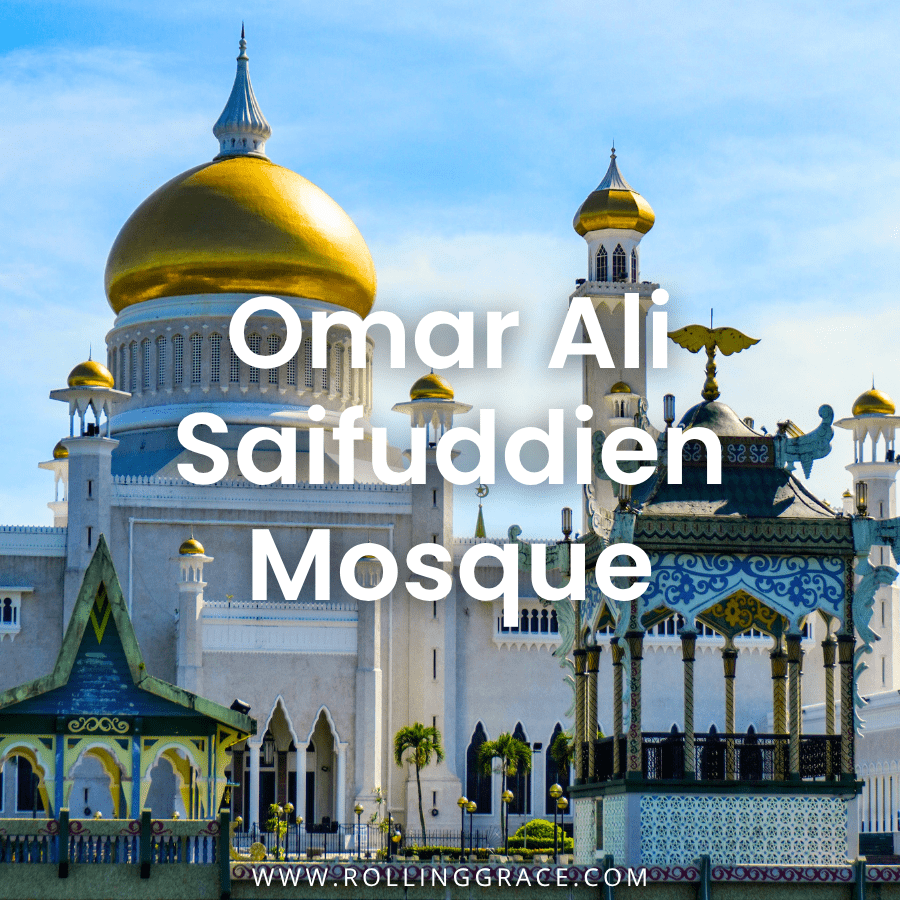
The first thing that registers from across the lagoon is the dome. It rises above a white marble building that looks almost modest by comparison, and it catches the light at an angle that makes it impossible to look away.
Masjid Omar Ali Saifuddien in Bandar Seri Begawan is one of the most photographed buildings in Southeast Asia for good reason. What the photographs do not convey is the detail. You have to get close for that.
Read also: Gadong Night Market Brunei: 12 Delicious Local Food to Try
History of Masjid Omar Ali Saifuddien
Named after Sultan Omar Ali Saifuddien III
Construction of Masjid Omar Ali Saifuddien began on 4 February 1954 and was completed on 26 September 1958, coinciding with the 42nd birthday of Sultan Omar Ali Saifuddien III, the 28th ruler of Brunei.
The mosque was named after him, and he was directly involved in its creation: the Sultan produced the initial architectural drawings himself before handing the design over to Italian architect and sculptor Cavaliere Rudolfo Nolli to develop.
The Booty and Edwards Chartered Architects firm executed the construction plans. The total cost of the build came to approximately US$5 million.
Architect of Modern Brunei
Sultan Omar Ali Saifuddien III ruled Brunei from 1950 to 1967 and is widely regarded as the architect of the country’s modern identity. It was his administration that restructured Brunei’s government, developed its infrastructure, and embedded Islam as the central pillar of national life.
In 1970, three years after his abdication, Brunei’s capital was renamed Bandar Seri Begawan in his honour. The word Begawan derives from the Sanskrit bhagavan, meaning the aura of god.
One of Two National Mosques in Brunei
Masjid Omar Ali Saifuddien is one of Brunei’s two national mosques, alongside Jame’ Asr Hassanil Bolkiah Mosque, which was commissioned by the current Sultan and opened in 1994.
The SOAS Mosque, as it is commonly abbreviated, remains the more architecturally distinctive of the two and the more central to daily life in the capital.

Mosque Architecture
Mughal and Italian Renaissance
The mosque’s design draws primarily from Mughal architecture, the same tradition that produced the Taj Mahal, with Italian Renaissance elements layered throughout. The result is a building that reads as distinctly Islamic but constructed with European precision and materials.
The white marble exterior, the proportions of the main dome, and the symmetry of the minarets together produce an effect that is both imposing and precise.
Dome
The main dome is the building’s most recognisable feature, and its surface is not gold leaf or paint. It is covered with 3.3 million individual pieces of Venetian gold mosaic glass, set by hand. The total height of the dome reaches 52 metres. On the lagoon’s surface on a calm day, the reflection is almost perfect.
Minaret
The main minaret stands at approximately 51 metres, the tallest in Brunei, and represents one of the five pillars of Islam. There are four smaller minarets around the prayer hall.
An elevator inside the main minaret carries visitors to the viewing deck, from which the city of Bandar Seri Begawan is visible in every direction.
Materials From Around the World
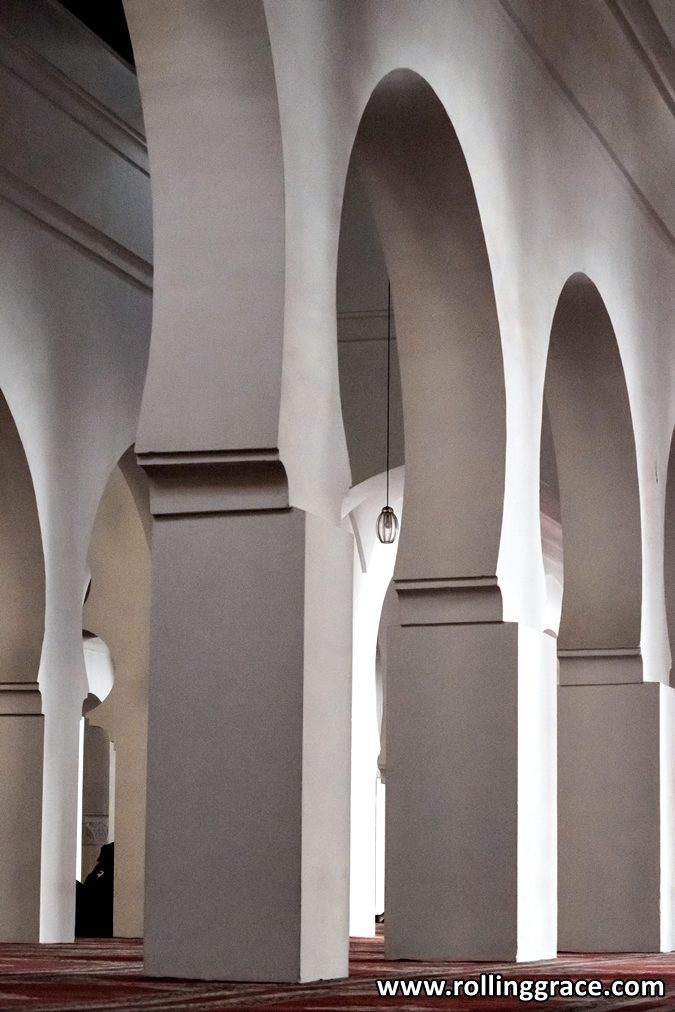
The interior of the mosque is a precise record of where Brunei’s wealth and connections reached in 1958. The floors and columns are Italian marble. The granite tiles are from Shanghai. The chandeliers are English, each one 4.6 metres in diameter and weighing over three tonnes, holding 62 fluorescent tubes. The carpets lining the prayer hall are Axminster, from Saudi Arabia and Belgium. The timber doors were made in the Philippines. The overall capacity of the prayer hall is 3,000 worshippers.
Kalat Pillars
One architectural detail that most visitors miss is the distinctive rope-like pattern on the pillars throughout the mosque. This motif is the Bruneian kalat, a thick traditional rope, and it appears throughout the building as a deliberate nod to local culture within a largely imported design.
The same pattern appears on the columns of the Lapau, Brunei’s royal ceremonial hall.
The Lagoon and the Mahligai Barge
Built on Water
The mosque is built on an artificial lagoon on the banks of the Kedayan River, adjacent to Kampong Ayer. The lagoon functions as a reflecting pool, doubling the mosque’s visual presence across the water.
A marble bridge connects the mosque to the barge in the centre of the lagoon. A separate bridge links the mosque grounds to Kampong Ayer on the far bank.
The Royal Barge
Floating in the lagoon beside the mosque is a full-scale replica of a 16th-century Bruneian mahligai, or royal barge. The replica was completed in 1967 at a cost of B$500,000 to commemorate the 1,400th anniversary of Nuzul Al-Quran, the revelation of the Quran.
The barge’s bow and stern are shaped like birds, its roof is pyramidal, and its surface is decorated with the floral and vegetal motifs of Brunei’s songket textile tradition. It is used for Quran recital competitions and state religious events.
Kampong Ayer
Visible from the mosque grounds and accessible by foot via the bridge, Kampong Ayer is one of the oldest continuously inhabited water villages in the world. It houses thousands of residents across a network of wooden stilt structures connected by walkways and bridges, most of them accessible only by water taxi.
The village predates the current city by several centuries and gives the mosque’s setting an historical context that the building alone cannot convey.

Visiting Omar Ali Saifuddien Mosque as a Non-Muslim
Non-Muslim visitors are welcome at Omar Ali Saifuddien Mosque during designated hours, but the schedule requires attention.
The interior is closed to non-Muslims on Thursdays entirely. On Fridays, interior access is restricted to 4:30 PM to 5:30 PM only. On all other days, Saturday through Wednesday, the interior is open during three time windows.
The exterior compound and grounds are open daily from 8:00 AM to 8:30 PM except during prayer times.
Interior visiting hours for non-Muslims
- Saturday to Wednesday: 8:30 AM to 12:00 PM | 1:30 PM to 3:00 PM | 4:30 PM to 5:30 PM
- Thursday: Closed to non-Muslims
- Friday: 4:30 PM to 5:30 PM only
- Exterior compound: Open daily 8:00 AM to 8:30 PM (closed during prayer times)
Dress Code
Modest dress is strictly enforced. Men must wear long trousers and sleeved tops. Women must cover their arms, legs, and hair. Free robes and headscarves are provided at the entrance for visitors who need them. Shoes must be removed before entering the prayer hall.
Non-Muslim visitors are welcome inside the mosque but must remain behind designated boundaries and may not enter the main prayer hall itself.
Photography
Photography of the exterior, grounds, lagoon, and barge is permitted and produces some of the most striking architectural photographs in Southeast Asia. Photography inside the mosque is not permitted.
The best time to photograph the exterior is late afternoon when the dome catches the western light directly, and after dark when the building is illuminated in yellow and green, its reflection moving across the lagoon below.
Ticket and Entrance Fee
Admission is free for all visitors.

What to See Nearby
Royal Regalia Museum
A ten-minute walk from the mosque, the Royal Regalia Museum houses an extensive collection of Brunei’s royal ceremonial objects, including the gold and silver regalia used during the current Sultan’s coronation in 1968.
Entry is free. It is one of the better free museums in Southeast Asia and significantly undervisited relative to its quality.
The Frame Brunei
Approximately 200 metres from the mosque in Taman Sultan Omar Ali Saifuddien, The Frame is a large steel viewing installation that frames a direct view of the mosque’s dome and minaret.
It has become one of the more practical photography points for capturing the full scale of the building against the sky.
Kampong Ayer Water Village
Cross the bridge from the mosque grounds and take a water taxi through the stilt village network.
The journey takes around 15 to 20 minutes and costs a few Brunei dollars. It is one of the more affordable and direct ways to understand how the city grew from a water-based settlement into the capital it is today.
Yayasan Sultan Haji Hassanal Bolkiah Complex
Directly opposite the mosque, this large shopping and commercial complex includes a food court on the upper floors with views back across the lagoon to the mosque. It is a practical lunch stop between visiting hours if you are planning a full day in the area.
Best Time to Visit
The late afternoon window from 4:30 PM to 5:30 PM is the most atmospheric time to visit. The dome catches the direct afternoon light, the call to prayer carries across the water, and the lagoon is at its calmest. After 6:00 PM, the exterior lighting activates and the reflection on the lagoon at night is worth staying for even after the interior closes.
Saturday through Wednesday for the widest access. Avoid Thursdays entirely if interior access matters to you. Fridays are manageable if you arrive for the 4:30 PM window, but the surrounding city is quieter and some nearby businesses will be closed.
Monsoon Considerations
Brunei’s northeast monsoon runs from October to February, bringing heavy afternoon rainfall. Morning visits during this period are more predictable for photography.
The mosque grounds drain quickly, but the lagoon can look choppy and grey under heavy cloud cover.
Frequently Asked Questions Masjid Omar Ali Saifuddien
Is Masjid Omar Ali Saifuddien open to non-Muslim visitors?
Yes. Non-Muslims are welcome during designated visiting hours. The interior is accessible Saturday through Wednesday during three time windows: 8:30 AM to 12:00 PM, 1:30 PM to 3:00 PM, and 4:30 PM to 5:30 PM.
On Fridays, interior access is limited to 4:30 PM to 5:30 PM only. The mosque is closed to non-Muslim visitors entirely on Thursdays. The exterior compound is open daily from 8:00 AM to 8:30 PM except during prayer times.
Do I need to pay to enter?
No. Entry to Masjid Omar Ali Saifuddien is free for all visitors.
What should I wear?
Modest dress is required. Men must wear long trousers and tops with sleeves. Women must cover their arms, legs, and hair. Free robes and headscarves are provided at the entrance for those who need them. Shoes must be removed before entering the prayer hall.
Can I take photographs inside the mosque?
No. Photography is not permitted inside the mosque. Photography of the exterior, grounds, lagoon, and the Mahligai Barge is permitted and produces excellent results, particularly in late afternoon light and after dark when the building is illuminated.
What is the gold on the dome made of?
The dome is covered with 3.3 million individual pieces of Venetian gold mosaic glass, set by hand. It is not gold leaf or paint. The effect in direct sunlight is what gives the mosque its distinctive glow across the lagoon.
Can I go up the minaret?
Yes. The main minaret has an elevator that carries visitors to the viewing deck at the top, from which the city of Bandar Seri Begawan is visible in all directions. Access is subject to visiting hours and mosque staff discretion.
Is the Mahligai Barge accessible?
The marble bridge connecting the mosque to the barge in the lagoon is periodically closed for maintenance. Check on arrival. The barge is clearly visible from the mosque grounds regardless of bridge access.
How to get to Masjid Omar Ali Saifuddien?
The mosque is within walking distance of central Bandar Seri Begawan. From the Royal Regalia Museum, walk southwest along Jalan Sultan towards Jalan McArthur. The dome is visible from several streets away.
Bus lines 22, 23, 24, 44, and 45 from the Bandar Seri Begawan bus terminal stop near the mosque at Jalan Kianggeh, a three-minute walk from the entrance.
Address: Jalan McArthur, Bandar Seri Begawan BS8711, Brunei Darussalam
What else is nearby?
The Royal Regalia Museum is a ten-minute walk away and free to enter. The Frame viewing installation is in the park directly adjacent to the mosque.
Kampong Ayer water village is accessible by foot via the bridge from the mosque grounds. The Yayasan Sultan Haji Hassanal Bolkiah Complex is directly opposite.
Is the mosque illuminated at night?
Yes. The mosque is lit from outside after dark in yellow and green light, and the reflection on the lagoon is one of the more striking night views in the city.
The exterior compound closes at 8:30 PM, so evening visits should account for that.
This guide is compiled from a personal visit and verified sources including Wikipedia, Brunei Tourism, the Department of Museums Malaysia, as well as recent visitor reports from TripAdvisor.
Get the good stuff first. Join Rolling Grace for the restaurants worth crossing a city for, the stays worth the upgrade, and the places to go before everyone else. Free, straight to your inbox.
Leave a Reply