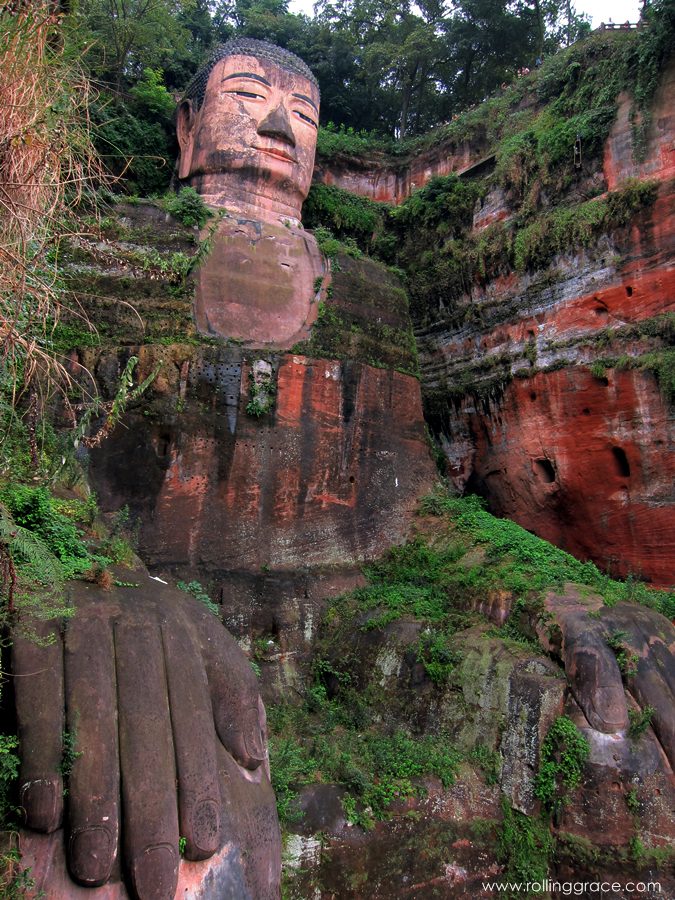
The Leshan Giant Buddha is 71 metres tall. Standing at its feet, you are eye-level with its toenails. Each one is large enough to seat several people. This is the scale of the thing, and no photograph prepares you for it.
Read also: 7 Best Things to Do in Emeishan City in Sichuan, China

History and When Was It Built
Carved into the sandstone cliff face of Lingyun Mountain at the confluence of the Min, Qingyi and Dadu rivers in Sichuan Province, the statue has been watching over the water since 803 AD.
Construction began in 713 under the direction of a Buddhist monk named Haitong, who believed a seated Buddha at the water’s edge would calm the turbulent currents that had been capsizing shipping vessels for generations.
Haitong died before the project was completed. It took 90 years and three generations of craftsmen to finish. The currents were, in fact, altered by the sheer volume of stone removed from the cliff during carving.


Leshan Giant Buddha Height
The statue is a Maitreya Buddha, depicted seated with hands resting on its knees. At 71 metres it is the largest stone Buddha in the world and the tallest pre-modern statue ever built. It was listed as a UNESCO World Heritage Site in 1996 alongside Mount Emei.
There are two ways to see it. The walking tour takes you down the Nine Bends Plank Road, a narrow zigzag staircase of 278 steps carved into the cliff face from the Buddha’s head to its feet. The widest section is 1.45 metres across. At its narrowest, one person passes at a time. During peak periods, the descent takes two to four hours. The ferry option (¥70) gives you a full panoramic view of the statue from the river, which is the only way to see the entire figure at once without stitching together different angles.
Both are worth doing if you have the time. The walking tour gives you the scale. The ferry gives you the composition.
- Entrance fee: ¥80 per person (includes Wuyou Temple and Mahao Cliff Tomb)
- Opening hours: 7.30am to 6.30pm (April to October); 8.00am to 5.30pm (October to March)
- Ferry: ¥70, available separately

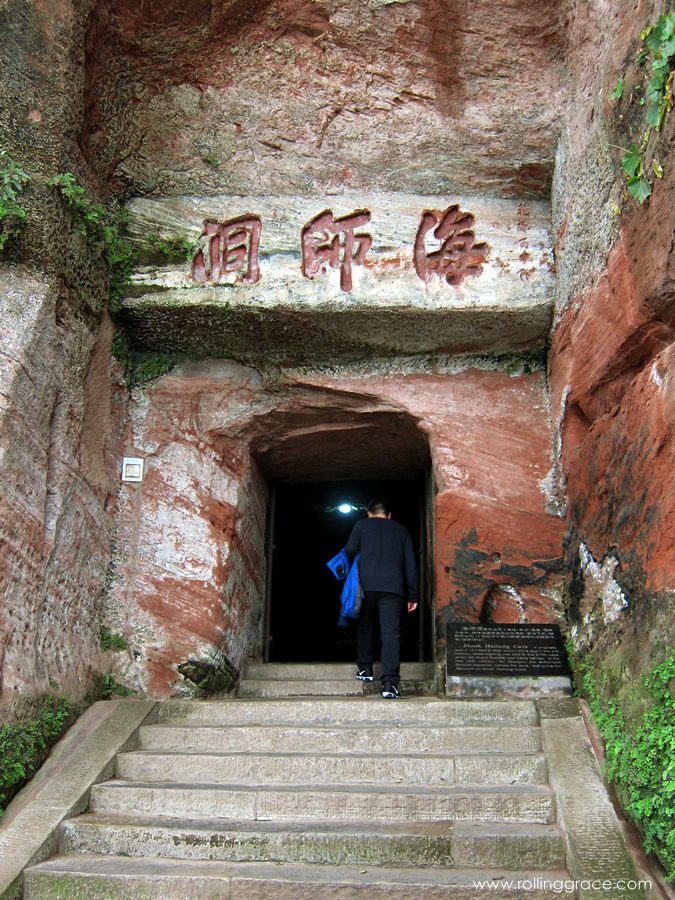
Monk Haitong Cave
Set into the cliff near the statue, this is the cave where Haitong is believed to have lived during the decades of construction. It is ten metres deep and easy to miss if you are focused on the queue ahead of you. Worth pausing for. The story of a monk who gouged out his own eyes to prove his integrity to a corrupt official attempting to seize the building funds is not one you forget quickly. Most visitors walk straight past without knowing it is there.
Lingyun Temple
Lingyun Temple stands at the top of Lingyun Mountain, close to the Giant Buddha’s head, and is your entry point for the walking descent. Built in the early Tang Dynasty, it predates the Buddha by several decades, making it over 1,400 years old. The current structure is a Qing Dynasty rebuild after the original was destroyed in a Ming Dynasty conflict.
The temple is composed of three halls arranged around a quadrangle courtyard: Tianwang Hall, Daxiong Hall and the Depository of Buddhist Sutras. It is busy because everyone passes through it. Spend ten minutes in the courtyard before joining the queue downward. The incense is constant and the crowd thins slightly if you wait near the halls rather than heading straight for the stairs.

Wuyou Temple
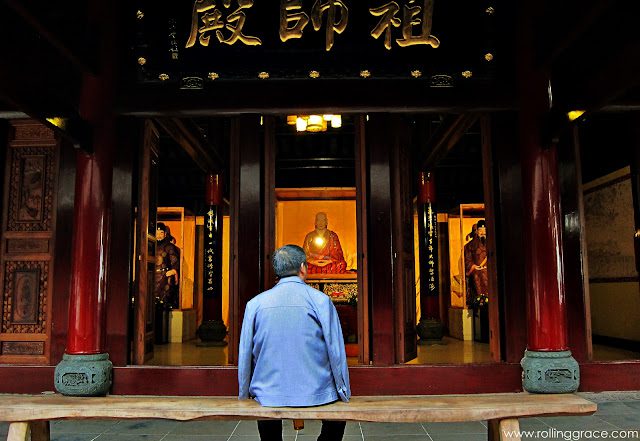
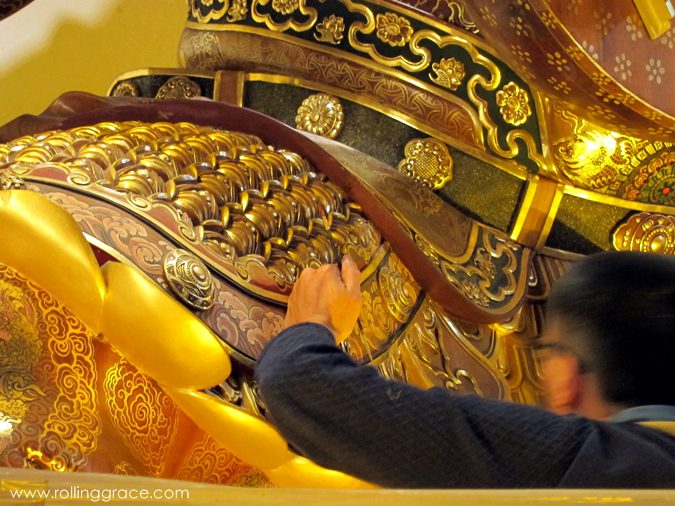
Wuyou Temple sits on Wuyou Mountain across from the Giant Buddha and is included in the standard entrance ticket. It is quieter than Lingyun, surrounded by bamboo and wintersweet, and significantly less crowded. The temple holds two notable pieces: a 9th-century bronze Dashi Buddha and an 11th-century gilded iron Amitabha statue group.
If you want to sit somewhere that is not a queue, this is it. The courtyards are calm, the views across the river toward the Buddha are good for photography, and most visitors skip it entirely in favour of getting back to the ferry or the car park.
Dafo Lake
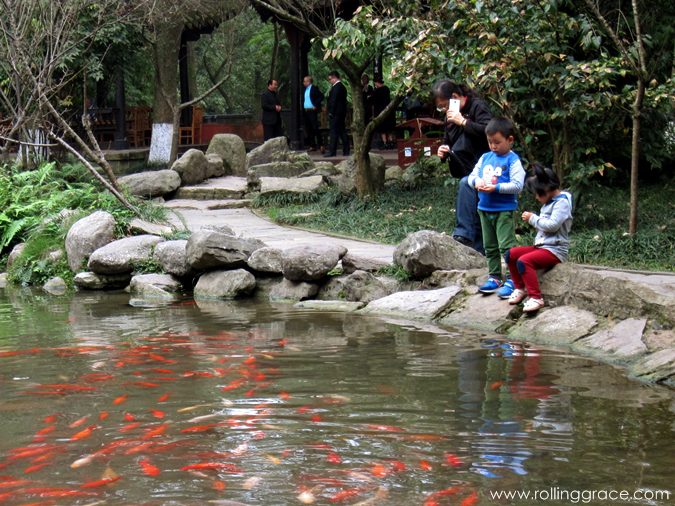
Located behind the Grand Buddha among the temples, Dafo Lake is a small stretch of water that most visitors encounter only briefly while moving between sites. Worth a short detour for the stillness. The area around the lake is shaded and considerably cooler than the exposed staircase sections.

People-Watching and the Texture of the Place
Leshan draws visitors from across China, and the range of people you encounter on the Nine Bends Plank Road is part of the experience. Elderly pilgrims navigating the steep descent with deliberate patience. Tour groups moving in tight formations with matching caps. A monk photographing the view with a smartphone. The walls of the staircase are riddled with small carved holes that visitors have been pressing coins into for decades, a local superstition about wishes and safe passage. Watching people poke carefully at the gaps is more entertaining than it sounds.
The Leshan Confucian Temple, a short walk from the main site, is a quieter counterpoint to the Buddhist intensity of the Buddha complex. Poetry and scholastic texts are carved into the wooden walls. It draws a fraction of the crowd and is worth the detour if you have the time.

How to Get to Leshan from Chengdu
By high-speed train
Depart from Chengdu East Railway Station (成都东站) and arrive in approximately 45 minutes. Tickets cost around ¥54. From Emeishan, the journey is 15 minutes and costs approximately ¥11.
By bus
Buses from Chengdu take approximately two hours. From Emeishan, around 20 minutes. Buses also connect Leshan with Jiajiang, Meishan, Ya’an, Yibin and Zigong.
By plane
There is no airport in Leshan. The nearest international gateway is Chengdu Shuangliu International Airport, 150km away. Connect onward by high-speed train or private transfer.
Leshan is most commonly visited as a day trip from Chengdu or as a stop between Chengdu and Emeishan. If you are combining both, stay overnight in Leshan or Emeishan rather than returning to Chengdu in between.
Important Things to Know
- Arrive late afternoon on a weekday to avoid the worst of the tour group queues on the Nine Bends Plank Road. Waiting times of 1.5 hours at peak periods are standard.
- Bring water and food. Tea houses are on site but options are limited and prices are not modest. The descent is long and the humidity near the rivers is significant.
- Wear layers. The breeze near the confluence of three rivers is considerable once you reach the lower sections of the staircase.
- The Nine Bends descent is steep. Anyone with knee problems should factor in extra time or consider the ferry instead.
- Tickets can be purchased online via WeChat or Alipay by searching “Giant Buddha Tourism.” Offline tickets are available at the North and South Visitor Centres, North Gate, South Gate, West Gate, and Wuyou Temple.
Visitor Information
- Address: Leshan Giant Buddha, 2345 Lingyun Road, Shizhong District, Leshan, Sichuan Province, China 614099
- Contact number: 0833-2355557
- Opening hours: 7.30am to 6.30pm (April to October); 8.00am to 5.30pm (October to March)
- Entrance fee: ¥80 per person
- Ferry: ¥70 per person
Get the good stuff first. Join Rolling Grace for the restaurants worth crossing a city for, the stays worth the upgrade, and the places to go before everyone else. Free, straight to your inbox.
Leave a Reply