Rising from the west bank of the Chao Phraya River, Wat Arun is one of Bangkok’s most recognisable landmarks. Its porcelain-covered spire shifts tone across the day, from pale grey in the morning to a warmer glow as the sun lowers. Despite its familiarity in photographs, Wat Arun is not a place that gives itself up quickly. It rewards attention, timing, and an understanding of context.
Often referred to as the Temple of Dawn, Wat Arun sits within the flow of river traffic, prayer, and everyday neighbourhood life. Boats move past without pause. Worship continues quietly inside its walls. The city adapts around it rather than pressing in.
Read also: Things to Do in Ko Phi Phi: 5 Experiences Worth Your Time

History of Wat Arun, Thailand
Wat Arun was established during the Ayutthaya period, when the site was known as Wat Makok. Its location on the west bank of the Chao Phraya River placed it along one of Siam’s most important transport and defence routes at a time when the river served as the primary channel for movement, trade, and military access.
Following the fall of Ayutthaya in 1767, King Taksin established Thonburi as the new capital, and the temple gained prominence during this transitional period. It was renamed Wat Chaeng, meaning Temple of Dawn, associated with both the timing of King Taksin’s arrival and the symbolic renewal of the kingdom.
Although Bangkok later developed eastward as the royal and administrative centre, Wat Arun remained an active religious site, continuing its role as a functioning temple rather than a former capital monument.
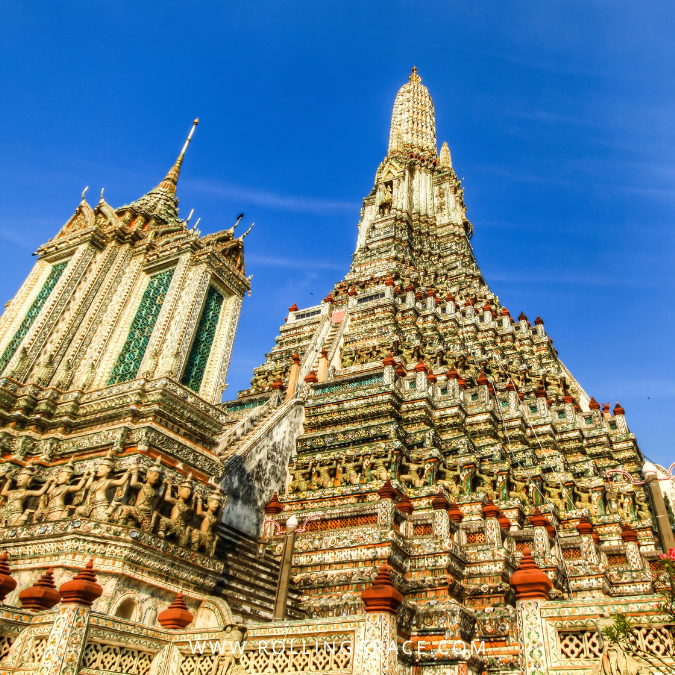
Origin of Temple of Dawn
The name Wat Arun derives from Aruna, associated with the rising sun. While sunrise visits are popular, the temple was never designed for a single moment of light. Its surfaces are constructed to refract brightness throughout the day, which is why late afternoon and early evening often reveal more depth and contrast than early morning.
Understanding this shifts how you plan your visit. Dawn is atmospheric, but not definitive.
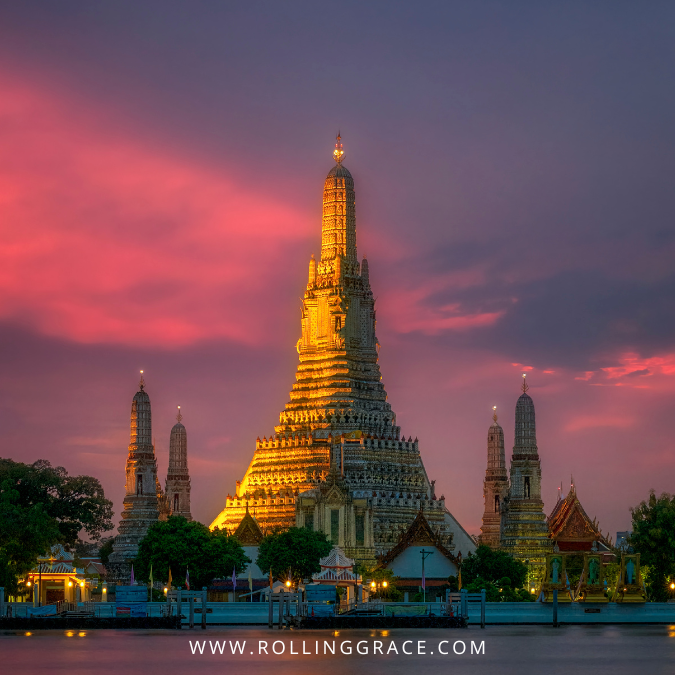
Built in the Ayutthaya Period
The site dates back to the Ayutthaya period, when it was known as Wat Makok. Its importance grew in the late eighteenth century during the reign of King Taksin, who established Thonburi as Siam’s capital after Ayutthaya fell.
The Wat Arun seen today was largely shaped in the early nineteenth century during the reigns of King Rama II and King Rama III. The central prang was expanded and refined, drawing on Khmer architectural influence and Buddhist cosmology to represent Mount Meru, the centre of the universe. Decorative ceramic and porcelain fragments, many sourced from Chinese trading vessels, were incorporated into the structure during this phase.
Central Prang and Architecture
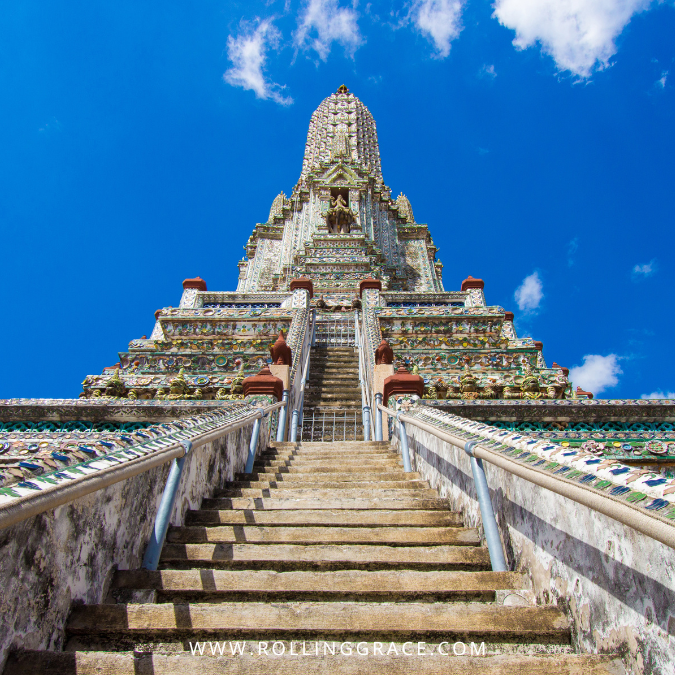
The Phra Prang rises to approximately 79 metres and defines the entire complex. Its vertical form reflects strong Khmer influence and symbolises Mount Meru, the centre of the Buddhist universe.
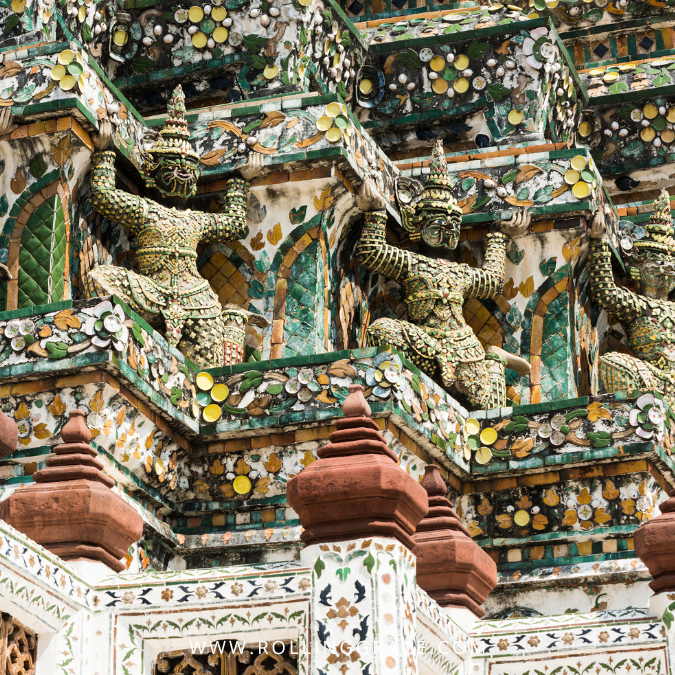
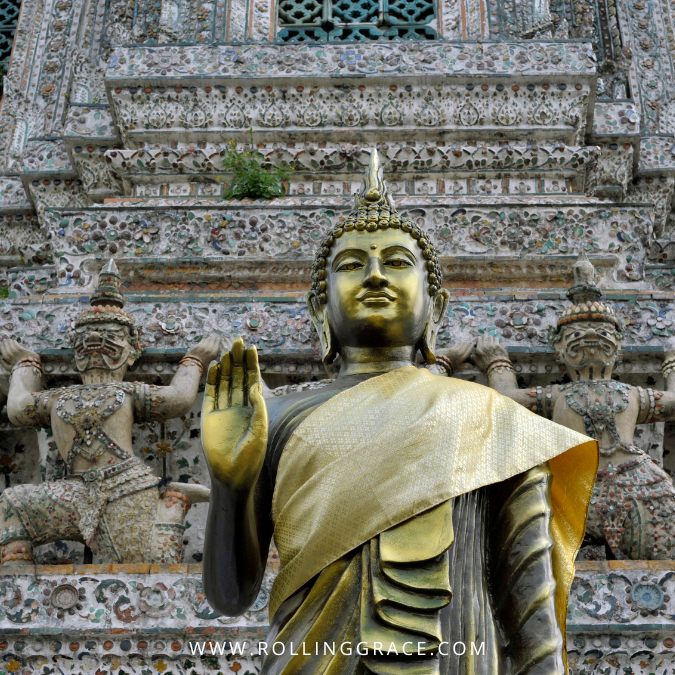
The surface is covered with ceramic and porcelain fragments, many repurposed from Chinese trading ships. From afar, the prang appears uniform. Up close, the irregularity, repairs, and age become visible, offering a record of time rather than perfection.
Four smaller prangs surround the central tower, aligned to the cardinal directions. These are symbolic structures, reinforcing ideas of balance and protection rather than acting as decoration.
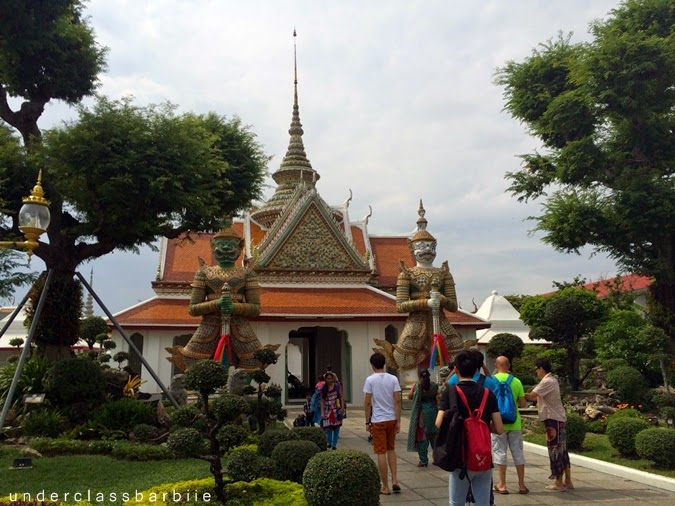
Guardian figures and mythological forms appear throughout the complex, offering visual references to Buddhist and Hindu traditions that reward closer observation.

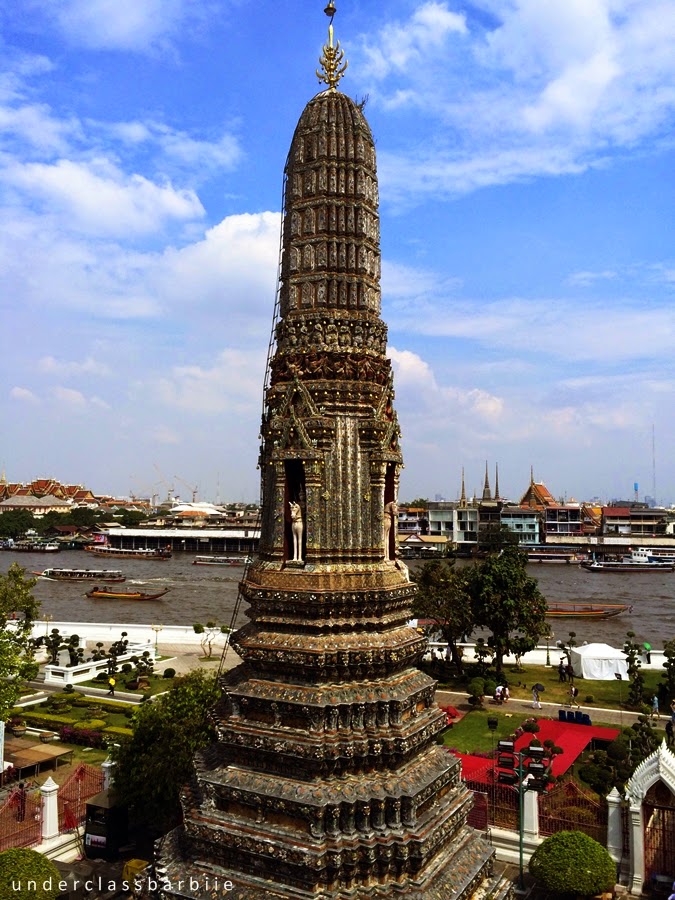
Climbing the Prang and What to Expect
Visitors are allowed to climb partway up the central prang at Wat Arun, ascending a series of steep stone steps that total roughly 160 steps from base to upper terrace. The climb usually takes 10 to 15 minutes one way, depending on fitness level and crowd conditions. The stairs become progressively narrower and steeper as you go higher, with minimal handrails and a sharp drop visible from most angles.
Surfaces can be slippery, particularly during humid weather or after rain, so shoes with good grip are important. Large bags are discouraged, and those uncomfortable with heights or steep inclines should skip the climb altogether.
The upper terrace offers river and city views, but many of the temple’s most intricate ceramic details are best appreciated from ground level, where movement is easier and sightlines are closer.
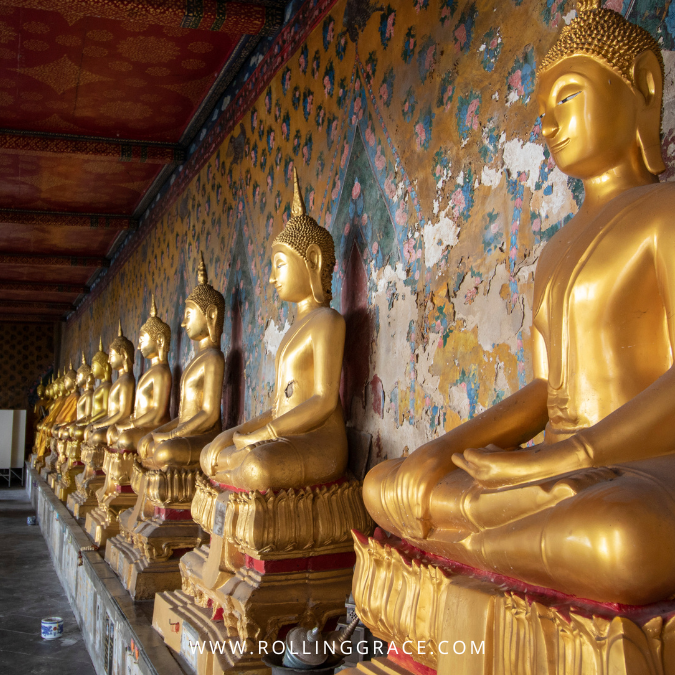
Theravada Buddhist Temple
Wat Arun remains an active Theravada Buddhist temple. Monks reside on site, prayers are conducted daily, and offerings continue throughout the year.
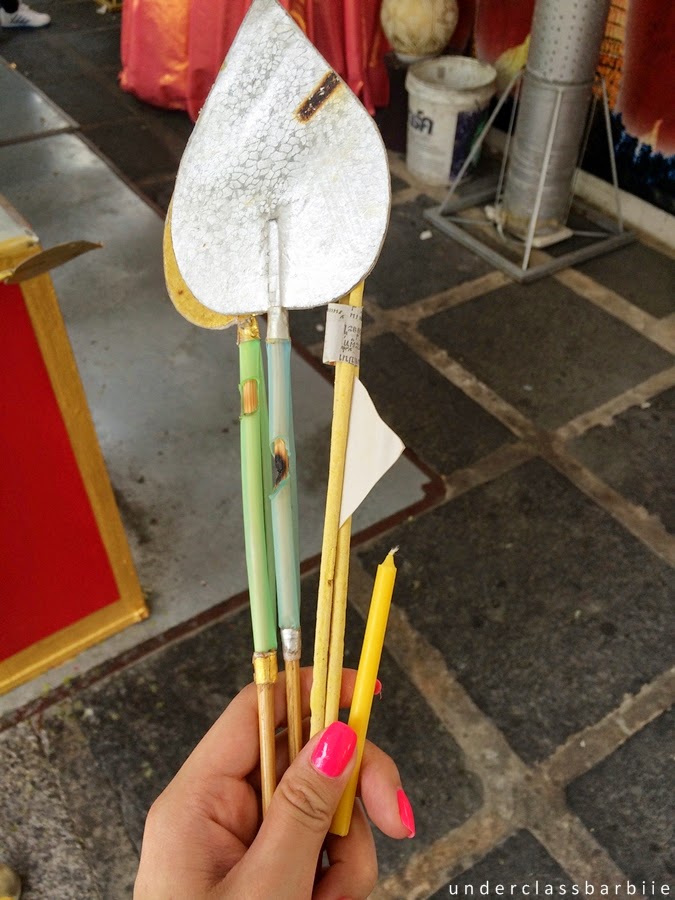
Donation rituals often involve incense, candles, and small sheets of gold leaf applied to Buddha images. Over time, these layers accumulate, visually recording devotion rather than restoration.
During major Buddhist festivals such as Visakha Bucha and Loy Krathong, Wat Arun becomes a focal point for communal worship. Crowds increase, movement slows, and ceremony takes precedence over photography or exploration.
Visitors during these periods should expect a different atmosphere, one centred on participation rather than observation.
Best Time to Visit
The most comfortable period to visit Wat Arun is during the cooler season from November to February, when temperatures and humidity are lower. For timing, aim to arrive between 8.00am and 9.30am for fewer visitors and softer light on the prang, or between 3.30pm and 5.00pm when the porcelain surface catches warmer afternoon light before closing.
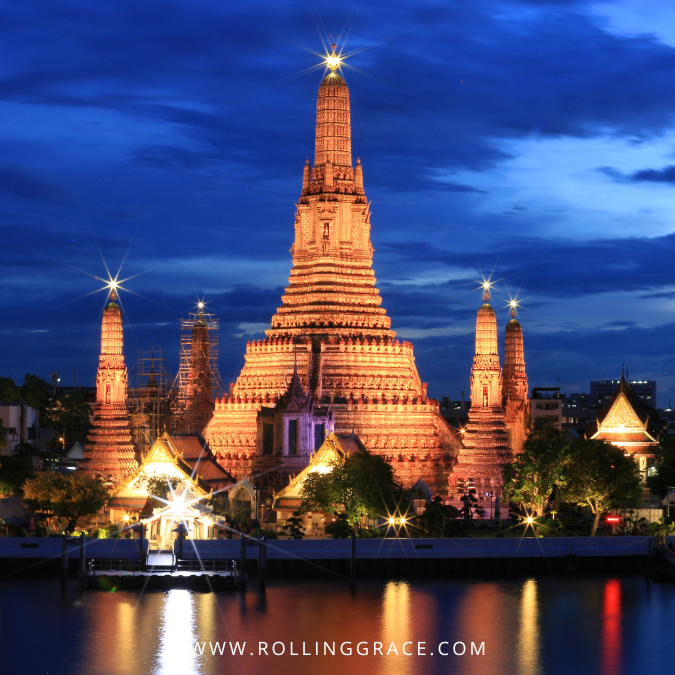
Avoid 11.00am to 2.00pm, which is typically the busiest window and the most uncomfortable due to heat and glare. If you are interested primarily in views rather than entering the complex, sunset sightings from across the river work well from around 5.30pm onwards, after the temple has closed but while the structure remains visible and later illuminated.
How to Get to Wat Arun
By BTS + River Boat (Recommended)
Take the BTS Silom Line to Saphan Taksin Station (S6) and walk directly to Sathorn Pier. From here, board a Chao Phraya Express Boat heading north. Boats run every 10–20 minutes. The ride to Tha Tien Pier (N8) takes around 15–20 minutes, depending on river traffic, and costs 15–40 THB, depending on the boat type.
From Tha Tien, take the short cross-river ferry to Wat Arun, which runs continuously during temple hours, takes about 3–5 minutes, and costs 5 THB per trip. This is the most consistent and time-efficient route.
By MRT + Ferry
Take the MRT Blue Line to Sanam Chai Station, Exit 5. From the station, walk 5–8 minutes to Tha Tien Pier, then cross the river by ferry to Wat Arun.
This option works well if you are already visiting Wat Pho or the Grand Palace, but involves more walking in heat.
By Taxi or Ride-Hailing
Taxis and Grab can drop you directly on the Bangkok Yai side near Wat Arun. Travel time varies widely based on traffic, typically 25–45 minutes from central Bangkok. This route is less predictable than river transport and is best used early in the morning or late in the evening.
What to Note
River transport is generally faster and more reliable than road travel during the day. Ferry tickets are purchased on site and usually require cash, so carry small change. During peak hours and festivals, queues at Tha Tien Pier can add 10–15 minutes to your journey.

Entrance Fees and Opening Hours
- Wat Arun is open daily from 8.00am to 5.30pm, with last entry at 4.30pm.
- Foreign visitors pay 100 THB. Thai nationals receive a discounted local rate. Children under 120 cm enter free.
- Dress codes are enforced. Shoulders and knees must be covered, and shoes must be removed when entering certain buildings.
Viewing Wat Arun from Across the River
Some of the most enduring views of Wat Arun are from the opposite bank near Wat Pho and Tha Tien, particularly at sunset. After dark, the illuminated prang remains visible long after visiting hours end.
Riverside walkways and cafés across the river provide calmer vantage points without entering the temple grounds.
Wat Arun is not a site to rush through. Its presence is defined by light, repetition, and restraint. From a distance, it anchors Bangkok’s skyline. Up close, it reveals age, belief, and continuity.
For visitors willing to slow down and observe rather than collect, the Temple of Dawn offers a clearer understanding of how Bangkok’s river, religion, and daily life continue to intersect.
Get the good stuff first. Join Rolling Grace for the restaurants worth crossing a city for, the stays worth the upgrade, and the places to go before everyone else. Free, straight to your inbox.
Leave a Reply