Masjid India Muslim Ipoh sits on Jalan Seenivasagam, beside St. Michael’s Institution, where it has stood for more than a century. Built in the early twentieth century, it remains a working mosque, part of the city’s daily life through prayer, routine, and long familiarity.
Its beginnings trace back to Ipoh’s growth in the nineteenth century, when tin mining drew migration into the Kinta Valley. South Indian Muslims were among those who settled here, establishing places of worship alongside trade and labour.
While food is often the most visible reminder of this history, Masjid India Muslim Ipoh offers a gentler way in, inviting you to understand how faith and migration quietly shaped the city over time.
Read also: Masjid Al Hussain Kuala Perlis: Floating Mosque of Perlis

The Origins of Masjid India Muslim Ipoh
As the South Indian Muslim population grew, so did the need for a dedicated space of prayer. Differences in ritual practice between the Shafiʽi school followed by local Malay Muslims and the Hanafi school observed by Indian Muslims made shared worship increasingly complex.
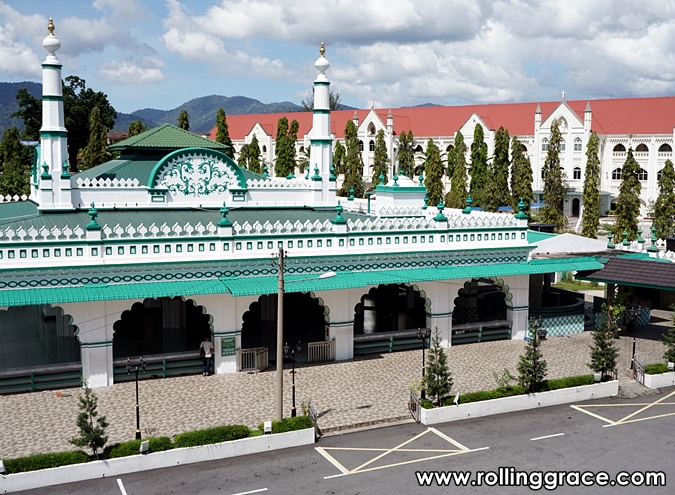
Rather than conflict, the response was architectural. A separate mosque was established, one that reflected both doctrinal needs and communal dignity. Positioned opposite Ipoh Padang and beside St. Michael’s Institution, the mosque became known locally as the Town Padang Mosque.
Formally named Masjid India Muslim Ipoh, it remains one of the city’s oldest functioning mosques.
A Brief History of the Mosque
Construction began in 1905, funded by Shaik Adam Mohammad Ghaus, a prominent Indian Muslim entrepreneur and founder of the Kinta Ice Works and Kinta Aerated Water Factory. Skilled Indian craftsmen were brought in specifically for the project, reflecting both technical ambition and cultural continuity.
The mosque was completed in 1908 at a reported cost of RM500,000, a substantial sum for the period. More than a place of worship, it was a statement of permanence in a rapidly changing town.
Mughal Influence and Architectural Character
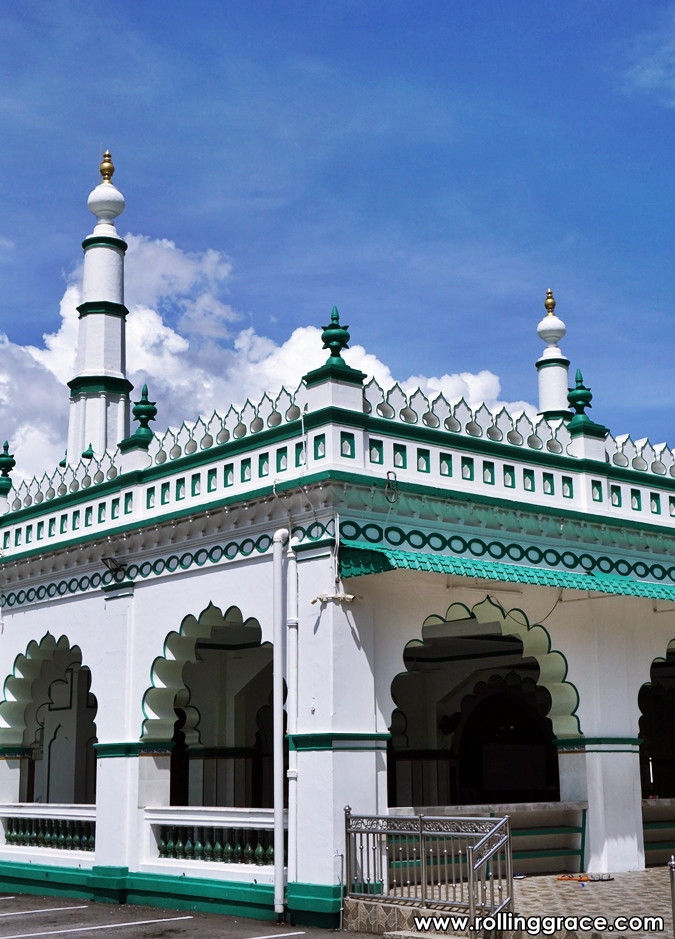
Masjid India Muslim Ipoh is heavily influenced by Mughal architecture, particularly the Diwan-i-Khas at Delhi’s Red Fort. Its rectangular plan, flat terraced roof, and flanking verandas give the building a grounded symmetry.
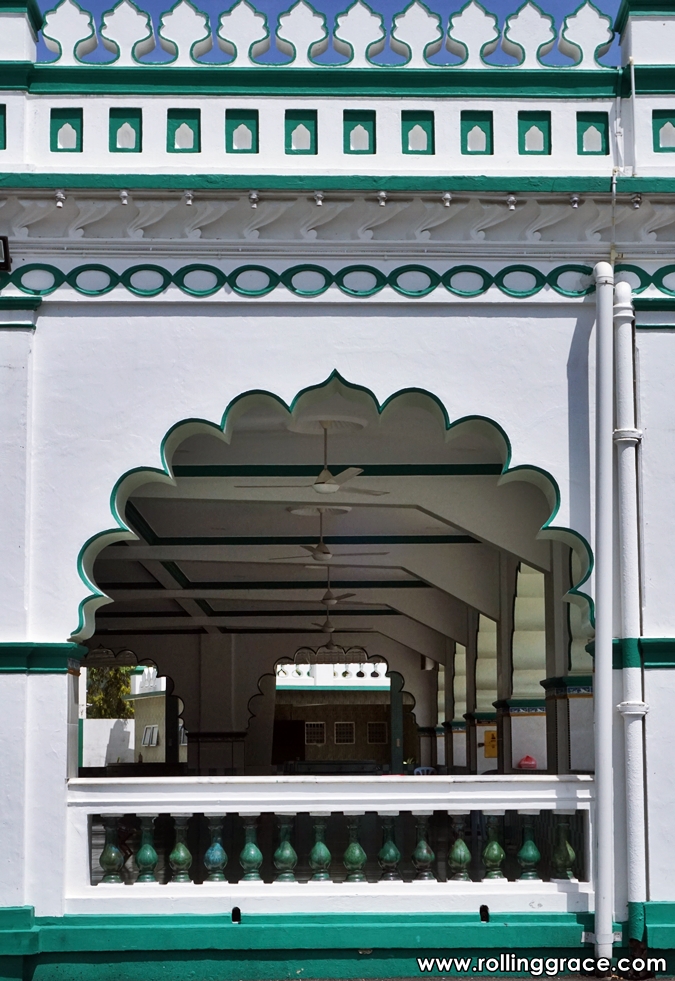
Two pointed minarets rise on either side, while a single pyramidal dome caps the prayer hall. Scalloped cusped arches soften the structure’s geometry, lending elegance without excess. Painted white with restrained green accents, the mosque’s exterior feels composed rather than ornate.
A separate square gateway marks the entrance to the compound, creating a subtle threshold between civic space and sacred ground.



Interior Details and Prayer Space
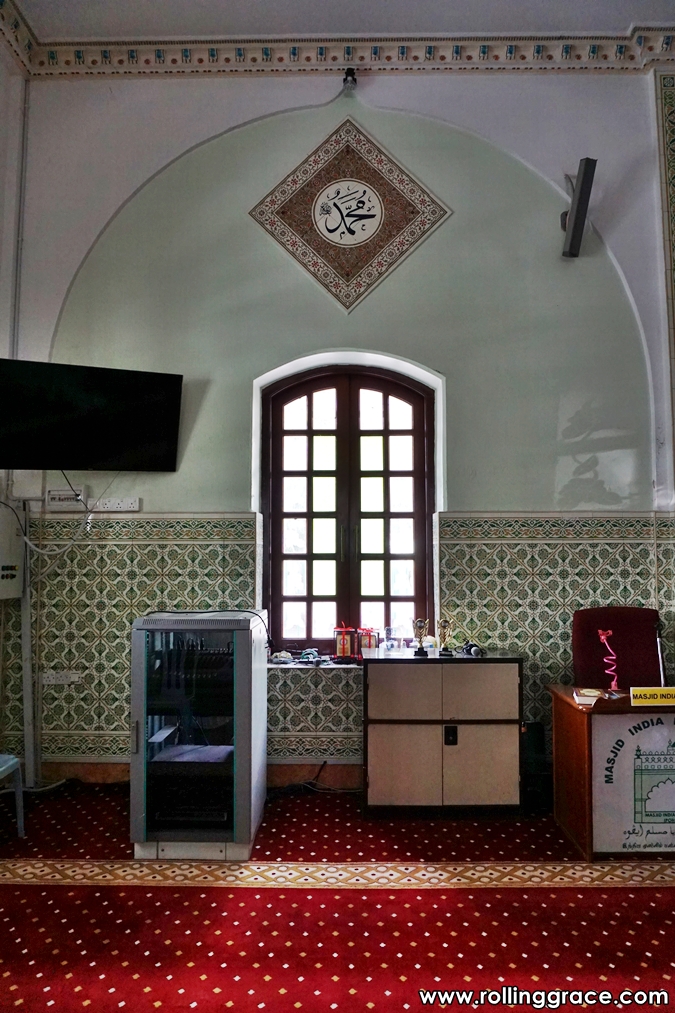
Inside, the mosque is defined by calm repetition. Arabesque geometric and floral tiles decorate the walls and pillars. The mihrab sits at the front of the prayer hall, aligned towards Mecca, with a wooden mimbar to its right.
Sermons are delivered in Tamil, reflecting the community the mosque continues to serve. A tall grandfather clock stands beside the mihrab, its presence both practical and symbolic, marking time in a space built for continuity.
A large chandelier hangs from the sculpted plaster ceiling, catching daylight that filters through long, square-framed windows. Red carpeting lines the floor, punctuated with white and yellow markers to guide congregational prayer.
A green spiral staircase with gold-painted wrought iron railing introduces a quiet moment of craft, while ablution areas are discreetly placed at the rear, separated from the prayer hall by semi-circular walls.

National Heritage Status and Cultural Significance
Also known as Shaik Adam’s Mosque, Masjid India Muslim Ipoh was gazetted as a national heritage site under Malaysia’s National Heritage Act of 2005. The designation recognises both its architectural merit and its cultural role.
For over a century, the mosque has served as a spiritual anchor for Ipoh’s Indian Muslim community, particularly those following the Hanafi school of fiqh. It stands as a record of migration, adaptation, and coexistence, a reminder that Ipoh’s history is layered well beyond colonial shopfronts and limestone hills.
Best Time to Visit
The most suitable times to visit Masjid India Muslim Ipoh are early mornings or late afternoons, outside the five daily prayer times: Fajr, Dhuhr, Asr, Maghrib, and Isha. As the mosque functions primarily as an active place of worship, access to the prayer hall may be limited during these periods. Visiting between prayer times allows for quiet observation while respecting congregational use.
Respectful dress and unobtrusive behaviour are essential, as the mosque’s primary purpose remains devotion, not tourism.
Visitor Information
Address: Jalan Seenivasagam, 30450 Ipoh, Perak Darul Ridzuan
Contact number: +605-254 1978
Get the good stuff first. Join Rolling Grace for the restaurants worth crossing a city for, the stays worth the upgrade, and the places to go before everyone else. Free, straight to your inbox.
Leave a Reply