John Ang did not set out to become one of the foremost authorities on Malay textiles. He discovered his first piece of limar in 2014 and could not find a single book about it. So he started travelling. That decision led to a collection that now spans thousands of pieces, research across multiple countries, and an exhibition at Semua House in Kuala Lumpur that brought 250 of those pieces before the Malaysian public for the first time.
We attended the exhibition as part of the Kreatif KL Festival, held in collaboration with Think City, Kuala Lumpur City Hall and Semua House, and supported by the Ministry of Finance.
Read also: 9 Types of Batik in Malaysia: Traditional Textiles & Designs
Table of Contents
Who Is John Ang?
John Ang is a Chinese-American art historian and collector who moved to Malaysia in 2018. His connection to the Malay textile trade runs deep: his great-great-grandfather, Tan Hiok Nee, was a textile trader who worked closely with the first Sultan of Johor Bahru in the mid-1800s. Ang has been an art dealer since 1969, working across wood, ceramics and textiles before narrowing his focus to Malay textiles in 2014.
His entry point was accidental. He acquired a piece he could not identify, soaked it in water to remove an oil stain, and found the next morning that the textile had dissolved entirely. It turned out to be a Tenggarung, a limar bersongket so rare that only two artisans in Terengganu are still capable of producing it. That discovery set the direction for everything that followed.
“I don’t just collect textiles, I collect stories,” John Ang has said. “Stories that show how interconnected we are as a people.”
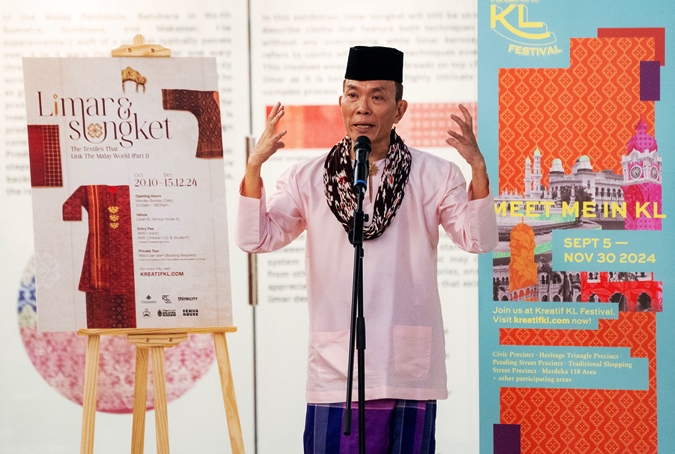
Limar and Songket Exhibition at Semua House Kuala Lumpur
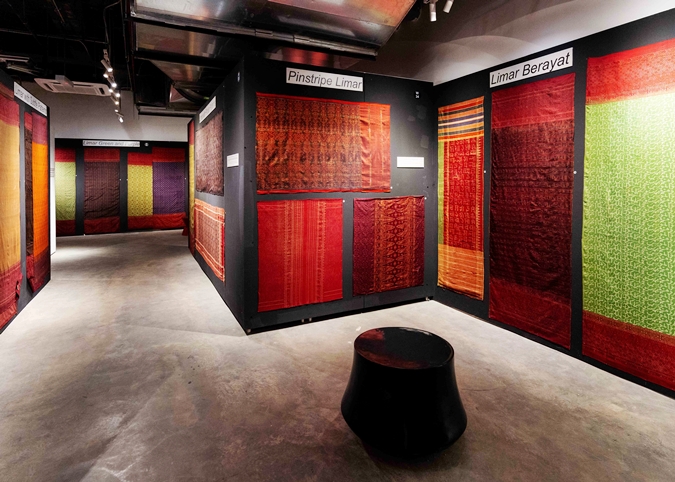
The Limar and Songket exhibition at Semua House on Jalan Bunus 6 displayed 250 pieces from John Ang’s collection, focused specifically on these two textile traditions. It ran as Part I of a broader project, with John Ang framing both songket and limar within their wider regional and historical context.
The exhibition entrance provided a guide to the motifs commonly found across these textiles. From there, the displays moved through specific regional variations: limar songket benang from Kelantan, limar bersulam, the soft purple tones of sewet tajong and sewet blongsong, and the intricate limar berayat, which incorporates Islamic calligraphy into the weave itself.
Among the standout pieces is a limar bersongket similar in design to a textile once worn by Sultana Khadija Khanum of Johor, whose husband Sultan Abu Bakar encountered the design during a visit to the Ottoman Empire in 1893. The piece is woven with real gold thread using a technique that requires the weaver to tie minuscule knots to groups of yarns before dyeing and then weaving the base cloth. It is among the most technically demanding processes in the entire Malay textile tradition.


What Are Limar and Songket?
Most Malaysians can identify songket. Fewer know what limar is, and fewer still can explain the difference with any precision. That gap is exactly what John Ang has spent the last decade trying to close.
Songket is a hand-woven fabric in silk or cotton with gold or silver supplementary threads inserted through a technique known as supplementary weft weaving. It was once exclusive to Malay nobility and remains one of the most technically demanding textiles produced in the region. It is largely practised in Terengganu, Kelantan, Brunei, Sarawak and Sumatra.
Limar is older and less widely understood. It is an ancient Malay weft ikat cloth produced through a sophisticated tie-dye technique applied to weft yarns before weaving. The result is a cloth with abstract, shifting patterns that differ from the structured geometry of songket. Both textiles have been used in festivals and ceremonies across the Malay world for centuries, in regions spanning southern Thailand, Cambodia, the Malay Peninsula, Sumatra and the coastal areas of Borneo.
Why Malay Textiles Are Under-Researched
John Ang has proposed recategorising Malay textiles into 12 main categories to reflect the full scope of the tradition and make it more accessible to the general public. The categories are: Songket, Limar, Telepuk or Prada, Sulaman or Tekatan, Pelangi, Ikat Loseng, Tenunan, Tapestry, Cetakan, Batik, Renda and Anyaman.
“Presently, only textile experts are familiar with these categories,” John Ang has noted. “A Malay textile is not necessarily made by the Malays, but is what Malays like. It is designed according to cara Melayu, the style of the Malays.”

Global Influence of Malay Textiles
The global reach of these connections is one of the exhibition’s central arguments. John Ang traced the origins and influences of the textiles he collected across India, Persia, China, Arabia, Turkey and Japan. A visit to Chau Doc in Vietnam yielded pieces of ikat loseng from a village where the community still speaks Malay. Pieces from Pattani in southern Thailand showed structural similarities to textiles produced on the Malay Peninsula. The collection makes the case that these textiles were never provincial. They travelled, and the evidence of that travel is visible in the cloth.
The exhibition does not simply focus on the local importance of Limar and Songket; it highlights their connections to a broader, global cultural dialogue. The techniques and patterns found in these textiles have drawn influence from various regions, from the intricate motifs of Middle Eastern textiles to the delicate patterns found in Chinese and Indonesian weaving traditions. This amalgamation of influences speaks to Malaysia’s position at the crossroads of maritime trade routes and cultural exchange throughout history.
John Ang’s work also demonstrates how Malay textiles served as both a medium of self-expression and a tool for diplomacy and trade. The exhibition emphasises the global appeal of these fabrics, which once travelled to far-off lands and became a subject of fascination for foreign collectors and connoisseurs. By displaying pieces with clear influences from other cultures, John Ang invites visitors to appreciate the interconnectedness of the Malay world with global artistic traditions.
Revival of Traditional Malay Textiles
The Limar and Songket exhibition forms part of a larger wave of cultural resurgence currently sweeping through Kuala Lumpur. The city is undergoing a cultural transformation, supported by organisations like Kuala Lumpur City Hall (DBKL) and Think City, which aim to rejuvenate the city’s heritage spaces and artistic expressions. Exhibitions like John Ang’s are integral to this revival, as they help reconnect Malaysians with their cultural roots while positioning Kuala Lumpur as a creative hub of Southeast Asia.
With the launch of the Kreatif KL Festival, Kuala Lumpur has further solidified its place as a centre for artistic and cultural dialogue. Events like these foster a deepened appreciation of Malaysia’s heritage among locals and tourists alike, offering them a chance to engage with the nation’s artistic legacy in a meaningful way.
John Ang’s exhibition aligns with these efforts, creating a platform that encourages reflection, understanding, and a renewed pride in Malaysia’s cultural heritage.
Future of Traditional Textiles in Malaysia
As Malaysia experiences this cultural resurgence, the Limar and Songket Exhibition plays a crucial role in shaping the future. They remind us of the beauty and significance of cultural heritage while fostering an environment where traditions are valued, respected, and carried forward. John Ang’s dedication to showcasing these textiles not only honours the artistry of the past but also paves the way for a new generation to appreciate and preserve their cultural roots.
Through John Ang’s work, it is evident that Malaysia’s traditional textiles are more than just historical artefacts; they are embodiments of cultural pride and resilience. By engaging with these textiles, visitors are invited to partake in a shared journey of rediscovery and celebration. This exhibition is more than a look back but an invitation to step forward with a renewed sense of appreciation for Malaysia’s cultural legacy.

Sustainability
Traditional weaving techniques for limar and songket are in decline. Only a small number of artisans remain capable of producing the more complex variants, including the limar bersongket. John Ang’s broader project, beyond collecting, is documentation: preserving the knowledge of these techniques before the last practitioners who hold them are gone.
Visiting Information
- Address: Level B1, Semua House, Jalan Bunus 6, City Centre, 50100 Kuala Lumpur
- Opening hours: 10am to 8pm
- Ticket price: RM10 (Adult), RM5 (Students & children under 12)
- Private tour: RM40 per pax
At its core, John Ang’s exhibition is a celebration of Malaysia’s artistic and cultural legacy. As visitors walk through the display, they are immersed in a tapestry of colours, patterns, and textures that embody the spirit of the Malay world. The exhibition’s educational approach encourages visitors to view these textiles not merely as objects of beauty but as windows into Malaysia’s past and symbols of its ongoing cultural renaissance.
The anticipation surrounding Malaysia’s submission of the kebaya for UNESCO recognition further underscores the current wave of heritage appreciation. This effort represents a broader desire to secure international recognition for traditional garments, a step that aligns with the aims of exhibitions like John Ang’s. The hope is that such recognition will inspire more Malaysians to engage with and preserve their cultural heritage.
Love stories like this? Subscribe to the Rolling Grace newsletter for thoughtful travel notes, hidden dining gems, and slow discoveries from across Asia.
Leave a Reply