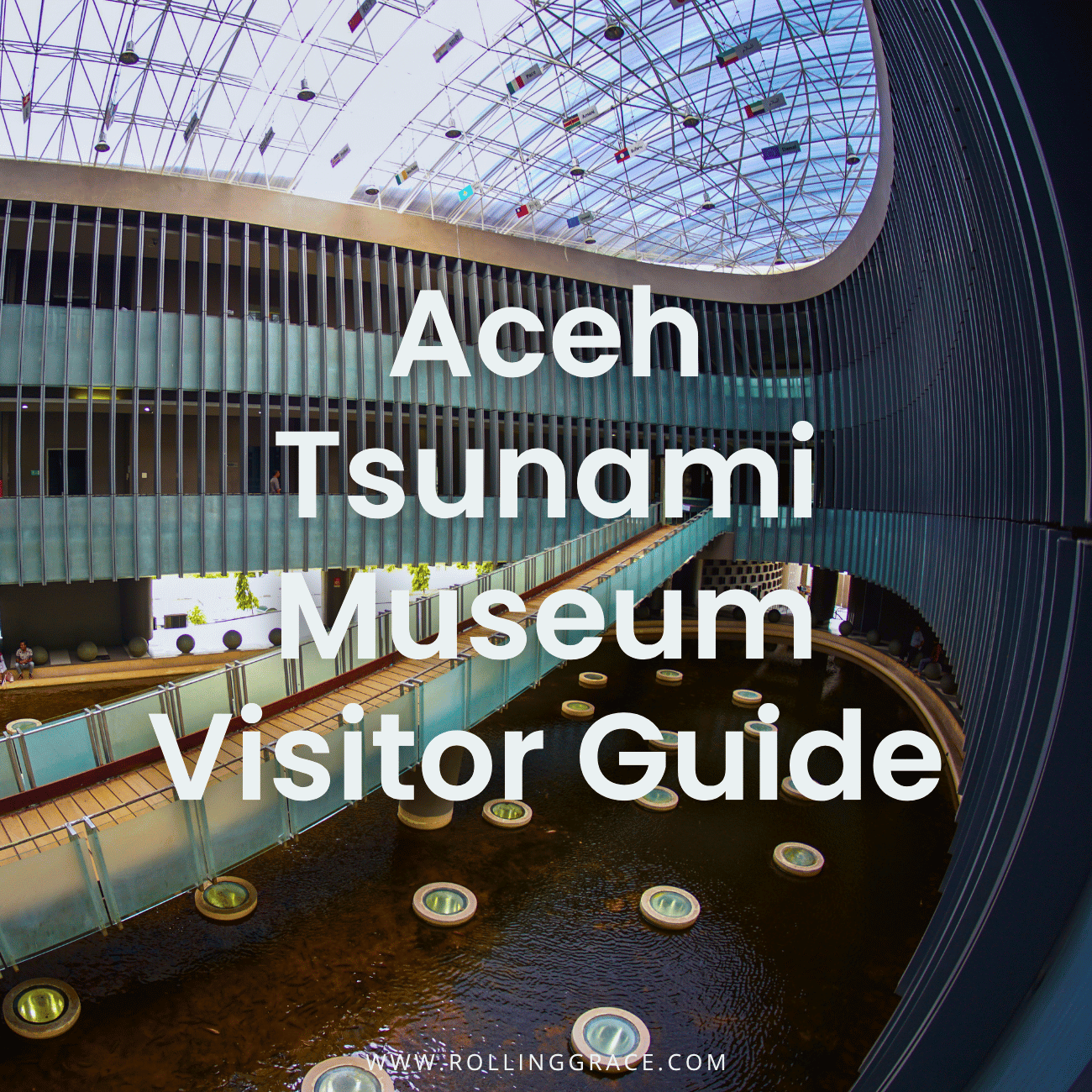
A building shaped like a breaking wave, a dark corridor with water running down its walls, a well lined with the names of the dead and a bridge hung with the flags of the countries that sent help.
The Aceh Tsunami Museum in Banda Aceh remembers the tsunami of 26 December 2004, which killed around 230,000 people across the Indian Ocean, about two-thirds of them in Aceh province.
We visited the museum in central Banda Aceh, starting, as every visitor does, in the dark of Lorong Tsunami. This guide covers the architecture, the seven spaces worth your time inside, ticket prices, opening hours, how to get there and the other tsunami memorials in the city.
Read also: Nasi Campur in Indonesia: 4 Facts On This Culinary Classic
What Is Museum Tsunami Aceh?
Museum Tsunami Aceh, known in English as the Aceh Tsunami Museum, is a memorial and disaster education centre in Banda Aceh, Indonesia, built to remember the victims of the 2004 Indian Ocean tsunami.
Designed by Indonesian architect Ridwan Kamil, it opened to the public in 2009 on Jalan Sultan Iskandar Muda in the city centre.
Displays on tsunami science, hazard maps and warning systems also teach visitors how to prepare for future disasters.
Aceh Tsunami Museum Architecture: Ridwan Kamil’s Escape Hill
Ridwan Kamil studied architecture at the Bandung Institute of Technology and urban design at the University of California, Berkeley. He co-founded the Bandung architecture firm Urbane in 2004 and went on to serve as mayor of Bandung from 2013 to 2018 and governor of West Java from 2018 to 2023.
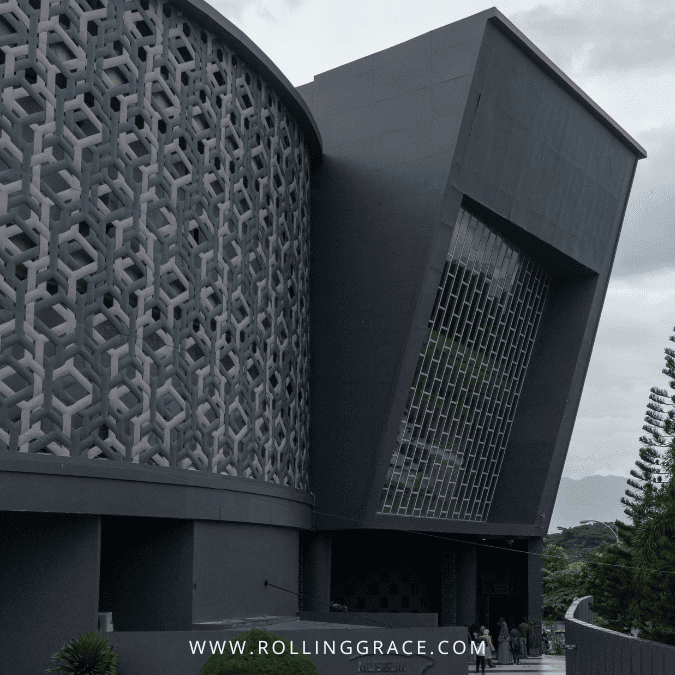
His design theme for the museum was “Rumoh Aceh as Escape Hill”. The building draws on the rumoh Aceh, the traditional Acehnese house on stilts built to cope with flooding, and its ground floor is left open so floodwater can pass straight through without damaging the building above. From outside, the four-storey, 2,500 m² building takes the shape of a tsunami wave.
The building is also designed as an escape hill, a refuge for people to run to if another tsunami strikes. Inside, the layout moves from narrow, dark corridors that recall the disaster to bright, open spaces that stand for hope and recovery.
Images of the Saman, the Acehnese “dance of a thousand hands”, appear on the walls.

7 Essential Spaces to See Inside the Aceh Tsunami Museum
Lorong Tsunami (Tsunami Alley)
Your visit begins in Lorong Tsunami, or Tsunami Alley, a narrow, dimly lit passage with water flowing down the walls and the sound of rushing water around you. The call to prayer sounds through the corridor too.
Read also: 10 Must Try Dishes in Bali Indonesia You Should Actually Eat
Tsunami Exhibition Rooms
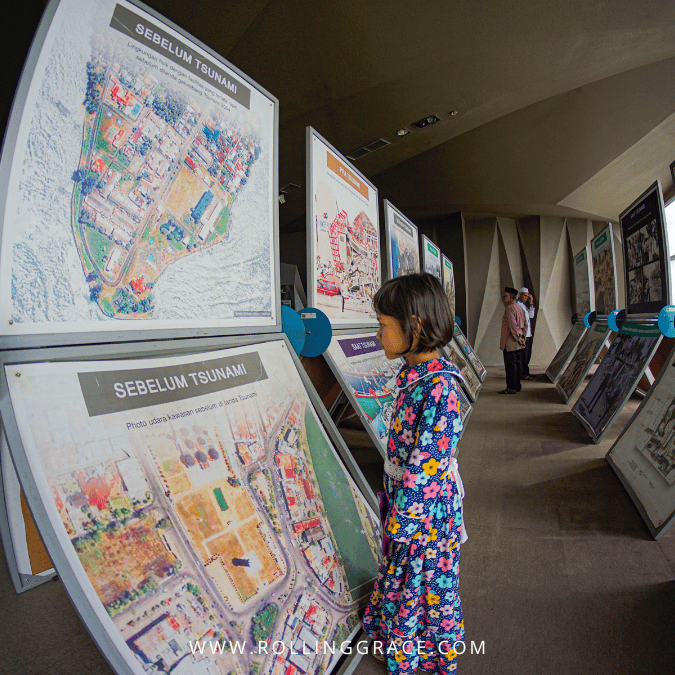
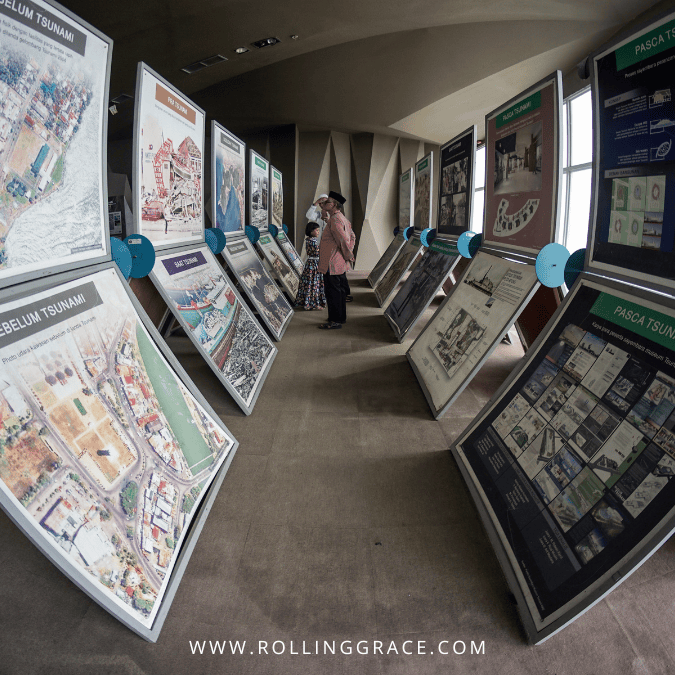
The exhibition floor tells the story of the disaster through dioramas, an electronic simulation of the earthquake, photographs, survivor stories and donated items.
A permanent display includes Australian filmmaker Jolyon Hoff’s documentary, Aceh: Ten Years After the Tsunami. Temporary exhibitions run on the same floor.
Sumur Doa Prayer Well
Sumur Doa, the Prayer Well, is a circular chamber with victims’ names inscribed on its walls and natural light falling from an opening above. Quran recitation plays in the dim space. Standing under that light, surrounded by names, is the moment from our visit that stayed with us longest.
Ruang Kenangan Memory Room
Ruang Kenangan holds digital photographs of the victims and the destruction.
Jembatan Harapan Bridge of Hope
Jembatan Harapan is a winding bridge that represents the struggle to survive. Above it hang the flags of the countries that helped Aceh after the tsunami, and after the dark corridors below, we found ourselves stopping to look up at them.
5 Breathtaking Things to Do at Tanah Lot Bali, Indonesia
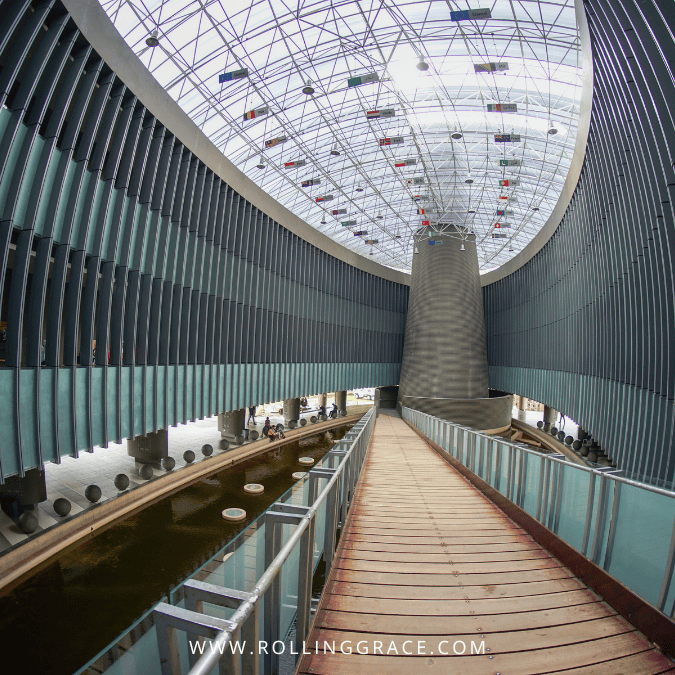
4D Audiovisual Room
The museum’s 4D cinema seats 24 people and screens a film of around 12 minutes about the tsunami. Seats are limited, so ask about screening times when you arrive.
Geology Room and Library
The third floor holds a geology room and a library. The top floor is not open to the public.
How Much Is the Aceh Tsunami Museum Entrance Fee?
Under Aceh’s Qanun Number 4 of 2024 on regional taxes and levies, the Aceh Tsunami Museum entrance fee is Rp3,000 for children, Rp5,000 for adults and Rp20,000 for foreign tourists.
The new prices were announced by the Aceh Culture and Tourism Office in October 2024.

Opening Hours of Aceh Tsunami Museum
The Aceh Tsunami Museum opens every day except Friday, from 09:00 to 12:00 and again from 14:00 to 16:00, according to Indonesia’s Ministry of Finance Aceh office.
Hours change during Ramadan: in 2026, visits ran in two sessions, 09:00 to 12:00 and 13:30 to 14:45, with the museum closed on Fridays.
Indonesia’s official tourism website recommends a morning visit to avoid the crowds.
How to Get to the Aceh Tsunami Museum in Banda Aceh
The Aceh Tsunami Museum stands on Jalan Sultan Iskandar Muda, Sukaramai, Baiturrahman, Banda Aceh 23116. It is about an 11-minute walk from Masjid Raya Baiturrahman, the city’s grand mosque, so the two make an easy pairing on the same morning.
At the museum, you will find parking, toilets, a prayer room and a souvenir shop.
Other Tsunami Memorials in Banda Aceh
The Aceh Tsunami Museum is one of several tsunami memorials in Banda Aceh. The most striking is PLTD Apung 1, a 2,600-tonne diesel power generator barge owned by the state electricity company PLN. The tsunami carried it 2 to 3 km inland, where it came to rest in Punge Blang Cut village.
After renovations in 2012 and 2013, the barge reopened as Museum PLTD Apung, with two towers, a monument, an elevated walkway, a jogging area and a fountain around it. It makes a good second stop after the Aceh Tsunami Museum.
Is the Aceh Tsunami Museum Worth Visiting?
Yes. The Aceh Tsunami Museum is the most important place in Banda Aceh to understand what happened on 26 December 2004 and how the province rebuilt.
Entry costs no more than Rp20,000, the building alone is worth seeing, and the disaster education is useful for anyone travelling along tsunami-prone coasts.
Allow time for the memorial spaces, especially Sumur Doa, and keep your voice down inside.
Get the good stuff first. Join Rolling Grace for the restaurants worth crossing a city for, the stays worth the upgrade, and the places to go before everyone else. Free, straight to your inbox.
Leave a Reply